
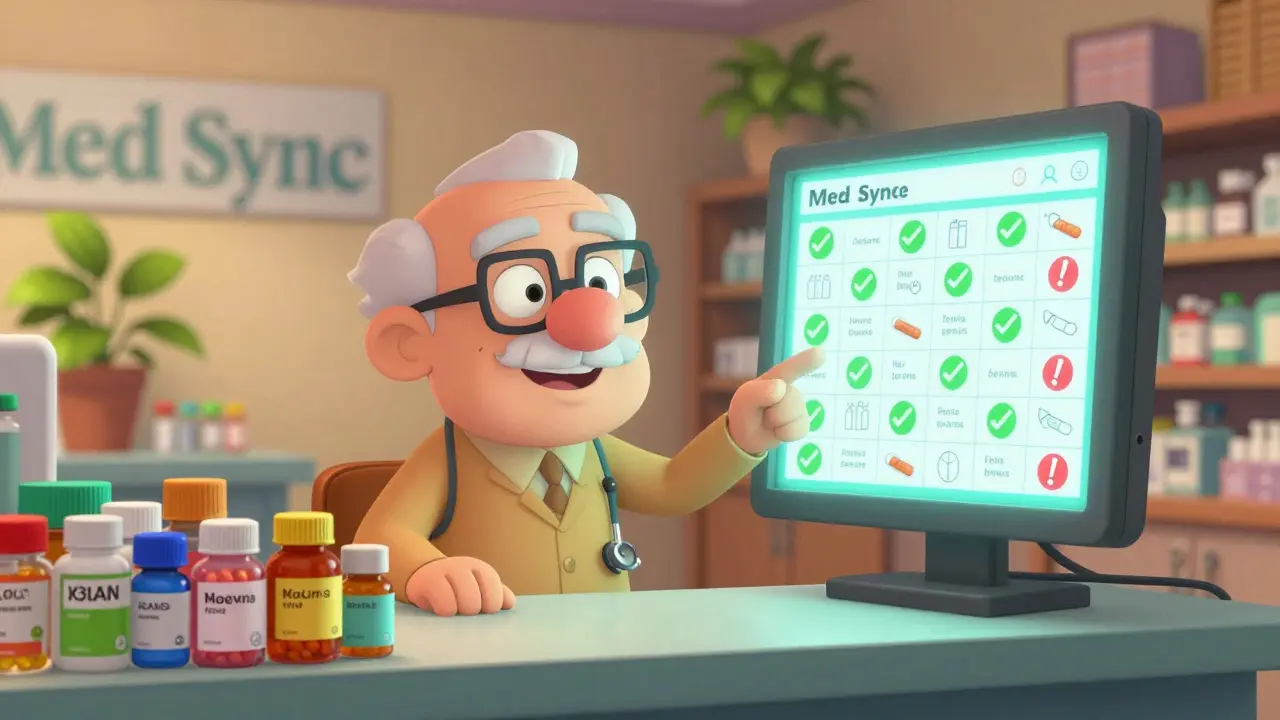
Medication Safety Risk Calculator
How Safe Are Your Medications?
Answer these questions to understand your risk of dangerous drug interactions based on your medication habits.
How Medication Synchronization Helps
Medication synchronization (med sync) aligns all your prescription refills to the same day each month. This simple process:
- Reduces missed doses by 85-90% (vs. 41% without)
- Prevents therapy duplication (from 7% to 0.3% risk)
- Creates one safety net with your pharmacist
Imagine taking five different medications every day - some for your blood pressure, others for diabetes, a painkiller, a cholesterol pill, and an antidepressant. Now imagine each of those prescriptions comes from a different pharmacy. One week you pick them up at CVS, the next at Walgreens, then a local store, maybe even a mail-order service. Sounds manageable? It’s not. This is how thousands of people live every day. And it’s far more dangerous than most realize.
How Using One Pharmacy Stops Dangerous Drug Interactions
When you use multiple pharmacies, each one only sees part of your medication picture. A pharmacist at one store might not know you’re also taking warfarin from another pharmacy. That’s a problem. Warfarin and common painkillers like ibuprofen can cause serious internal bleeding when mixed - and studies show this combination increases bleeding risk by five times. Pharmacists at single pharmacies have full access to your entire list: prescriptions, over-the-counter drugs, vitamins, and even herbal supplements. Their systems scan for over 10,000 possible drug interactions in real time. When you spread your prescriptions across multiple locations, those systems are blind to half your meds. That’s why patients using more than one pharmacy have a 34% higher chance of a dangerous drug interaction, according to a 2014 study published in the Journal of Managed Care & Specialty Pharmacy.Therapy Duplication: The Silent Killer
One of the most common - and preventable - mistakes is taking two drugs with the same active ingredient. For example, you might get a blood pressure pill from one pharmacy and a combination pill from another that contains the exact same medicine. You think you’re getting better control. Instead, you’re doubling your dose. This is called therapy duplication. In patients using multiple pharmacies, it happens in about 7% of cases. But in those who use just one pharmacy? It drops to 0.3%. That’s nearly a 96% reduction. Pharmacists at a single location catch these errors before you even leave the counter. They don’t just fill prescriptions - they protect you.How Medication Synchronization (Med Sync) Makes Life Easier
Most people hate juggling refill dates. One prescription runs out on the 5th, another on the 12th, and you’re rushing to the pharmacy every week. Medication synchronization - or “med sync” - fixes that. It’s a simple program where your pharmacy coordinates all your refills to come due on the same day each month. You walk in once, pick up everything, and you’re set until next month. This isn’t just convenient - it’s life-saving. Studies show patients on med sync have 85-90% adherence rates. That means they actually take their meds as prescribed. Without it, 41% of patients miss at least one dose every month, according to Avalon Pharmacy’s 2022 survey. Missed doses lead to hospitalizations. Hospitalizations cost an average of $8,750 per event. Med sync prevents that.
The Real Cost of Shopping Around for Lower Prices
It’s tempting to switch pharmacies to save money. Maybe your blood pressure med is $10 cheaper at Walmart, and your antidepressant is $15 less at Target. You think you’re saving $150-$300 a year. But here’s the hidden cost: using multiple pharmacies increases your risk of a serious adverse drug event by 27%. The Agency for Healthcare Research and Quality estimates that preventable medication errors cost the U.S. healthcare system $29 billion annually. And every time you switch pharmacies, you’re putting your safety at risk. Pharmacists can’t protect you if they don’t know what you’re taking. The savings you get on one pill aren’t worth the risk of an ER visit, a fall, a stroke, or worse.What Happens When You Consolidate Your Prescriptions
Switching to one pharmacy doesn’t happen overnight. It takes 2-4 weeks. Here’s how it works:- Choose your pharmacy - ideally one you trust and visit regularly.
- Bring a complete list of everything you take: prescriptions, OTC meds, supplements, even CBD or herbal teas.
- Ask for a comprehensive medication review. Most pharmacies offer this for free.
- Request to enroll in their medication synchronization program.
- They’ll transfer your prescriptions from other pharmacies - this takes 2-5 business days per script.
- They’ll give you short-term refills to align your dates.
- Within a month, you’ll have one pickup day, one pharmacist who knows you, and one safety net.
Why Pharmacists Are Your Best Safety Partner
Pharmacists aren’t just people who hand out pills. They’re medication experts trained to spot risks others miss. Dr. Amit Kakar, Pharm.D., says, “All prescriptions are monitored preventing duplicate medication.” That’s the core benefit. When you see the same pharmacist every month, they remember your history. They notice if you’ve gained weight, started a new supplement, or skipped a dose. They can adjust timing, suggest combination pills, or warn you about side effects before they happen. Patients who use one pharmacy report 78% better understanding of their meds. That’s not luck - it’s continuity.
What About Electronic Health Records? Won’t They Solve This?
Epic and Cerner now share medication data between providers - that’s progress. But here’s the catch: pharmacies don’t always have access to that data. And even when they do, the systems aren’t perfect. Many patients still use multiple pharmacies because they don’t know their records are connected. Or they switch pharmacies for price reasons and don’t realize the risk. The technology helps - but it doesn’t replace the human connection. Only a pharmacist who sees your full history, talks to you face-to-face, and remembers your name can truly keep you safe.Who Benefits Most From One Pharmacy?
If you take five or more medications daily - which 15% of U.S. adults do - you’re at the highest risk. Diabetics, heart patients, older adults, and those with mental health conditions are especially vulnerable. But even if you’re on just two or three meds, the risk adds up. One study found that patients on three or more medications who used multiple pharmacies were 68% more likely to experience an adverse event than those who didn’t. You don’t need to be “high risk” to benefit. You just need to be smart.The Future Is Connected - But You Still Have to Act
The U.S. healthcare system is slowly changing. In 2024, Medicare Part D introduced incentives for pharmacies that hit 90%+ medication synchronization rates. AI tools are coming - USC’s Polypharmacy Research Group is testing a decision-support tool expected to launch in mid-2025. But none of that matters if you’re still hopping between pharmacies to save a few bucks. The tools are there. The data is there. The expertise is there. All you have to do is walk into one pharmacy, hand over your list, and say: “I want to be safe.”Can I still use different pharmacies if I only take one or two medications?
You can, but it’s still risky. Even with just two prescriptions, you could accidentally combine drugs that interact - like a common painkiller with blood pressure medicine. Pharmacists at one location catch these issues before they happen. If you switch pharmacies, you lose that protection. For safety, one pharmacy is always better.
How long does it take to switch all my prescriptions to one pharmacy?
It usually takes 2-4 weeks. Transferring each prescription takes 2-5 business days. Your pharmacy will give you short-term refills to cover the gap. Once everything’s transferred, they’ll align your refill dates so you get all your meds on the same day each month.
Will my insurance still cover my meds if I switch pharmacies?
Yes. Most insurance plans work with hundreds of pharmacies. Your new pharmacy will check your coverage and find the lowest price for each drug. You won’t lose benefits - you’ll gain safety. Many pharmacies even offer price matching if you show them a lower quote from another store.
Do I need to tell my doctor I’m switching pharmacies?
Not necessarily. Your new pharmacy will handle the transfer. But it’s a good idea to mention it during your next doctor visit. That way, your medical record stays accurate, and your doctor knows who’s monitoring your meds.
What if I don’t trust my local pharmacy?
Find one you do trust. Look for a pharmacy with a pharmacist who takes time to talk to you. Ask friends or family for recommendations. Chain pharmacies like CVS, Walgreens, and Rite Aid all offer med sync programs. Independent pharmacies often provide more personalized care. Your safety is worth the effort.




One comment
This whole post is corporate propaganda disguised as public health advice. Pharmacies don't care about your safety-they care about your prescription volume and kickbacks from Big Pharma. The 'med sync' program? It's just a way to lock you in so they can upsell you vitamins and supplements you don't need. And don't get me started on how they 'monitor' your meds-those systems are run by algorithms trained on biased data that ignore cultural and genetic differences in drug metabolism. You think one pharmacy is safer? Try telling that to the guy in rural India who gets his insulin from five different vendors because his local pharmacy charges triple.
This is such a needed conversation! 💙 I switched to one pharmacy last year after my grandma had a bad interaction between her blood thinner and a new OTC sleep aid. Her pharmacist caught it before she even left the counter. Now we all use the same one-my mom, my dad, even my sister’s anxiety med. It’s crazy how much peace of mind it gives you. Plus, they remember your dog’s name and ask how your kid’s soccer season went. That human connection? Priceless.
Love this breakdown. I’m a caregiver for my dad with 7 meds, and I didn’t realize how much risk we were taking until we consolidated. The pharmacy we picked even sent us a printed med list with color-coded icons for timing-morning, night, with food, etc. They also flagged a duplicate dose in his blood pressure meds that his cardiologist had missed. I’ve since convinced three other families to do the same. It’s not just convenience-it’s a safety net you didn’t know you were missing.
Yeah right, like the pharmacy ain’t just another middleman trying to upsell you on probiotics and CBD gummies while your insulin costs $500 a vial. And don’t even get me started on how they 'transfer' scripts-half the time they lose them or mix up the dosages. I’ve had my thyroid med come back as a blood pressure pill twice. One pharmacy? More like one more chance for the system to screw you over. I’ll stick to my five spots, thanks.
One pharmacy = fewer errors. Period. The data’s clear. Even if you’re only on two meds, the risk isn’t zero. Just do it.
Thank you for sharing this! 🙌 I’m a nurse and I see so many seniors confused by refill schedules and drug interactions. One of my patients was taking two different versions of the same diuretic because she didn’t realize they were the same thing. Her pharmacist at her one pharmacy caught it and called her daughter. That’s the kind of care you can’t get from an app or a mail-order service. It’s not just about convenience-it’s about being seen. 🌸
Let’s be real-this isn’t even a debate. If you’re on more than three medications and you’re still hopping between pharmacies like a drug dealer on a caffeine high, you’re not being smart, you’re being reckless. The 34% higher interaction rate? That’s not a statistic-that’s a death sentence waiting to happen. And don’t give me that 'I save money' nonsense. A single ER visit for a drug interaction costs more than a year’s worth of pharmacy co-pays. You’re not saving money-you’re gambling with your life. The fact that this even needs explaining is depressing. Go to one pharmacy. Get the med sync. Talk to your pharmacist like a human being. It’s not hard. It’s not optional. It’s basic survival.
I’ve been using one pharmacy for 8 years now. My pharmacist knows my meds better than my primary care doc sometimes. She noticed I was getting dizzy after I started taking turmeric supplements-turned out it was interacting with my blood pressure med. She called my doctor, we adjusted everything, and now I’m stable. That’s not luck. That’s accountability. If you’re still switching pharmacies for a $5 discount, you’re not saving money-you’re paying for ignorance in pain, hospital bills, and stress. Just pick one. You’ll thank yourself later.