
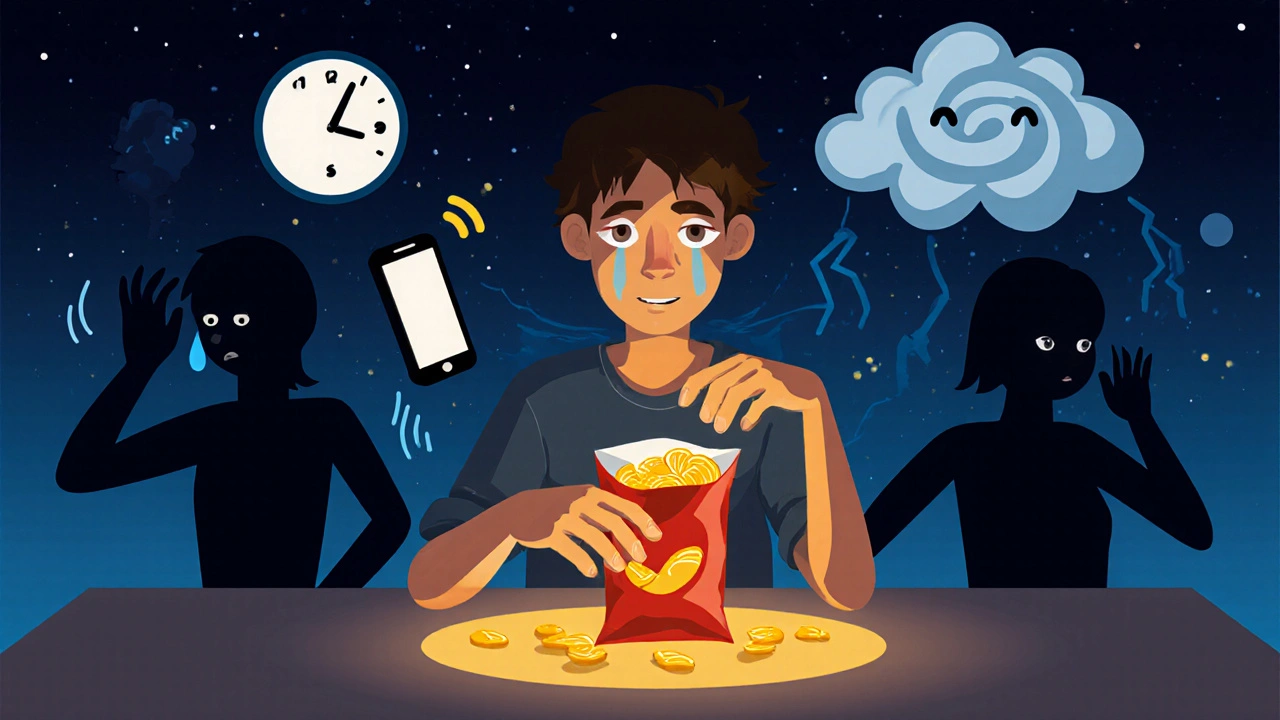
Most people who struggle with emotional or binge eating aren’t lacking willpower. They’re lacking awareness. You sit down to eat, and before you know it, half the bag of chips is gone. Or you’re scrolling through your phone at 10 p.m., mindlessly grabbing cookies because you’re stressed, bored, or just used to it. It’s not hunger. It’s habit. It’s emotion. And no diet has fixed it for you-because diets don’t address what’s really going on.
What Mindful Eating Actually Means
Mindful eating isn’t about eating kale instead of cake. It’s not a diet. It’s not counting calories or cutting out carbs. It’s about paying attention-really paying attention-to what’s happening when you eat. The taste, the texture, the smell. The thoughts running through your head. The emotions you’re trying to numb. This approach comes from mindfulness, a practice rooted in ancient traditions but made practical for modern eating habits by psychologist Jean Kristeller in the early 2000s. Her program, Mindfulness-Based Eating Awareness Training (MB-EAT), was the first to show that simply slowing down and tuning into your body could reduce binge episodes by 40% in just 12 weeks. And those changes stuck-52 weeks later, people were still eating differently. Unlike restrictive diets that fail for 95% of people within a year, mindful eating works because it doesn’t fight your instincts. It helps you understand them.Why Emotional Eating Keeps Happening
Your brain doesn’t distinguish between stress from a work deadline and hunger from skipping lunch. When you’re overwhelmed, anxious, or lonely, your body releases cortisol. That triggers cravings for high-sugar, high-fat foods-quick dopamine hits that temporarily make you feel better. Research shows 78% of what we eat isn’t driven by physical hunger. It’s triggered by emotions, environments, or routines. You eat because you’re tired. Because your partner was late. Because you watched a sad movie. Because your office always has donuts on Friday. The problem isn’t the food. It’s the autopilot. You’re not eating because you’re hungry. You’re eating because you’re trying to feel something else.How Mindful Eating Breaks the Cycle
Mindful eating interrupts that autopilot. It doesn’t ban cookies. It doesn’t shame you for eating them. It asks: Why are you eating this right now? Here’s how it works in practice:- You pause before eating. Not for five minutes. Just 10 seconds.
- You ask: Am I physically hungry? On a scale of 1 to 10, where 1 is starving and 10 is painfully full, where am I right now?
- You notice your emotions. Are you anxious? Bored? Sad?
- You take three slow breaths.
- Then you eat.
The Five Senses Trick
To eat mindfully, you need to engage your senses. Not just taste. All five.- Sight: Look at your food. Notice the colors, the way the light hits it. Is it arranged neatly? Is it messy?
- Smell: Take a deep breath. Can you pick out three different aromas? The butter? The herbs? The caramelization?
- Sound: Listen. Does the apple crunch? Does the toast crackle? Does the chocolate snap?
- Touch: Feel the texture. Is it smooth? Crumbly? Chewy? Cold? Warm?
- Taste: Let it sit on your tongue. Don’t swallow right away. Notice how the flavor changes. Does it get sweeter? Saltier? Bitter?

What Mindful Eating Isn’t
It’s not about eating perfectly. You won’t always get it right. Some days, you’ll eat quickly because you’re in a rush. That’s okay. The goal isn’t perfection. It’s awareness. It’s not a replacement for therapy if you have severe binge eating disorder. For people with clinical BED, medication or cognitive behavioral therapy (CBT) may be needed. But mindful eating works better than CBT when it comes to sticking with it long-term. One 2022 study showed 83% of people kept practicing mindful eating after a year, compared to just 67% for CBT. It’s also not intuitive eating. Intuitive eating is about trusting your body’s food choices over time. Mindful eating is about paying attention to each bite, right now.Real Results from Real People
On Reddit’s r/MindfulEating community-with over 14,500 members-people share stories like:- “I used to binge every day. After three months of mindful eating, it’s down to once a week. I still eat junk food. But now I choose it. I don’t lose control.” - u/MindfulEater89
- “I didn’t realize I was eating because I was lonely. Now I notice it. I call a friend instead.” - u/HealthyHabits22
How to Start Today (No App Needed)
You don’t need a subscription. You don’t need to join a class. You don’t need to buy special tools. Just try this:- At your next meal, put your fork down between bites.
- Take a sip of water.
- Ask yourself: Am I still hungry? Or am I eating because I’m stressed?
- Notice how the food tastes now, compared to the first bite.

What to Do When It’s Hard
Some days, it feels impossible. You’re tired. You’re rushed. Your kid is screaming. You’re at your desk, eating a granola bar while answering emails. That’s normal. Here’s what to do:- Don’t beat yourself up. Just notice it. Say to yourself: “I’m eating on autopilot.” That’s the first step.
- Next time, even if it’s just one bite, pause. Breathe. Taste.
- If you’re eating because you’re stressed, try a 60-second walk outside. Or drink a glass of water. Or write down one word that describes how you feel.
Why This Works Better Than Diets
Diets promise quick results. They say: “Cut sugar. Eat less. Follow this plan.” But they ignore the emotional root. That’s why 95% of people regain the weight. Mindful eating says: “Understand why you’re eating. Then choose.” It doesn’t force you to change your food. It changes your relationship with food. A 2023 study from the Journal of Eating Disorders found mindful eating was 37.2% more effective at reducing acute binge episodes than intuitive eating. Why? Because it targets the moment of impulse-right before you reach for the food. And it’s sustainable. A 12-month follow-up showed 78% of people kept practicing mindful eating. Not because they had to. Because they wanted to. They felt better. They enjoyed food more.When to Seek Help
Mindful eating is powerful. But it’s not a cure-all. If you’re bingeing five or more times a week, feeling out of control, or experiencing shame or guilt after eating, you may need more support. Clinical binge eating disorder (BED) affects 2.8% of adults in the U.S. and is often linked to depression, anxiety, or trauma. In those cases, combining mindful eating with therapy or medication can boost success rates to 86.3%. The American Psychiatric Association says mindful eating should be part of a broader plan-not the only tool. If you’re unsure, talk to your doctor. Or look for a certified MB-EAT facilitator. There are over 1,200 in the U.S. alone.Final Thought: You’re Not Broken
You’re not lazy. You’re not weak. You’re not failing. You’re human. Eating to soothe emotion isn’t a flaw. It’s a coping mechanism. And like all coping mechanisms, it can be replaced-with something kinder, quieter, and more sustainable. Mindful eating doesn’t ask you to change your habits overnight. It asks you to notice them. To feel them. To choose differently-not because you should, but because you want to. And that’s how lasting change begins.Can mindful eating help me lose weight?
Yes-but not because it’s a weight-loss diet. Mindful eating helps you eat less by helping you feel satisfied sooner. People who practice it regularly often lose weight naturally because they stop eating out of habit or emotion. Studies show an average reduction of 5.2 binge episodes per week to just 1.8 after 12 weeks. Weight loss is a side effect, not the goal.
Do I need to meditate to practice mindful eating?
No. While formal meditation can help build awareness, mindful eating works on its own. You don’t need to sit cross-legged or chant. Just slow down during meals. Pay attention to your food. That’s enough to start seeing results.
How long until I see results?
Most people notice a difference in their eating patterns within two to three weeks. A 2023 USU Extension study found that participants reduced binge episodes from 14 times a month to under 4 after just 8 weeks. The key is consistency-not perfection.
Can I still eat my favorite foods?
Absolutely. In fact, mindful eating encourages it. When you stop labeling foods as “good” or “bad,” you take away their power. You can have cake-just eat it slowly, savor it, and notice how you feel afterward. Often, you’ll find you don’t need as much.
Is mindful eating right for me if I’m always busy?
Yes-even more so. Busy people are the ones most likely to eat on autopilot. Start small: pick one meal a day to eat without distractions. Even five minutes of focused eating counts. Over time, you’ll find you enjoy meals more, even when you’re rushed.
What if I forget to be mindful during a meal?
That’s normal. Everyone forgets. The trick isn’t to catch yourself every time-it’s to notice when you forget. Just say to yourself: “I wasn’t paying attention.” That awareness is the practice. The next bite is your chance to begin again.
Can children or teens practice mindful eating?
Yes. Simple versions work well for kids. Ask them to describe the color of their food. Have them count how many times they chew each bite. Encourage them to notice how they feel after eating. These small habits build awareness early and can prevent emotional eating patterns later.




One comment
I used to eat like a robot-fork in, mouth open, repeat. Then I started pausing. Just 10 seconds. And wow. I actually tasted my food for the first time in years. The salt on my fries? The crunch of the lettuce? I didn’t know I was missing it. Now I eat slower, I’m full sooner, and I don’t feel guilty afterward. It’s not magic. It’s just… awareness.
Okay but like… isn’t this just ‘eat slower’ with a fancy name? I’ve been doing this since I was 12. I chew 20 times per bite. I still eat pizza at 2 a.m. and I’m fine. Stop selling mindfulness like it’s a cult.
While the phenomenological framework of MB-EAT is undeniably compelling-particularly its epistemological grounding in embodied cognition-it’s reductive to frame this as a ‘solution’ to complex neurobehavioral dysregulation. The ontological assumption that ‘awareness’ alone can dissolve conditioned affective responses ignores the neurochemical architecture of reward pathways. One cannot simply ‘breathe’ one’s way out of dopamine-driven compulsivity without addressing the limbic-hypothalamic-pituitary axis. I’ve seen this in my clinical practice: awareness without integration is performative mindfulness.
This is the most condescending garbage I’ve read all week. You act like everyone who eats emotionally is just ‘not paying attention.’ What about trauma? What about depression? What about living in a food desert where the only ‘mindful’ option is a 50-cent bag of chips? Stop pretending this is a universal fix for people who don’t have the luxury of time, energy, or mental space to ‘pause.’
I appreciate the research cited, but I think there’s a gap here. Mindful eating is valuable, yes-but it’s not a standalone intervention for clinical BED. The study you referenced from the Journal of Eating Disorders doesn’t account for comorbid conditions. I’ve worked with patients who practiced mindful eating daily and still needed SSRIs and CBT. The synergy matters. You can’t just say ‘try breathing’ and call it a day. This isn’t a self-help blog-it’s a medical issue for many.
Hey, I get what you’re saying-but I’ve been eating mindfully for 18 months now. I used to binge on ice cream every night after work. Now? I eat one scoop. Slowly. With a spoon. I even say ‘thank you’ to the ice cream before I eat it. Yeah, I know it sounds weird. But it works. I don’t feel like a monster anymore. And I’m not even trying to lose weight. I just… feel better. Like I’m not at war with myself.
I tried this for a week. I put my phone down. I chewed. I noticed the butter melting on my toast. I didn’t feel like I was missing out. I just… ate. And then I stopped when I was full. No guilt. No drama. It was quiet. And kind of beautiful.
From India, I’ve seen this work with my aunt. She used to eat while watching TV, crying after every episode. Then she started eating alone, with just a cup of chai. She said she finally tasted her food again. Not because she wanted to lose weight. Because she wanted to feel something real. Mindful eating isn’t Western. It’s ancient. We’ve always known this. We just forgot.
I love that you mentioned the five senses. I started doing this with my daughter. We play ‘food detective’ at dinner. What color is the broccoli? Does it smell like grass? Does it crunch like snow? She’s 7. She doesn’t know what ‘mindfulness’ is. But she’s learning to be present. And honestly? That’s the real win.
My partner and I do this now at dinner. No phones. Just us and the food. It’s weirdly romantic. We don’t talk much. We just chew. And sometimes… we smile. I didn’t realize how much I’d been missing until I stopped rushing through meals. This isn’t a diet. It’s a love language.
You Americans always turn everything into a spiritual awakening. In my country we just eat what we want and don’t overthink it. If you’re stressed, eat. If you’re bored, eat. If you’re rich enough to care about ‘five senses,’ good for you. But don’t pretend this is some universal truth. Most people just need to eat less sugar, not meditate with their fork
So… you’re saying the solution to binge eating is… to eat slower? And we all just didn’t think of this because we were too busy scrolling? Cool. Cool cool cool. I’ll add ‘pause’ to my to-do list right after ‘meditate’ and ‘find my purpose.’
Wait-I just tried this at lunch. Put my fork down. Took a breath. Realized I was eating because I was mad at my boss. So I drank water. Then I ate the rest slowly. And you know what? The sandwich tasted better. I didn’t even finish it. I’m not even mad anymore. I think… I think this actually works. Thanks.