
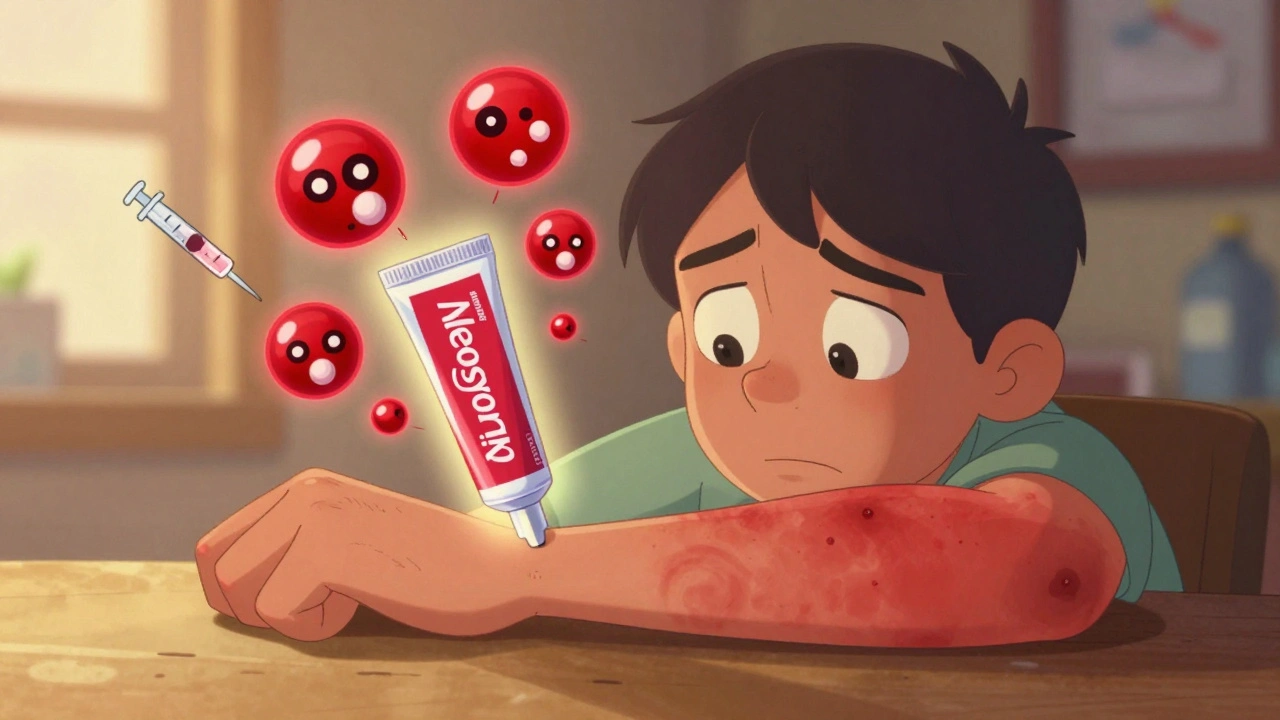
Why Your Skin Is Reacting to the Cream You’re Using
You put on a cream for your eczema, and instead of getting better, your skin gets redder, itchier, and starts flaking. You switch to another ointment. Same thing. You think it’s getting worse-until you realize the treatment itself might be the problem. This isn’t rare. In fact, topical medication allergy is one of the most overlooked causes of persistent skin rashes.
What’s happening is called allergic contact dermatitis. It’s not a simple irritation. It’s your immune system reacting to something in the medicine you’re applying. And it’s more common than most doctors admit. About 1 in 6 people who get patch tested for stubborn rashes turn out to be allergic to a topical drug-antibiotics, steroids, or even numbing agents.
What’s Actually Causing the Reaction?
Not all skin reactions are allergies. Some are just irritations from harsh ingredients. But true allergic contact dermatitis is a delayed immune response. It doesn’t show up right away. You use the cream, and 24 to 72 hours later, your skin flares up-red, swollen, blistered, or cracked. It often looks like a bad sunburn, but it’s confined to where the product touched your skin.
The biggest culprits? Antibiotics like neomycin and bacitracin. They’re in so many over-the-counter ointments-Neosporin, Polysporin-that people assume they’re harmless. But neomycin alone triggers allergic reactions in nearly 10% of patch-tested patients. Corticosteroids, the go-to treatment for eczema and psoriasis, can also cause allergies. Yes, the very thing meant to calm your skin is sometimes making it worse. About 1 in 50 people who use topical steroids develop an allergy to them.
Other common offenders include local anesthetics like benzocaine (found in some numbing sprays and gels) and NSAIDs like ketoprofen (in some pain-relief gels). Even preservatives and fragrances in the base of these creams can be triggers. And here’s the kicker: you might be allergic to more than one thing. Cross-reactivity is common. If you’re allergic to hydrocortisone (a low-potency steroid), you might also react to other steroids in the same chemical family. But knowing which group a steroid belongs to can help you avoid the wrong ones and still find a safe alternative.
How Doctors Diagnose It (And Why It’s Often Missed)
Most GPs and even some dermatologists don’t think to test for topical medication allergies. They see a rash, assume it’s eczema flaring up, and prescribe more steroid cream. That’s why 40 to 60% of these cases are misdiagnosed at first.
The only reliable way to confirm a topical allergy is patch testing. It’s not a skin prick test. You don’t get poked. Instead, tiny amounts of potential allergens-including common topical drugs-are taped to your back for 48 hours. You come back at 48 and 96 hours for readings. If your skin reacts, you know what’s causing it.
Studies show patch testing finds the culprit in about 70% of cases when done correctly. And the results change everything. One 2022 study found that 89% of patients with chronic rashes saw their skin clear up completely within four weeks once they stopped using the allergen. Without that step, only 32% improved-even with strong medications.
And it’s not just about prescription creams. Many people don’t realize that their moisturizer, sunscreen, or even hand sanitizer contains the same allergens. That’s why dermatologists now ask you to bring everything you put on your skin to your appointment. About 30% of allergens are found in products you wouldn’t call “medication.”
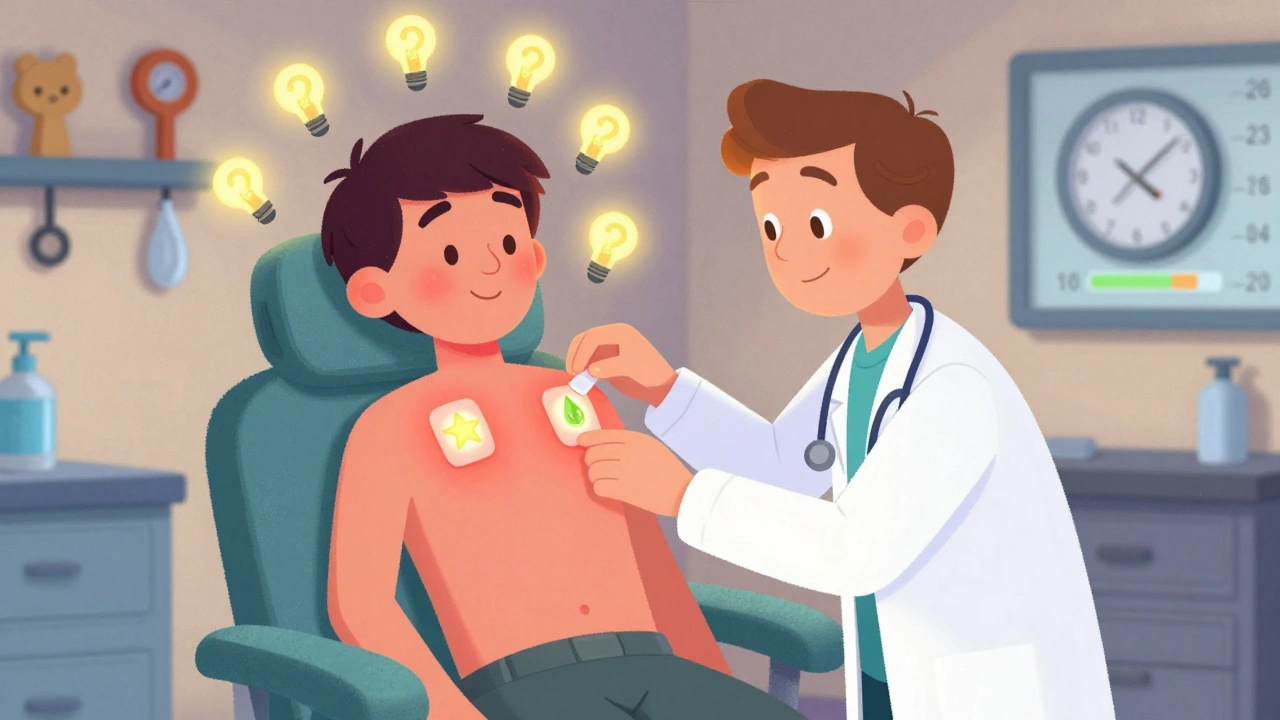
What to Do If You’re Diagnosed
Once you know what’s causing the reaction, the most important step is simple: stop using it. Completely. That includes avoiding any product with that ingredient-even if it’s in a different brand or form.
But stopping the allergen isn’t always enough. You still need to treat the inflammation. For mild cases, over-the-counter 1% hydrocortisone cream can help. But if it’s not working after a week, you likely need something stronger. Prescription mid- to high-potency steroids like triamcinolone or clobetasol work fast-most people feel relief within 24 to 48 hours.
But here’s the catch: if the rash is on your face, eyelids, or groin, you can’t use strong steroids. They can thin your skin. In those areas, doctors recommend low-potency options like desonide or non-steroid alternatives like pimecrolimus (Elidel) or tacrolimus (Protopic). These are calcineurin inhibitors. They don’t thin the skin, and studies show they work in 60 to 70% of cases. The downside? They can sting at first. About 40% of users report a burning sensation, but it usually fades after a few days.
If the rash covers more than 20% of your body, you might need oral steroids like prednisone. A typical course is 40 to 60 mg daily for two to three weeks, then slowly tapered. Most people see dramatic improvement within a day or two.
What You Can Do Right Now
You don’t have to wait for a doctor’s appointment to start protecting your skin.
- Stop using any new product that came on the market right before your rash started.
- Check labels for neomycin, bacitracin, benzocaine, or ketoprofen. Avoid anything with them.
- Switch to fragrance-free, preservative-free moisturizers. Look for brands labeled “hypoallergenic” and “steroid-free.”
- Take a photo of your rash and note when it started, where it is, and what you applied before it appeared. This helps your doctor spot patterns.
- Ask your pharmacist if your cream contains any common allergens. They have access to ingredient databases.
What’s New in Treatment and Prevention
Things are changing fast. In 2023, a new diagnostic tool called the “Topical Medication Allergy Score” was introduced in Europe. It uses 12 specific criteria to spot patterns doctors used to miss. It’s already raising diagnosis accuracy from 65% to 89%.
Researchers are also testing diluted patch tests for people with broken skin-like those with severe eczema. In the past, these patients often got false negatives because their skin couldn’t absorb the allergens properly. Now, using 10 times weaker concentrations, doctors are catching allergies in 90% of cases instead of just 68%.
On the prevention side, new barrier creams are in development. These don’t treat the rash-they stop allergens from penetrating the skin in the first place. Early trials show they reduce allergen absorption by 73%. Three are in late-stage testing.
The NIH has also invested $4.7 million to study whether we can predict who’s at risk for these allergies before they even happen. Imagine a simple blood test that tells you, “Don’t use neomycin.” That’s not science fiction anymore.

Real Stories, Real Impact
One Reddit user wrote: “I used hydrocortisone for years. My eczema got worse every time. I thought I was just failing at treatment. Turns out, I was allergic to it. Once I stopped, my skin healed in six weeks.”
Another patient, a nurse, developed hand dermatitis from disinfectant wipes containing benzocaine. She was told it was “dry skin from washing hands too much.” It took three years and five doctors before she got patch tested and found the real cause.
These aren’t outliers. The National Eczema Association found that people with topical medication allergies see an average of 3.2 doctors before getting the right diagnosis. They spend an average of 6 months suffering before finding relief.
When to See a Specialist
If you’ve been using a topical treatment for more than two weeks and your skin isn’t improving-or it’s getting worse-you should see a dermatologist who does patch testing. Not all dermatologists offer it. Ask if they’re members of the American Contact Dermatitis Society. They’re more likely to have the right tools and experience.
Also, if you’ve had a rash that keeps coming back in the same spot after using any cream, ointment, or gel-even if it’s been months between flare-ups-that’s a red flag. Delayed reactions are sneaky. Your body remembers the allergen.
Final Thought: Your Skin Is Talking
It’s easy to blame your skin for not healing. But sometimes, the problem isn’t your body-it’s the product you’re using. Topical medication allergies are real, common, and treatable. The key is recognizing the pattern, stopping the trigger, and getting tested. You don’t have to live with a rash that won’t go away. There’s a solution. You just need to know where to look.
Can you develop a topical medication allergy even if you’ve used the product for years?
Yes. Allergic contact dermatitis is a delayed immune response that often develops after repeated exposure. You can use a cream safely for months or even years, then suddenly react. Your immune system doesn’t recognize the ingredient as a threat until it’s been exposed enough times to build a memory. This is why people often don’t realize the medicine is the problem until the rash gets worse.
Is patch testing painful?
No. Patch testing is not painful. Small amounts of potential allergens are placed on adhesive patches and taped to your back. You won’t feel anything during the 48-hour period. You may feel mild itching or irritation if you’re allergic, but there are no needles or pricks involved. The only discomfort comes from having to avoid showering or sweating while the patches are on.
Can I use over-the-counter hydrocortisone if I’m allergic to steroids?
No. If you’re allergic to corticosteroids, even low-dose OTC hydrocortisone can trigger a reaction. Hydrocortisone is a steroid, and if your allergy is to that specific chemical group, using it-even in small amounts-can make your rash worse. Always check with your dermatologist before using any steroid cream, even if it’s labeled “mild.”
What’s the difference between irritant and allergic contact dermatitis?
Irritant contact dermatitis happens when a substance directly damages your skin-like soap, bleach, or excessive handwashing. It doesn’t involve your immune system. Allergic contact dermatitis is a true immune reaction to a specific allergen. It usually appears 24 to 72 hours after exposure, is more itchy, and often has clear borders where the product touched your skin. Patch testing can tell the difference.
Are there any natural alternatives to steroid creams for allergic contact dermatitis?
There’s no proven natural cure, but some non-steroid options work well. Topical calcineurin inhibitors like tacrolimus and pimecrolimus are FDA-approved for eczema and often used off-label for allergic dermatitis. They don’t thin the skin and are safe for long-term use on the face. Barrier repair creams with ceramides and fatty acids can also help restore your skin’s natural protection. Avoid “natural” remedies like tea tree oil or essential oils-they’re common allergens themselves.
How long does it take for contact dermatitis to clear up after stopping the allergen?
Once you stop using the allergen, itching usually improves within 48 to 72 hours. Redness and swelling fade over the next week. Complete healing typically takes 2 to 4 weeks. If your rash hasn’t improved after 4 weeks, you may still be exposed to the allergen-maybe in another product, or you have a secondary infection. See your doctor.
Can I get patch tested for multiple medications at once?
Yes. Standard patch test trays include 30 to 40 common allergens, including antibiotics, steroids, anesthetics, and preservatives. Your dermatologist will customize the panel based on your history-what you’ve used, where the rash is, and what you do for work. For example, if you’re a nurse, they’ll test for disinfectant allergens. If you use herbal creams, they’ll test plant-based allergens.
Do I need to stop using all topical products before patch testing?
You should stop using strong topical steroids for at least two weeks before testing, because they can suppress your skin’s reaction and cause false negatives. But you can keep using gentle, fragrance-free moisturizers. Avoid applying anything to your back where the patches will go. Your dermatologist will give you exact instructions.



One comment
Neomycin is in 78% of OTC creams. The FDA knows. They don't care. Big Pharma funds the dermatology associations. Patch testing? Only if you can afford $800 and take 3 days off work. They want you addicted to steroids. This isn't medicine. It's a business model.
You know what this really is? A metaphor. Your skin is screaming because you've been poisoning yourself with synthetic nonsense for decades. We've forgotten how to let the body heal. Steroids are just chemical Band-Aids on a soul-deep disconnection from nature. The real cure? Stop treating your skin like a battlefield. Start treating it like a temple.
I used Neosporin for 12 years and thought I was fine... until my face started peeling like a snake 🥲 I cried for 3 days. Then I found out I was allergic to EVERYTHING. Now I only use plain petroleum jelly. And I hate everyone who says 'just use coconut oil' lol. Coconut oil is a trap. 😭
Patch testing is a scam. They test for 40 things but never the real ones. The real allergens are in your water your food your laundry detergent your phone screen your pillow. They don't test for electromagnetic fields or glyphosate. They don't want you to know the truth. I stopped using everything. Now I just rub dirt on my skin. Works better than anything.
I get it. I've been there. That burning feeling when you put on Protopic? Yeah. It sucks. But I promise you it gets better. I was on prednisone for months. My skin looked like a battlefield. Then I found a derm who actually listened. It took 14 weeks. But now? I haven't had a flare in 8 months. You're not broken. You just haven't found the right person yet. I believe in you.
Americans are so lazy they'd rather slap on a steroid cream than learn what's in their own damn products. Meanwhile in Germany, they banned neomycin in OTC stuff in 1998. We're still letting Big Pharma poison our kids because we can't read a label. Stop blaming your skin. Start blaming the system.
This is such an important conversation. So many of us suffer in silence thinking we're just 'bad with skincare.' But the truth is, our bodies are trying to tell us something. I'm so glad this article exists. It's not just about avoiding neomycin-it's about listening to our skin as a wise, intelligent part of ourselves. If you're reading this and still struggling? You're not alone. Reach out. Find a dermatologist who sees you, not just your rash.
Let me just say-this whole topic is a perfect microcosm of modern medical negligence. We live in an age where we have genomic sequencing, AI diagnostics, and nanotechnology-but we still rely on 1950s patch testing protocols that were designed for cotton farmers, not 21st-century consumers who use 17 different topical products daily. The fact that dermatologists still don't routinely test for preservatives like methylisothiazolinone or fragrance mix-despite it being in 80% of 'hypoallergenic' products-is not just incompetence; it's systemic betrayal. And don't even get me started on how insurance refuses to cover patch testing unless you've already suffered for 18 months and seen five doctors. This isn't healthcare. It's a profit-driven, bureaucratic maze designed to keep you dependent, confused, and quietly suffering while they bill you for more steroid creams.