
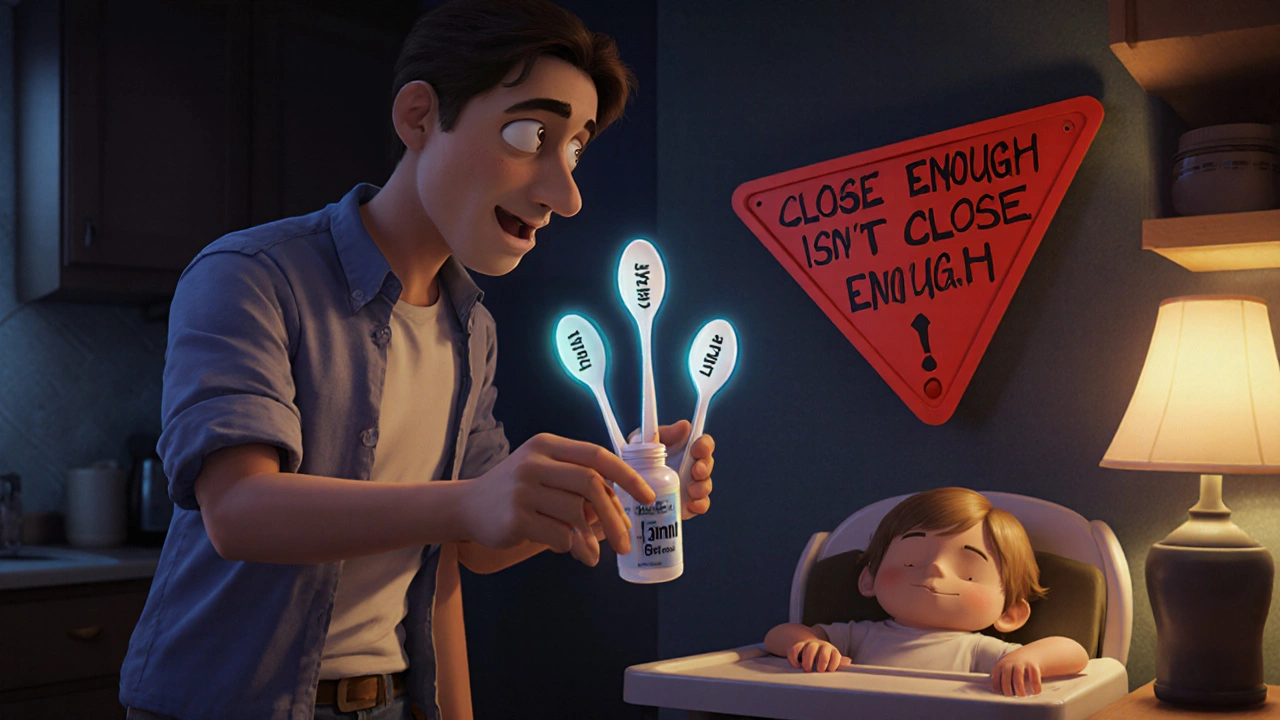
Every year, more than 10,000 parents in the U.S. call poison control centers because they gave their child the wrong dose of liquid medicine. Not because they forgot. Not because they were careless. But because they used a household spoon to measure it.
Why a Spoon Isn’t Just a Spoon
You’ve done it. You’re tired. The child is fussy. The medicine bottle says "5 mL"-but you don’t have the dosing cup. So you grab a teaspoon from the drawer. It looks right. It’s close enough, you think. It’s not. A real medical teaspoon holds exactly 5 milliliters. A household teaspoon? It holds anywhere from 3 to 7 milliliters. That’s a 40% difference. If your child’s dose is 5 mL, and you use a spoon that holds only 3 mL, you’re giving them 40% less medicine. The infection doesn’t clear. The fever comes back. You take them back to the doctor. Or worse-you use a tablespoon by mistake. A tablespoon is 15 mL. That’s three times the dose. For a small child, that’s not a mistake. It’s an emergency. The American Academy of Pediatrics warned about this in 1978. Yet today, 75% of American families still use kitchen spoons to give medicine. That’s three out of every four households. And it’s not just in the U.S. This happens everywhere.How Bad Are the Errors?
A 2014 study from the National Institutes of Health found that nearly 40% of parents gave the wrong dose when using household spoons. Over 41% made errors even when trying to follow the label exactly. That’s not because they’re bad parents. It’s because the system is broken. Labels that say "teaspoon" or "tsp" make people reach for the kitchen drawer. A 2016 study showed that when labels used "mL" instead, the number of parents who chose a kitchen spoon dropped from 33% to less than 10%. That’s a 23-point difference. Just changing the words on the bottle made a huge difference. And it’s not just about teaspoons. Dosing cups? They’re better-but only if they’re marked in milliliters and you’re measuring at eye level. Most cups only have marks at 5 mL, 10 mL, 15 mL. What if the dose is 3.5 mL? You can’t measure that accurately with a cup. You guess. And guesswork kills.The Right Tool: Oral Syringes
The most accurate tool for giving liquid medicine to a child? An oral syringe. Not a dropper. Not a cup. Not a spoon. Oral syringes measure down to 0.1 mL. They have clear, easy-to-read lines. They’re designed for one thing: giving exact doses. And they’re often free. When you pick up your child’s prescription, ask the pharmacist for an oral syringe. Most pharmacies, including ones like Aspirus, now give them out with every liquid pediatric medication. If they don’t, ask again. Don’t take no for an answer. Use the syringe every time. Even if the dose is 1 mL. Even if it’s 7.5 mL. Even if your child squirms. Hold the syringe steady. Gently squirt the medicine between the cheek and tongue-not straight to the back of the throat. That reduces choking and gagging.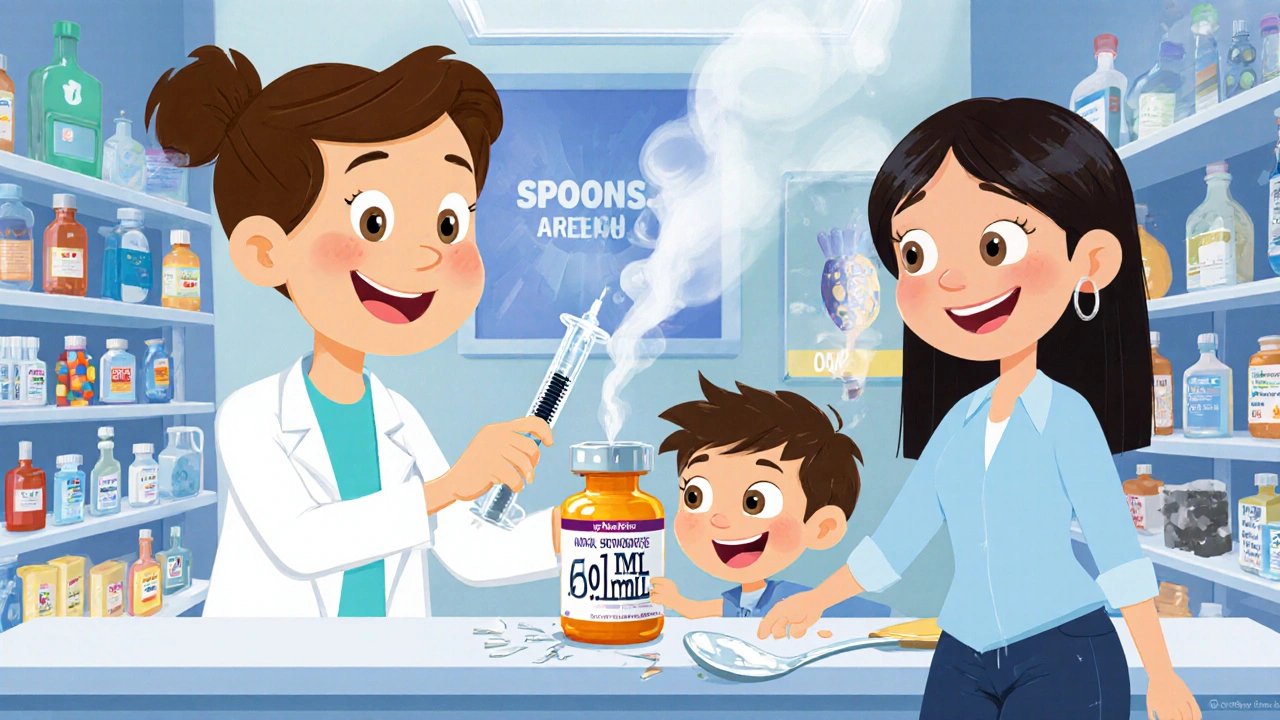
What About Droppers and Dosing Cups?
Droppers are okay-sometimes. But they’re harder to control. Liquid can drip. You can’t always tell how much is left. They’re better than spoons, but not as good as syringes. Dosing cups? They’re fine for doses that are multiples of 5 mL-like 10 mL or 15 mL. But if the dose is 2.5 mL or 8 mL? You’re guessing again. And guesswork isn’t safe. The CDC’s "Spoons are for Soup" campaign says it plainly: "Milliliters (mL) are for Medicine." That’s the rule. No exceptions.How to Get It Right Every Time
Here’s what to do the next time your child needs liquid medicine:- Read the label. If it says "tsp" or "teaspoon," ask the pharmacist to rewrite it in mL.
- Always use the measuring tool that came with the medicine. If it didn’t come with one, ask for an oral syringe.
- Never use a kitchen spoon, coffee spoon, or dessert spoon.
- Measure at eye level. Don’t hold the syringe up high. Bend down. Look straight at the markings.
- If the dose is less than 5 mL, use the syringe-never a cup.
- Keep the syringe clean. Rinse with water after each use. Don’t let it get sticky.
- Store the syringe with the medicine. Don’t toss it in the drawer.
What If You Already Made a Mistake?
If you gave your child medicine with a spoon and you’re not sure how much they got, don’t panic-but don’t wait either. Call your pediatrician or poison control. In the U.S., the number is 1-800-222-1222. In the UK, call 111. Tell them:- What medicine it was
- How much you think you gave
- What spoon you used (teaspoon? tablespoon?)
- How old your child is and how much they weigh
Why This Isn’t Just a "Tip"-It’s a Safety Rule
This isn’t about being perfect. It’s about being safe. Children aren’t small adults. Their bodies process medicine differently. A dose that’s safe for a 100-pound teen can be dangerous for a 20-pound toddler. Even a 1 mL error can cause vomiting, drowsiness, or worse. The FDA, CDC, and American Academy of Pediatrics all agree: milliliter-only dosing with calibrated tools is the standard. Not because they’re being picky. Because lives depend on it. Pharmacies are starting to change. More labels now say "5 mL" instead of "1 tsp." But not all. So you have to be the one to insist on accuracy.What’s Changing? What’s Next?
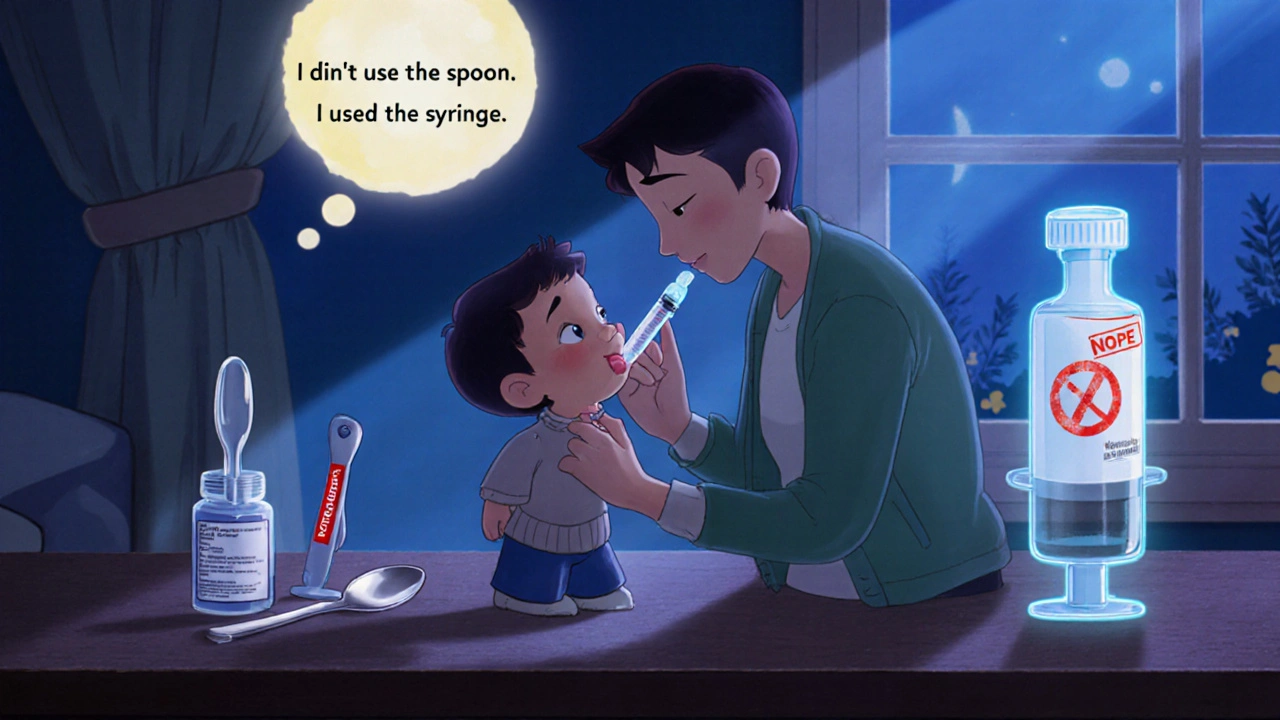
More hospitals and pharmacies are now required to provide oral syringes with pediatric prescriptions. Some states are pushing for laws that make milliliter-only labeling mandatory on all children’s medicines. But until then, the responsibility falls on you. You’re the one holding the syringe. You’re the one reading the label. You’re the one who says, "No, I’m not using the spoon. I’m using the syringe." It’s not inconvenient. It’s necessary.Final Thought: It’s Not About Perfection. It’s About Prevention.
You don’t need to be a doctor. You don’t need to memorize dosing charts. You just need to remember one thing: Spoons are for soup. Medicine needs a syringe. Keep one in your medicine cabinet. Keep one in your diaper bag. Keep one in your purse. Make it as routine as washing your hands before feeding your child. Because when it comes to your child’s medicine, "close enough" isn’t close enough.Can I use a kitchen teaspoon if I don’t have a syringe?
No. Household teaspoons vary in size from 3 mL to 7 mL, while a true medical teaspoon is exactly 5 mL. Using one can lead to underdosing or overdosing-both dangerous for children. Always ask your pharmacist for an oral syringe, even if you have to request it twice.
Why do medicine labels sometimes say "teaspoon" instead of "mL"?
Some older labels still use "tsp" or "teaspoon" because of outdated standards. But the FDA and AAP now recommend milliliter-only labeling. If you see "teaspoon," ask your pharmacist to confirm the dose in mL and provide a proper measuring tool. Don’t assume the label is correct.
Are dosing cups ever okay to use?
Only for doses that are exact multiples of 5 mL (like 5 mL, 10 mL, 15 mL), and only if the cup is clearly marked in milliliters and you measure at eye level. For doses like 2.5 mL or 7.5 mL, dosing cups are unreliable. Use an oral syringe instead.
How do I know if I gave too much medicine?
Signs of overdose include drowsiness, vomiting, confusion, fast or slow breathing, or unusual behavior. If you suspect an overdose, call poison control immediately (1-800-222-1222 in the U.S., 111 in the UK). Don’t wait for symptoms to appear.
Can I reuse an oral syringe?
Yes, if you clean it properly. Rinse it with clean water after each use. Let it air dry. Don’t store it with the plunger pushed in. Replace it if the markings become unclear or if the plunger gets sticky. Most syringes last several weeks with proper care.
Why don’t pharmacies always give out syringes?
Some pharmacies still don’t have them on hand or assume you’ll use a cup. But you have the right to ask. If they say no, ask to speak to the pharmacist. Most will provide one if you request it. If they still refuse, go to another pharmacy. Your child’s safety isn’t optional.




One comment
Who the hell cares about spoons? We did it for generations and kids turned out fine. Now we got apps for everything and panic over 0.5 mL. My kid took medicine with a spoon and still beat cancer. Stop over-engineering parenting.
Oh wow, a whole essay on how to use a syringe. Next you’ll tell us to sterilize the spoon with a blowtorch. 🤡 We’re not astronauts, we’re parents. If your kid dies from a teaspoon, maybe don’t have kids?
Oh my goodness, this post made me cry 😭 I’ve been using spoons because I didn’t know better - and now I feel so guilty. But thank you for saying it gently. In Nigeria, we use spoons too, and no one ever taught us about mL. I’m going to ask my pharmacist tomorrow for a syringe. You’re right - it’s not about perfection, it’s about love. 🙏
Just thinking about how many parents are terrified to give medicine because they’re afraid they’ll mess up… it breaks my heart. 🥺 We’re so quick to judge, but no one teaches us this stuff. The fact that a simple label change drops errors by 23%? That’s not a parenting failure - that’s a system failure. We need to stop blaming moms and start fixing the bottles.
Also - oral syringes are free? That’s wild. Why isn’t this common knowledge? I’m printing this out and handing it to every new parent I know.
And yes, spoons are for soup. I just ate ramen with one this morning. Medicine? Nah. That’s a syringe job. 🤖💙
This is such a helpful guide - thank you for writing it. I used to use the dosing cup until my son gagged on 7.5 mL. Now I always use the syringe, even for tiny doses. It’s a little awkward at first, but it’s so much safer. I keep one in my diaper bag and one by the medicine cabinet. Easy fix, huge difference.
If you’re still using a spoon, you’re not just irresponsible - you’re dangerous. This isn’t opinion. This is CDC data. You’re not a good parent because you’re ‘used to it.’ You’re a liability. Stop making excuses. Get the syringe. Now.
Bro, in India we use spoons because pharmacies don’t even have syringes 😅 I asked for one last month and the pharmacist laughed. Said, ‘Beta, just use the spoon, it’s fine.’ So I did. But now I’m scared. Should I buy one online? 🤔
Hey, I’m from India too - and you’re not alone. I bought a 10-pack of oral syringes off Amazon last year for $3. They last forever. Just rinse them, store them in a ziplock with the medicine, and boom - you’re doing it right. No more guessing. No more panic. Seriously, it’s the cheapest safety upgrade you’ll ever make. 🙌