
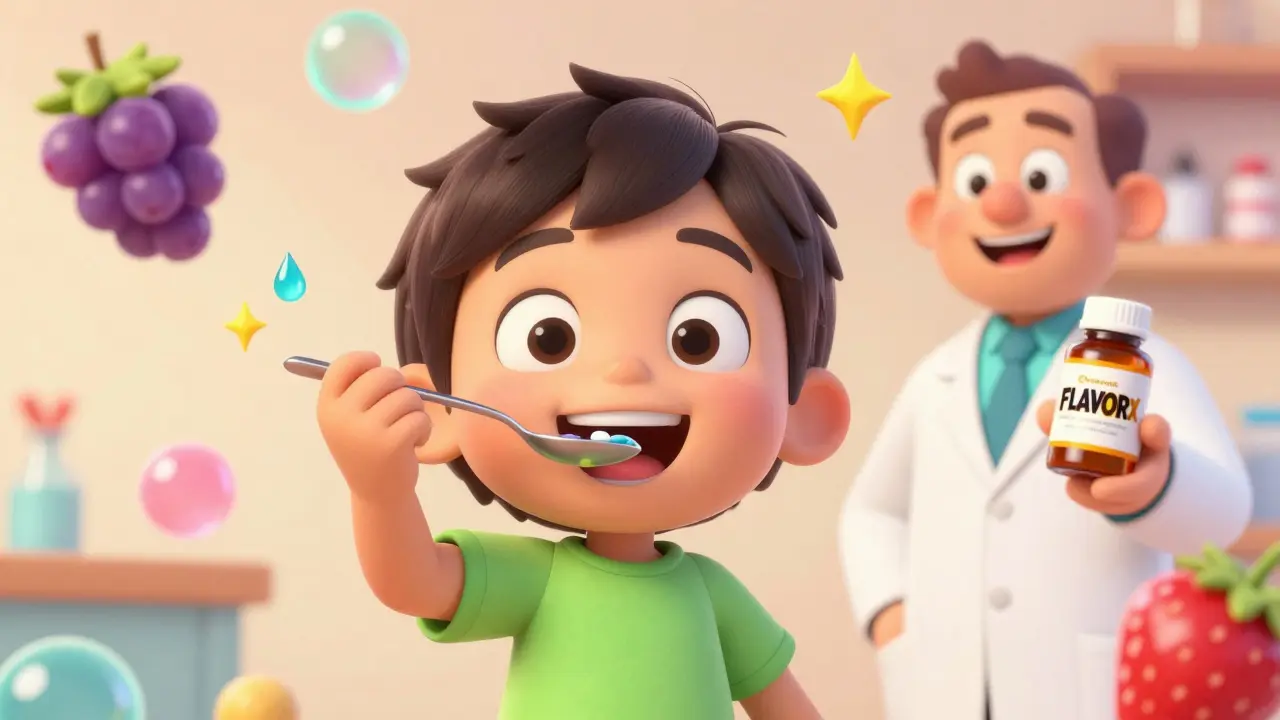
When your child refuses to take medicine, it’s not just stubbornness-it’s biology. Many liquid antibiotics, antifungals, and antivirals taste bitter, metallic, or burning. And when kids spit it out, gag, or cry, parents are left feeling helpless. But there’s a simple, proven fix: flavoring services for pediatric medications.
Why Taste Matters More Than You Think
It’s not just about being picky. A child’s sense of taste is sharper than an adult’s. That’s why something that seems mildly unpleasant to you can feel like poison to them. Studies show that more than 78% of pediatric patients struggle with taking their medicine, and nearly half of those struggles come down to taste alone. When kids refuse meds, doses get skipped. Infections don’t clear. Antibiotic resistance grows. And parents end up stressed, guilty, and exhausted. The data doesn’t lie. When flavoring was added to bitter liquid medications, non-compliance dropped from 76% to just 20%. That’s not a small improvement-it’s a revolution. The National Community Pharmacists Association found that flavoring increased compliance from 53% to over 90%. That means for every five children who used to skip doses, now four are taking their medicine as prescribed.How Flavoring Services Actually Work
Flavoring isn’t magic. It’s pharmacy science. Community pharmacists take a standard liquid prescription-like Amoxicillin or Augmentin-and add a safe, food-grade flavoring agent directly into the bottle. These flavorings are dye-free, sugar-free, and don’t interfere with the medication’s potency. The process takes less than two minutes. No special machines. No extra training. Just a pharmacist, a few flavor options, and a child who finally doesn’t hate medicine. The most common medications that get flavored? Augmentin, Amoxicillin, Azithromycin, Cefdinir, and Clindamycin. These are the antibiotics most often prescribed to kids. And the top flavors? Grape, bubblegum, strawberry, watermelon, and cherry. These aren’t random choices. They’re based on real preference data from thousands of children. Grape wins by a landslide. But bubblegum? That’s the surprise hit. One parent in Mississippi said her 4-year-old now asks for his medicine because it tastes like bubblegum. That’s not just compliance-that’s ownership.Why Home Hacks Don’t Work
You’ve probably tried mixing medicine with juice, applesauce, or chocolate syrup. It seems logical. But here’s the problem: you’re changing how the drug is absorbed. Mixing with food can delay or block absorption. Some meds need to be taken on an empty stomach. Others can react chemically with sugar or acid. A study in Pharmacists and Pediatric Medication Adherence showed that over half of parents who mixed meds with food ended up giving incorrect doses. That’s dangerous. Flavoring services solve this. The flavoring is added directly into the medication by a trained pharmacist who knows exactly how much to add without affecting the concentration. The dose stays accurate. The drug stays effective. And the child? They get a sweet, familiar taste that doesn’t compromise treatment.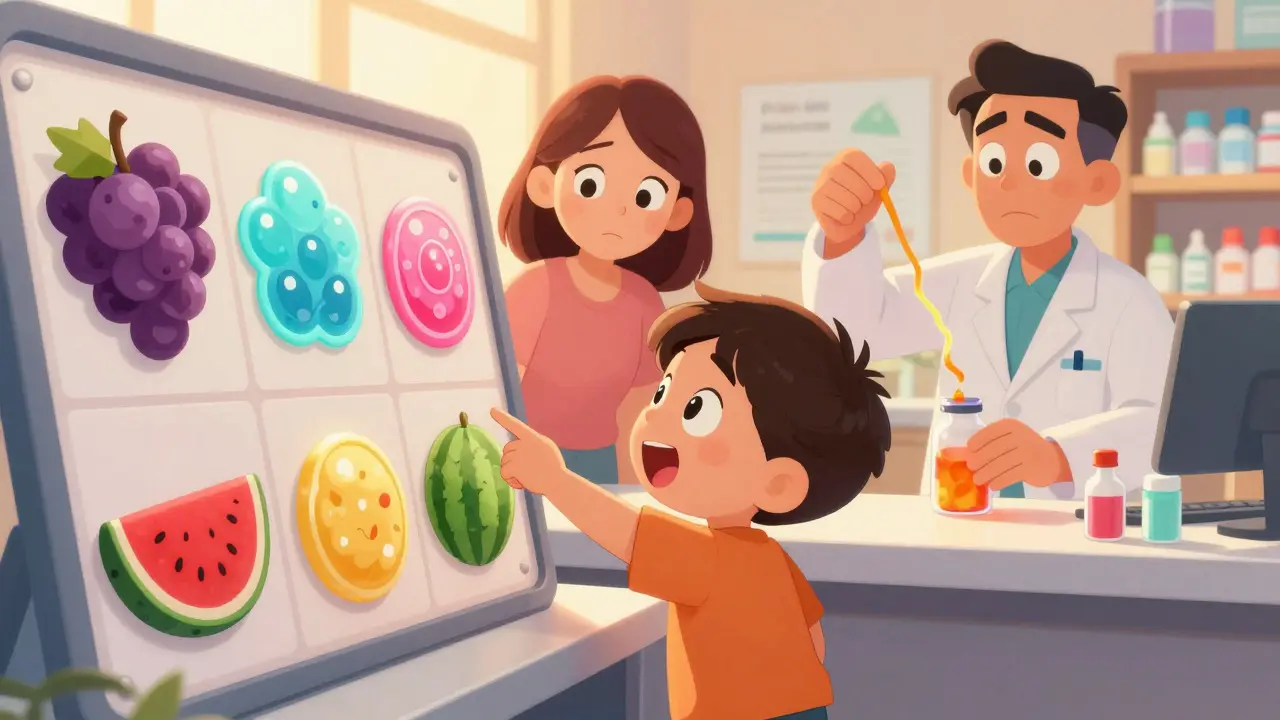
What Flavoring Can’t Fix
Flavoring isn’t a cure-all. Some kids still refuse medicine even when it tastes like candy. Some medications are too thick, too oily, or too unstable to be flavored safely. And for older kids with chronic conditions-like epilepsy or cystic fibrosis-chewable tablets or orally disintegrating tablets (ODTs) often work better than liquids. A trial in Africa showed that for antimalarial drugs, 91% of children took prepacked tablets, while only 42% took the liquid version-even when it was flavored. That’s because swallowing pills becomes easier with age and routine. Flavoring helps, but it doesn’t replace good formulation design. Still, for the millions of kids who need liquid meds, it’s the best tool we have right now.Real Impact in Real Pharmacies
Intermountain Healthcare started offering FLAVORx in all their pharmacies in 2023. They charge $1.50 per prescription. That’s less than a candy bar. And the results? Parents are happier. Pharmacists report fewer refusals. Kids are calmer. Buck Stanford, their pharmacy operations director, says their goal is simple: “Ensure patients are adherent and receive the best outcomes from their medication therapy.” Germantown Pharmacy in Mississippi doesn’t just offer flavoring-they let kids pick their own flavor. “It encourages a child to take charge of their own health,” says the pharmacist. That small act of choice turns a power struggle into a partnership. And that’s why families keep coming back. FLAVORx research found that most parents who try the service say they’d recommend the pharmacy to friends. That’s loyalty built on trust, not ads.
What Parents Need to Know
Most parents don’t know this service exists. That’s the biggest barrier. If your child’s prescription is bitter, ask your pharmacist. Don’t wait until the third failed attempt. Ask at pickup. Ask when you call in the script. Ask if they offer flavoring for liquid meds. It’s not always listed on the website. It’s not advertised on TV. But it’s available in over 90% of community pharmacies across the U.S.-and increasingly in the UK and Europe. You can usually choose from 5 to 10 flavors. Avoid artificial colors if your child has sensitivities. Always confirm the flavoring is sugar-free and dye-free. And if your child has a known allergy to certain fruits or artificial ingredients, tell the pharmacist. They’ll check compatibility before adding anything.What’s Next for Pediatric Medication Flavoring
The future is brighter. Companies like Pfizer are funding research into next-generation taste-masking technologies-not just adding flavor, but changing how the drug interacts with taste receptors. Dr. Michael Bartlett, who first noticed the problem in pediatric cancer trials back in 2011, is now working on coatings that prevent bitterness from hitting the tongue at all. The FDA recognizes taste as a “key factor in successful therapeutic intervention.” That’s official. And as healthcare shifts toward outcomes-based payment models, adherence becomes a metric that affects funding. Pharmacies that offer flavoring aren’t just being nice-they’re improving health outcomes and reducing hospital readmissions.Bottom Line: A Small Change, a Big Difference
Medicine doesn’t work if it’s not taken. For kids, taste is the gatekeeper. Flavoring services remove that barrier. They’re cheap. Safe. Fast. And backed by real data. They turn a daily battle into a routine. They give kids control. They give parents peace of mind. If your child is struggling with liquid meds, don’t just grit your teeth and try again. Ask your pharmacist. It might be the easiest way to fix a problem that’s been holding your child back for too long.Can any liquid medication be flavored?
Most liquid medications can be flavored, but not all. Some formulations-like suspensions with high viscosity or those that are pH-sensitive-can become unstable when flavoring agents are added. Pharmacists check compatibility using manufacturer guidelines and clinical databases before applying flavoring. If a medication isn’t suitable, they’ll let you know and suggest alternatives.
Does flavoring change the dose or effectiveness of the medicine?
No. FDA-approved flavoring agents are designed to be added in tiny amounts that don’t alter the concentration, potency, or absorption of the medication. The flavoring is mixed uniformly and tested for stability. Reputable systems like FLAVORx are rigorously validated to ensure the drug still works exactly as prescribed.
Is flavoring safe for kids with allergies?
Yes, if you inform the pharmacist. Most flavoring services use dye-free, sugar-free, nut-free, and gluten-free bases. But since flavors can contain fruit extracts or artificial compounds, it’s essential to disclose any known allergies. Pharmacists will cross-check ingredients and avoid risky combinations. Always ask for the ingredient list if you’re unsure.
How much does it cost to flavor a child’s medication?
In the U.S., the cost is typically $1.50 per prescription, as seen in systems like Intermountain Healthcare. Some pharmacies include it for free as part of patient care. In the UK, availability is growing, and pricing varies by pharmacy-some charge a small fee, others absorb it into service costs. Always ask when picking up the prescription.
What if my child doesn’t like any of the flavors offered?
Most pharmacies offer 5-10 standard options like grape, strawberry, and bubblegum. If your child rejects them all, ask if they can order a less common flavor like mango, peach, or even chocolate. Some specialty compounding pharmacies can create custom blends. It may take an extra day, but it’s worth it if it means your child actually takes their medicine.
Can flavoring help with over-the-counter meds like cough syrup?
Absolutely. Many OTC cough syrups and antihistamines taste terrible. If your pharmacy offers flavoring services, you can request it for non-prescription meds too. Just bring the bottle in and ask. Pharmacists can often flavor even non-prescription liquids, making it easier to give your child relief without the tears.




One comment
I tried this with my 3-year-old and OMG it was a game changer 🥹 She used to scream like I was poisoning her, now she says "Grape time!" and holds out the cup like it's a treat. I cried. Not because she took it, but because I finally felt like a good mom for once.
Wow. So the solution to kids not taking medicine is... making it taste like candy? Groundbreaking. Next you'll tell us to put glitter in their antibiotics so they think it's a unicorn potion. 🙄
This is a classic example of patient-centered care intersecting with pharmacoeconomics. The flavoring intervention isn't just about compliance-it's a behavioral nudge that reduces downstream healthcare costs. The $1.50 per script is a no-brainer ROI when you factor in reduced ER visits from non-adherence. The data from Intermountain is statistically significant and replicable across community pharmacy settings.
I just want to say thank you to every pharmacist who does this. I’ve been on the other side-my daughter has epilepsy and we’ve gone through 12 different liquid meds. One pharmacist remembered her favorite flavor (bubblegum) from last time and had it ready without me asking. I haven’t cried in public since 2020… until that day. 🫂
You’re all acting like this is some miracle. What about the kids who hate ALL flavors? Or the ones with sensory processing disorders? Or the ones whose parents can’t afford the $1.50? This isn’t a solution-it’s a Band-Aid on a broken system.
My son used to gag on everything. We tried juice, applesauce, even hiding it in peanut butter (which, btw, was a disaster). Then we asked the pharmacist about flavoring and he gave him mango. Now he asks if it's 'medicine day' and high-fives the counter. I don't know what I did to deserve this, but I'm not complaining.
For anyone wondering if this works with OTC meds-yes. I had my 5-year-old on an antihistamine that tasted like chemical regret. The pharmacist flavored it cherry and she took it without a fuss. No more battles at 2 a.m. Just peace. And a slightly sweeter house.
This is ridiculous. You’re teaching kids that medicine should taste like candy. What happens when they grow up and need chemo? Or antibiotics that can’t be masked? You’re creating a generation of kids who think medicine is supposed to be fun. That’s dangerous.
In India, this service is still rare, but I’ve seen it in a few urban pharmacies. The challenge is cost and awareness. Many parents don’t even know it exists. I’ve started sharing this post in local parenting groups. If we can make this standard in community pharmacies here too, it could change lives. Small change, big difference.
I work in pediatrics. I’ve seen kids vomit meds, cry for 20 minutes, and then refuse to take anything for days. This isn’t a gimmick. It’s a clinical necessity. One child I treated had a seizure because his parents couldn’t get him to take his anticonvulsant. He was 2. He didn’t hate the medicine-he hated the taste. Flavoring didn’t just help compliance-it saved his life.
From a compounding pharmacy standpoint, the key is formulation stability. Not all suspensions are compatible with flavoring agents-especially those with high viscosity or pH-sensitive APIs. We use the FLAVORx compatibility database and validate each batch with HPLC before dispensing. It’s not just about flavor-it’s about pharmacokinetic integrity.
I think this is a terrible idea. You’re normalizing the idea that medicine should be sweet. What about discipline? What about teaching kids to do hard things? This is just coddling. And why do we need to spend $1.50 on something that should be a basic part of the prescription? This is capitalism at its worst.
In Canada, this service is increasingly available, particularly in urban centres. However, the regulatory framework remains fragmented across provinces. While Health Canada permits the use of food-grade flavouring agents under specific conditions, standardization of protocols and ingredient disclosure remains inconsistent. Nonetheless, the patient satisfaction metrics are overwhelmingly positive, and I commend the initiative as a humane advancement in pharmaceutical care.