
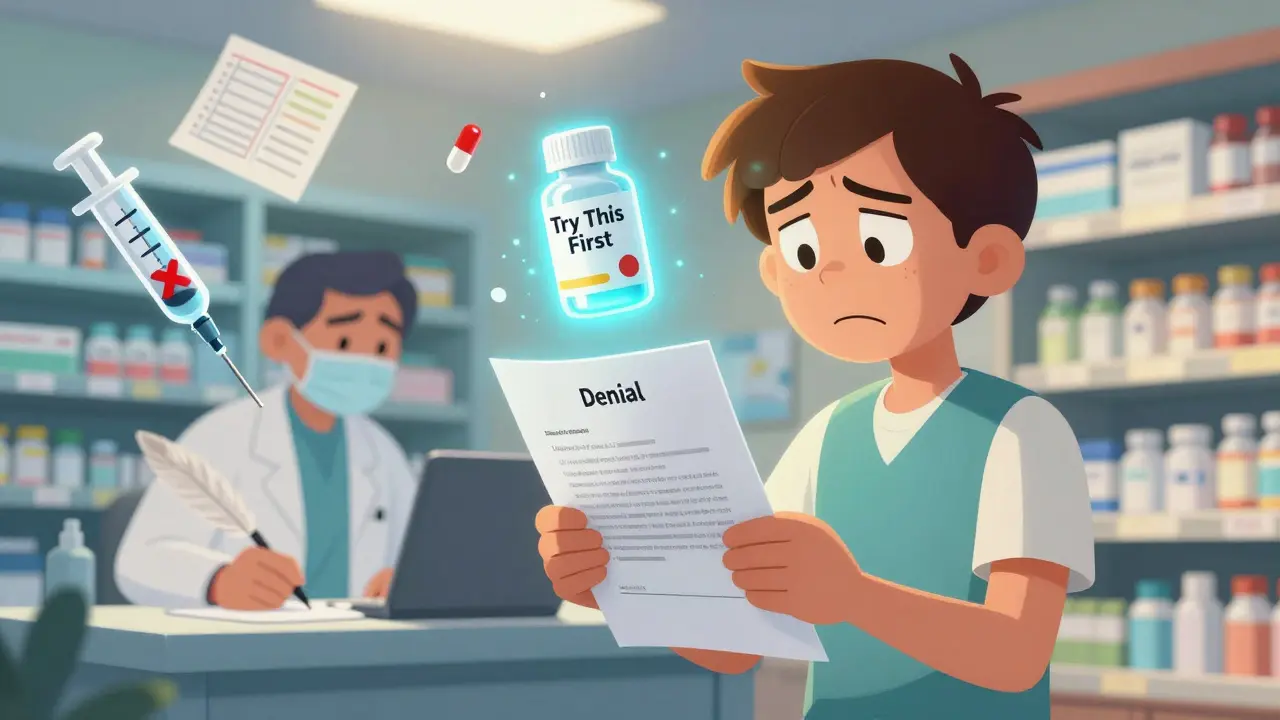
When your doctor prescribes a brand-name medication and your insurance denies coverage, it’s not just a paperwork issue-it’s a health risk. You might be on a drug that works, and switching to a generic could mean more seizures, worse pain, or dangerous side effects. Insurance companies deny these prescriptions all the time, often because they want you to try cheaper alternatives first. But you don’t have to accept it. You have rights, and there’s a clear path to get your medication covered.
Why Your Insurance Denies Brand-Name Medications
Insurance plans use formularies-lists of approved drugs-to control costs. Brand-name medications are often excluded unless you prove a generic won’t work. In 2022, nearly 18% of prior authorization requests for specialty drugs were denied, and over 60% of those were for brand-name drugs. Insurers don’t always deny because the drug isn’t needed. Sometimes, they’re following a policy that prioritizes cost over clinical judgment. Many patients are caught off guard. They’ve been on the same brand-name drug for years-maybe insulin, a biologic for rheumatoid arthritis, or a migraine medication-and suddenly, their plan drops coverage with no warning. Under ERISA-governed plans (which cover about 61% of Americans), insurers can change formularies with minimal notice. That’s why it’s critical to act fast when you get a denial letter.What to Do Right After a Denial
The moment you get a denial, don’t wait. Start by reading your Explanation of Benefits (EOB). By law, insurers must send this within five business days. Look for the reason: “Generic equivalent available,” “Prior authorization not submitted,” or “Not medically necessary.” Write it down. This is your first piece of evidence. Next, call your doctor’s office. Ask for a letter of medical necessity. This isn’t a form-it’s a detailed letter from your provider explaining why the brand-name drug is essential. GoodRx analyzed 1,200 cases and found that appeals with this letter had a 78% success rate. Without it, your chance of winning drops to under 25%. The letter needs specifics:- Your diagnosis and how the brand-name drug treats it
- Previous attempts with generics or alternatives-and what happened (e.g., “Patient had three severe hypoglycemic episodes on generic insulin”)
- Lab results, hospitalizations, or quality-of-life impacts tied to the medication
- Diagnosis codes (ICD-10) and prescription codes (CPT or HCPCS)
- Reference to the prior authorization number, if one exists
How to File an Internal Appeal
Your first appeal goes to your insurance company. You have 180 days from the denial date to file (120 days for Medicare, 60-90 days for Medicaid depending on your state). Don’t wait until the last minute. Most appeals fail because people delay. Your appeal letter should include:- Your full name, policy number, and member ID
- Date of denial and denial reference number
- Copy of the doctor’s letter of medical necessity
- Any supporting records: lab reports, pharmacy logs, specialist notes
- A clear request: “Please approve coverage for [brand-name drug] under my plan”

What Happens If the Internal Appeal Fails
If your insurer says no again, you move to an external review. This is where your chances improve dramatically. Internal appeals succeed in about 39% of brand-name cases. External reviews? About 58% approval rate. Who handles it? It depends on your plan:- For non-ERISA plans (most state-regulated plans): Contact your state’s insurance commissioner’s office.
- For ERISA plans (employer-sponsored): File with the U.S. Department of Health and Human Services.
Why ERISA Plans Are Tricky
If your insurance comes from your job, it’s likely governed by ERISA. That’s the 1974 federal law that says your plan isn’t subject to state insurance laws. It sounds technical, but here’s the real impact:- You can’t sue your insurer in state court.
- You must exhaust all appeals before going to federal court.
- Even if you win in court, a federal judge decides-not a jury.
Real Stories That Worked
One Reddit user, “DiabeticDad87,” got his child’s Humalog insulin denied. He didn’t argue. He sent a letter with hospital records showing his child had three ER visits in six months from low blood sugar on a generic insulin. Approval came in 11 days. Another patient on PatientsLikeMe spent six months fighting a denial for a brand-name migraine drug. The insurer said “triptans are available.” But the patient had tried seven different triptans-each caused nausea, dizziness, or heart palpitations. Only the brand-name drug worked. The appeal succeeded after hiring a lawyer. Cost? $2,500. Worth it. A 2022 survey by the Patient Advocate Foundation found that 44% of people needed help from a provider or lawyer to get through the process. You’re not failing if you ask for help.
What You Can Do While You Wait
Appeals take time. You can’t stop your medication. Many drug manufacturers have patient assistance programs. Eli Lilly’s Insulin Value Program has helped over 1.2 million people get brand-name insulin while their appeal is pending. Check the manufacturer’s website. Ask your pharmacist. These programs often cover the full cost for up to a year. Also, ask your doctor if they can prescribe a 30-day supply at a reduced cash price. Some pharmacies offer discounts on brand-name drugs if you pay out-of-pocket. It’s not ideal, but it’s better than going without.What’s Changing in 2025
The Biden administration’s 2023 Executive Order on Healthcare Competition pushed CMS to enforce appeal rights more strictly. The 2023 Consolidated Appropriations Act now requires Medicare Part D plans to show real-time coverage info when a prescription is entered-so you know before you leave the pharmacy whether it’s covered. That should cut denials by 15-20%. Some states are also passing laws to limit prior authorization. California now requires insurers to approve or deny requests within 24 hours for urgent cases. Other states are following. But here’s the truth: the system is still broken. Physicians now spend over 13 hours a week just managing prior authorizations. Insurers are using AI to auto-denial more claims. That’s why your voice matters. The more people appeal, the more insurers have to change.When to Walk Away
Not every denial is worth fighting. If your doctor says a generic would work just as well, maybe switch. But if you’ve tried alternatives and they failed-if you’ve had side effects, hospital visits, or worsening symptoms-then you have a strong case. Don’t let fear of complexity stop you. You don’t need to be a legal expert. You just need to be persistent. Get the letter. Submit the appeal. Follow up. Ask for help. You’re not alone.What if my insurance says a generic is just as good?
Insurers often claim generics are equivalent-but that’s not always true. For some medications, like certain epilepsy drugs, biologics, or insulin, generics can cause dangerous fluctuations in blood levels or immune reactions. Your doctor’s letter must document specific failures with generics, including lab results, side effects, or hospitalizations. That’s what turns a generic claim into a medical necessity case.
How long does an appeal take?
Internal appeals take 30 days for new prescriptions and 60 days for ongoing medications. Expedited cases must be decided in 4 business days. External reviews take 30-60 days. If you request an expedited external review due to a life-threatening condition, the timeline can be shortened to 72 hours in many states.
Can I get my medication while waiting for an appeal?
Yes. Many drug manufacturers offer patient assistance programs that provide free or low-cost medication during the appeal process. Eli Lilly, Novo Nordisk, and Roche all have such programs. Ask your pharmacist or check the drug manufacturer’s website. Some pharmacies also offer cash discounts on brand-name drugs if you pay out-of-pocket temporarily.
Do I need a lawyer to appeal?
You don’t need one to start-but for ERISA plans or if your appeal has been denied twice, a lawyer can double your chances. Law firms like Kantor & Kantor specialize in insurance denials and often work on contingency. Patient advocacy groups also offer free legal help. Don’t assume you can’t afford it-many services are free or low-cost.
What if my appeal is denied again?
If your external review is denied, you can file a lawsuit-but only if your plan is governed by ERISA. For non-ERISA plans, you may have state-level options. In either case, consult a health law attorney. Many cases settle before trial when insurers realize you’re prepared to go further. Keep all documentation. Every denial letter, call log, and medical record becomes evidence.



One comment
Wow. This is the most comprehensive guide I’ve seen on insurance denials. I’ve been through this with my dad’s biologic for RA - took 4 months, 3 appeals, and a lawyer who charged less than my monthly coffee habit. Worth every penny. 🙌
AI auto-denials are just corporate greed in a suit. They don’t care if you die. They just care if the algorithm says ‘no.’ 😈
Let’s be real - the system is rigged. Insurers aren’t ‘managing costs,’ they’re gambling with lives. And when you win an appeal? They just raise premiums next year. This isn’t healthcare. It’s a predatory subscription model with side effects. 💥
Thanks for laying this out so clearly. I’ve been too overwhelmed to act after my denial last month. This gives me a roadmap. Just need to get my doctor to write the letter now…
While the procedural framework outlined here is commendable, one must not overlook the structural inefficiencies inherent in the U.S. healthcare delivery architecture. The conflation of fiscal prudence with clinical efficacy represents a fundamental epistemological failure in managed care paradigms. Moreover, the reliance on physician-generated letters of medical necessity - though statistically efficacious - is a Band-Aid on a hemorrhaging wound. A systemic overhaul, not individual advocacy, is required to rectify this commodification of human health. The 2025 CMS directives, while incremental, are a necessary step toward de-privatizing medical decision-making.
My wife got her migraine drug approved after 7 months. We used every trick here - lawyer, patient program, even called the CEO’s office. They caved. Don’t give up. You got this. 💪❤️
insurers are just modern day vampires 🧛♂️ sucking blood from the sick while laughing in their penthouses… we are all just data points to them… the system is a lie… but at least we fight… 🌱✨
Did anyone else get a denial letter that just said 'not medically necessary' with zero details? I called them three times and they kept transferring me. Feels like they’re hoping you’ll give up.