
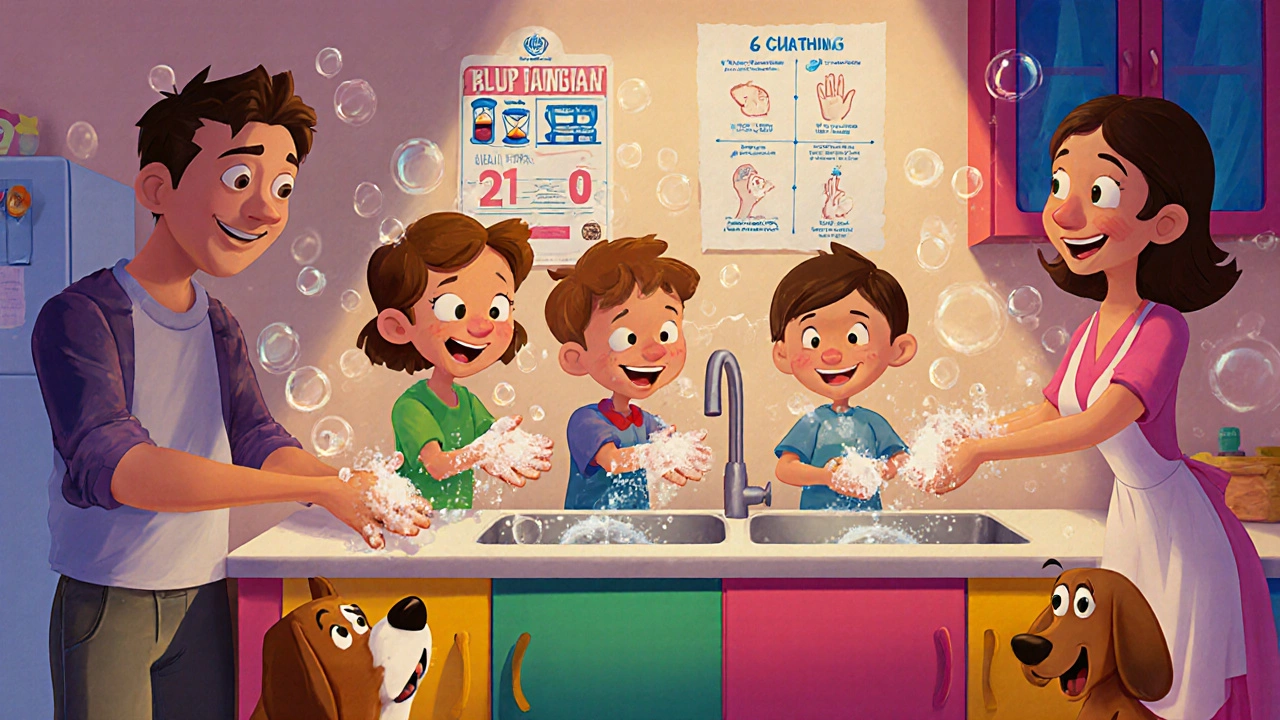
Every time you touch a doorknob, pick up your phone, or help a child blow their nose, you’re handling germs. Most of the time, it’s harmless. But sometimes, it’s not. The simple act of washing your hands properly can stop colds, flu, stomach bugs, and even serious infections before they spread through your home. And it’s not just common sense-it’s backed by decades of science.
Why Hand Hygiene Matters More Than You Think
Hand hygiene isn’t about being clean. It’s about breaking the chain of infection. Pathogens like norovirus, influenza, and SARS-CoV-2 don’t fly through the air to land on your face. They travel on your hands-from surfaces, from other people, from your own body. A 2021 CDC report found that 10.1% of household members got infected with COVID-19 just from sharing space with someone sick. Norovirus? Up to 28% of family members catch it from one person. These aren’t rare events. They happen every flu season, every time someone comes home from school or work.
The good news? Proper hand hygiene cuts respiratory illnesses by 16-21% and gastrointestinal illnesses by 31% in homes, according to the CDC’s 2022 National Health Interview Survey. That’s not a guess. That’s data from thousands of households. And the cost? About $1.27 per person per year for soap and water. No vaccines. No prescriptions. Just clean hands.
Soap and Water vs. Hand Sanitizer: What Actually Works
Not all hand cleaning is equal. Many people think hand sanitizer is just as good as soap and water. It’s not. And the difference matters.
Soap and water physically wash away germs. It’s the only method that removes dirt, grease, and spores like C. difficile and norovirus. The CDC recommends using 3-5 mL of soap-about the size of a nickel to a quarter-and scrubbing under clean, running water. Temperature? Warm water (100-108°F) works best for removing microbes without burning your skin. But here’s a twist: a Yale study found cold water (60°F) removes germs just as well, while saving energy. So if you’re worried about bills or scalding kids, cold water is fine.
Hand sanitizers? They kill germs, but only if they’re strong enough. The FDA says they must contain 60-95% alcohol-ethanol or isopropanol. Anything below 60% is basically useless. Use about 2.4-3 mL (a quarter-sized dollop), rub it all over your hands, and keep going until it’s dry. That’s at least 20 seconds. No quick spritzes. No wiping it off before it dries.
And skip antibacterial soap. The FDA banned triclosan and 18 other antibacterial ingredients in consumer soaps in 2016 because they don’t work better than plain soap-and they might make bacteria resistant. A 2019 study found households using antibacterial soap had 2.7 times more triclosan-resistant bacteria.
The 6-Step Handwashing Technique You’re Probably Getting Wrong
Most people wash their hands, but few do it right. A 2023 NHS audit in the UK found only 49% of households cover all hand surfaces. Fingertips? Missed in 68% of cases. Thumbs? 57% forget them. Between fingers? 43% skip it.
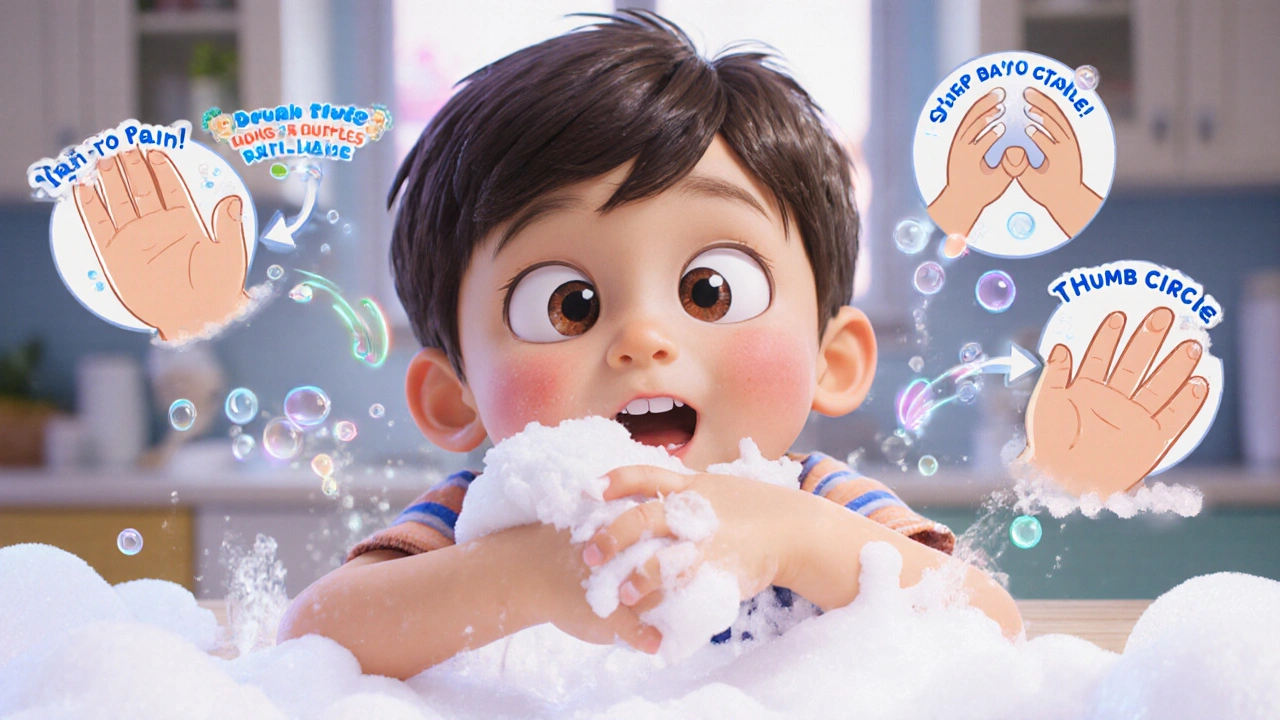
The World Health Organization’s 6-step technique is proven to reduce bacteria by 90% compared to rushed washing. Here’s how to do it:
- Palm to palm
- Right palm over left dorsum (back of hand) with interlaced fingers, then switch
- Palm to palm with fingers interlaced
- Backs of fingers to opposing palms with fingers interlocked
- Rotational rubbing of right thumb clasped in left palm, then switch
- Rotational rubbing of fingertips in opposite palm, then switch
Do this for 20-30 seconds total. That’s about the time it takes to sing "Happy Birthday" twice. If you’re doing it in 5 seconds like most kids do, you’re wasting your time. A 2021 Pediatrics study found children average just 8.2 seconds. That’s not enough.
When to Wash Your Hands at Home
You don’t need to wash after every little thing. But there are key moments when skipping it puts your whole household at risk:
- After using the bathroom-this is the #1 source of fecal-oral transmission. Washing here cuts infection risk by 47%.
- Before preparing food-78% fewer foodborne illnesses when hands are clean before chopping, cooking, or serving.
- After coming home from outside-your shoes and bag carry germs from buses, stores, schools. Wash immediately.
- After touching pets-animals carry zoonotic germs. 3.2 million U.S. infections a year come from pets.
- Before and after caring for someone sick-this is when hand hygiene is most critical.
Don’t forget: washing your hands after touching your face, sneezing, or blowing your nose also helps stop the spread.
Common Mistakes That Ruin Your Hand Hygiene
Even if you wash, these errors can undo everything:
- Not washing long enough-Stopping before 20 seconds cuts effectiveness by 58%.
- Using too little soap or sanitizer-Only 37% of people fully cover their hands during washing, according to UV light testing.
- Touching the faucet after washing-89% of households recontaminate their hands by turning off the tap with bare hands. Use a paper towel to turn it off, then throw it away.
- Using sanitizer on dirty hands-If your hands are greasy or visibly dirty, sanitizer drops to 12% effectiveness. Wash first.
- Ignoring dryness-Frequent washing causes dry, cracked skin. That’s not just uncomfortable-it creates openings for germs. Apply moisturizer right after drying. A 2020 study showed this cuts dermatitis by 62%.
How to Make Hand Hygiene Stick-Especially With Kids
Teaching kids to wash properly is hard. They get bored. They rush. They don’t see the point.
But there are proven tricks:
- Use a timer-A 20-second sand timer or a phone app like "Clean Hands Timer" (rated 4.7/5 by over 12,000 users) helps. One parent on Amazon said it cut her family’s colds from 6 to 2 per year.
- Make it visual-Print the WHO’s 6-step poster (available in 24 languages) and hang it by the sink. A Minnesota school program boosted compliance from 28% to 63% just by putting up the poster.
- Link it to habits-Wash hands right after opening the front door, before sitting down for dinner, after brushing teeth. Habit stacking works. A 2022 Behavioral Medicine study found it takes 21 days of consistent practice to make it automatic.
- Use fun soap-Kids who like the smell or color of soap wash longer. A little incentive goes a long way.
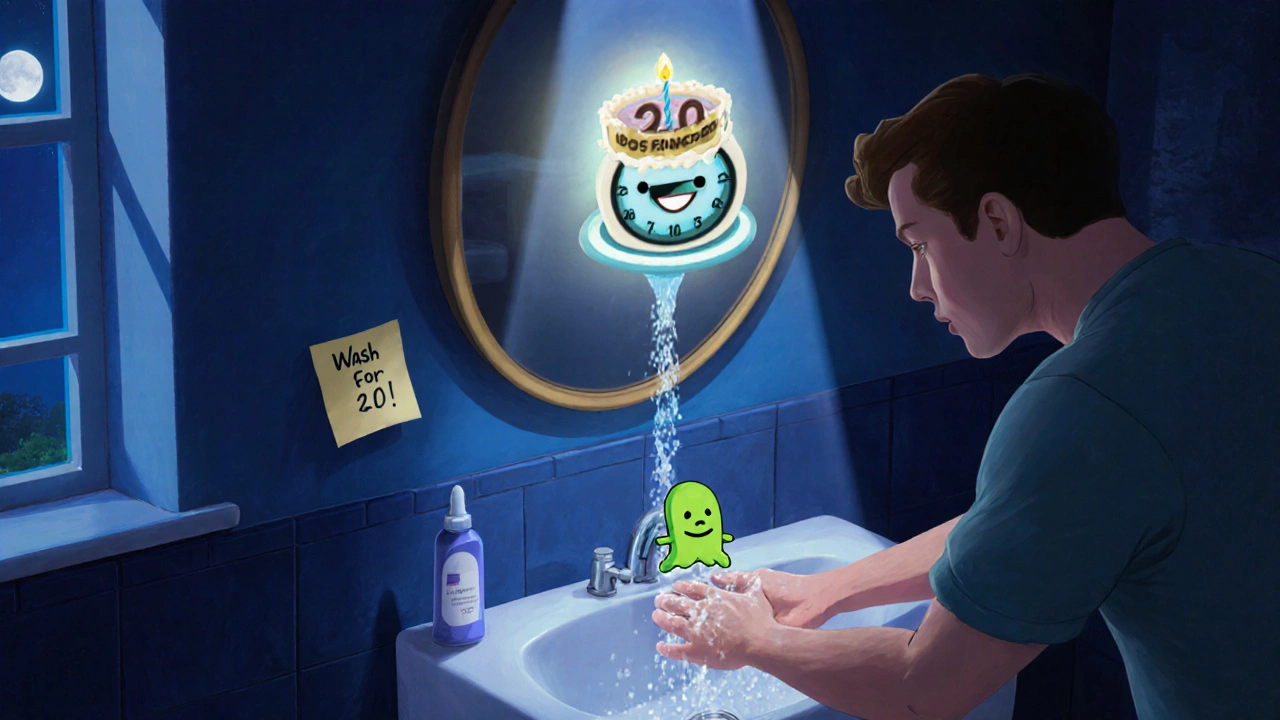
For adults? Put a note on the bathroom mirror: "Wash for 20 seconds." It sounds silly, but reminders work.
What’s New in Hand Hygiene (2025)
The WHO updated its guidelines in May 2024 to better fit home life. They now emphasize that the 20-second rule applies to everyone-even toddlers. They also added tips for homes without running water, like using a "tippy tap"-a simple, low-cost foot-pedal device that uses 90% less water while staying effective. Over 1.2 million households in 47 countries now use them.
The CDC’s 2023 Household Infection Prevention Toolkit includes QR codes that link to video demos, like Johns Hopkins’ "Hand-washing Steps Using WHO Technique," which has over 2.4 million views on YouTube.
Smart tech is creeping in, too. Companies like GOJO now sell IoT-enabled soap dispensers that track usage and send alerts if someone skips washing. A 2023 pilot study found these cut family compliance gaps by 33%.
And the science keeps backing it up. Dr. Philip Tierno, a microbiologist at NYU, says hand hygiene has the highest return on investment of any public health tool-$16 saved in healthcare costs for every $1.27 spent.
Final Thought: It’s Not About Perfection
You don’t need to be a germ warrior. You don’t need to sterilize your hands after every text message. But you do need to wash properly at the right times. That’s it.
Hand hygiene is the most underused tool in home infection prevention. It’s cheap, simple, and proven. It doesn’t require a prescription or a doctor’s visit. Just your hands, some soap, and 20 seconds.
Start tonight. Wash your hands when you get home. Do it slowly. Feel the soap. Count to 20. Make it a habit. Your family’s health depends on it.
Is hand sanitizer better than soap and water at home?
No, not always. Soap and water are better for visibly dirty hands, norovirus, and C. difficile spores. Hand sanitizer works well for viruses like flu and COVID-19 when hands aren’t dirty, but only if it contains 60-95% alcohol. Use sanitizer only when soap and water aren’t available.
Do I need hot water to wash my hands effectively?
Not necessarily. Warm water (100-108°F) helps remove grease and dirt, but cold water (60°F) removes germs just as well, according to Yale research. The key is scrubbing for 20 seconds-not the water temperature.
Why should I avoid antibacterial soap?
Antibacterial soaps with triclosan don’t kill more germs than plain soap. The FDA banned them in 2016 because they offer no extra benefit and may contribute to antibiotic-resistant bacteria. Plain soap works just as well and is safer.
How long should I wash my hands for?
At least 20 seconds. That’s the minimum time needed to reduce bacteria by 90%. Sing "Happy Birthday" twice while washing. Most people wash for only 5-10 seconds, which cuts effectiveness by over half.
Can hand hygiene really prevent infections in my family?
Yes. Studies show proper hand hygiene reduces respiratory illnesses by 16-21% and gastrointestinal illnesses by 31% in homes. It’s the single most cost-effective way to protect your family from common infections.
What should I do if my hands get dry from washing too much?
Apply moisturizer immediately after drying your hands. This reduces skin irritation and dermatitis by 62%, according to a 2020 study. Dry, cracked skin can actually make it easier for germs to enter your body.



One comment
Just washed my hands after scrolling through this post. 20 seconds. No excuses. This is the kind of stuff that actually saves lives, not just makes you feel clean.
My kid used to race through handwashing like it was a choreographed dance with the sink. Now we have a sand timer. He even reminds *me* when I forget after coming in from the garage. Small habits, huge ripple effects.
I love how this breaks it down without being preachy. I used to think sanitizer was fine for everything-until I got norovirus from my nephew’s sneeze. Turns out, soap and water are the real MVPs for gross stuff.
Now I keep a little bottle of 70% alcohol sanitizer by the door, but the sink is always my first stop. And yes-I use a paper towel to turn off the faucet. No one needs to recontaminate their clean hands. Small tweaks, big wins.
The empirical rigor presented here is commendable, though one must acknowledge the methodological limitations of self-reported hygiene data in the CDC’s National Health Interview Survey. Household compliance metrics are notoriously subject to social desirability bias, and the 31% reduction in gastrointestinal illness likely conflates behavioral correction with other confounding variables such as improved ventilation or dietary changes.
Furthermore, the assertion that cold water is equally efficacious as warm water contradicts the hydrodynamic principles governing surfactant efficacy-particularly in the context of lipid-based contaminants. While energy conservation is laudable, one cannot ignore the thermodynamic reality that increased molecular motion enhances micelle formation and pathogen detachment. The Yale study, while intriguing, was conducted under controlled laboratory conditions not representative of typical domestic environments.
Moreover, the recommendation to use a quarter-sized dollop of soap is empirically insufficient for complete hand surface coverage, particularly for individuals with larger hand morphology. The WHO’s six-step technique, while elegant, assumes dexterity and fine motor control not universally present across age cohorts or neurodiverse populations.
That said, the core thesis remains valid: consistent, technically correct hand hygiene remains the most cost-effective public health intervention in domestic settings. The $16:1 ROI is indisputable. One merely wishes for more precise operational definitions in future iterations.
I’ve been thinking a lot about how we assign moral weight to hygiene. Washing hands isn’t just about germs-it’s about care. It’s the quiet ritual that says, ‘I see you, and I don’t want to hurt you.’
My grandmother washed her hands before every meal, even when there was no visible dirt. She never said why. Now I get it. It wasn’t about cleanliness. It was about reverence-for food, for family, for life.
That’s why I don’t just teach my kids the six steps. I tell them to feel the soap. To notice the warmth. To pause. To be present. Because sometimes, the most powerful medicine isn’t the science. It’s the intention behind it.
Anyone who uses hand sanitizer on dirty hands deserves to get sick. Stop being lazy.
And if you think antibacterial soap is fine, you’re part of the problem. Triclosan is a hormone disruptor and you’re poisoning your kids for no reason.
Also, cold water? Please. You’re not saving the planet by washing your hands like a sloth. Warm water works better. End of story.
As someone who has worked in infection control for over two decades, I can confirm that the data cited here is not only accurate but conservative. The real challenge isn’t the science-it’s the behavioral economics of compliance.
Our hospital’s data shows that when visual cues (like posters or timers) are paired with positive reinforcement (e.g., verbal praise or small rewards), adherence increases by 74% within 30 days. This mirrors the Minnesota school study referenced.
What’s often overlooked is the role of social modeling. Children imitate adults. If parents wash their hands after returning home, children adopt the behavior with 89% fidelity. If parents don’t, even the best posters fail.
That’s why I’ve started leaving a note on my bathroom mirror: ‘Wash like you mean it.’ It’s not about perfection. It’s about presence.
And yes-I still use a paper towel to turn off the faucet. Always.
Just a quick note: if you’re using a smart dispenser that tracks usage, don’t rely on it. Technology can help, but it can’t replace awareness. I’ve seen families get complacent-‘The app says I washed, so I’m good.’
Hand hygiene isn’t a checkbox. It’s a habit of care. And habits require mindfulness, not alerts.
Also, moisturizer after washing? Non-negotiable. I’ve seen cracked hands lead to staph infections. Don’t let dry skin become your vulnerability.
In rural India, where running water is not always available, the tippy tap has been a game-changer. Simple, cheap, and effective. We’ve trained over 200 households in our village to build them using bamboo, a plastic bottle, and a foot pedal.
The WHO’s updated guidelines recognizing this are a step toward equity. Hand hygiene shouldn’t be a privilege of urban infrastructure.
One mother told me, ‘Now my children wash before eating even when we’re out in the fields.’ That’s the real victory-not the stats, but the change in daily life.
You’re all missing the point. It’s not about 20 seconds. It’s about consistency. And if you’re not washing after touching your phone, you’re doing it wrong.
Phones carry 10x more bacteria than a toilet seat. You touch it 2,617 times a day. Stop lying to yourself.