
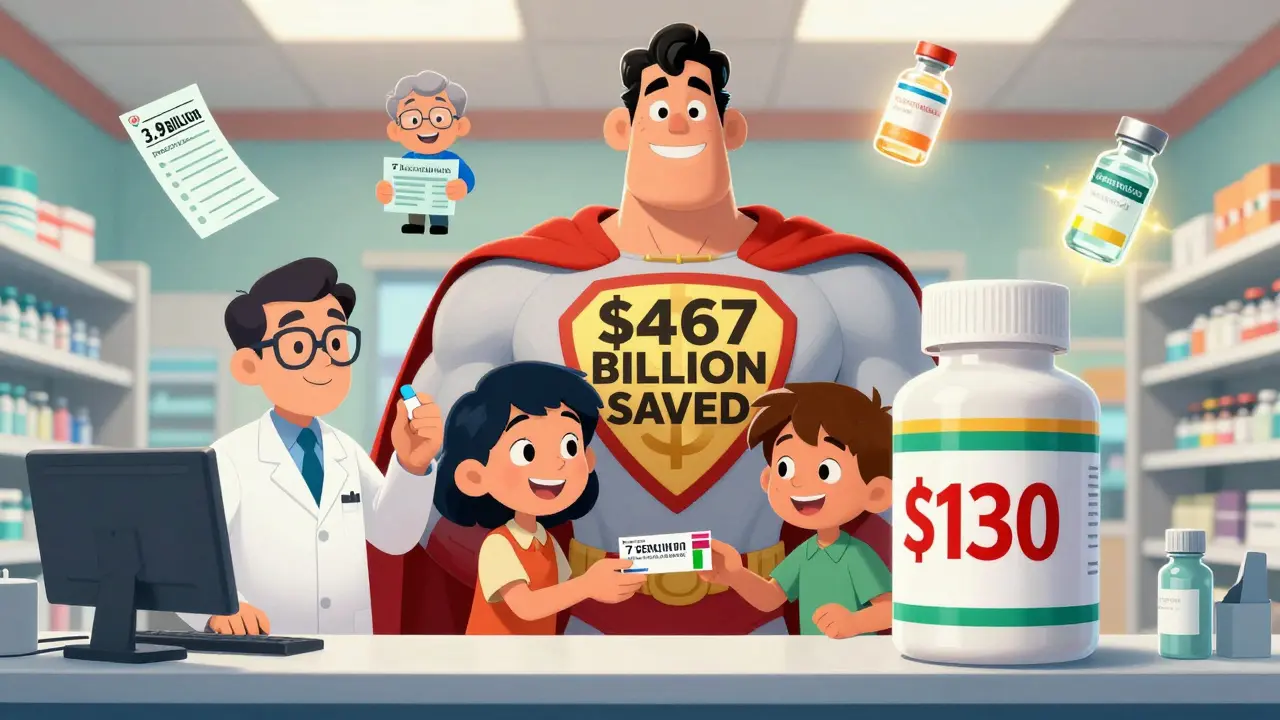
Every year, Americans fill over 3.9 billion prescriptions. Almost 90% of them are for generic drugs. But here’s the wild part: those 90% of prescriptions cost only 12% of the total money spent on prescriptions. Meanwhile, brand-name drugs - which make up just 10% of prescriptions - eat up 88% of the spending. That’s not a mistake. That’s the system working exactly as it should. And it’s saving the U.S. healthcare system $467 billion in a single year.
How Much Are You Really Saving?
If you’ve ever picked up a generic prescription, you already know it’s cheaper. But how much cheaper? In 2024, the average out-of-pocket cost for a generic drug was $6.95. For the same medicine in brand-name form? $28.69. That’s almost five times more. For someone without insurance, the gap gets even wider. Brand-name drugs cost an average of $130.18 per prescription - up nearly 50% since 2019. Meanwhile, generics went down to $6.95, a 6% drop from previous years. That’s not luck. That’s competition.Think about that. You’re paying less for the exact same medicine. Same active ingredient. Same dosage. Same effectiveness. The only difference? The label. And yet, the price difference is massive. That’s why the average Medicare beneficiary saved $2,643 in 2024 just from using generics. That’s not a small perk. That’s enough to cover a month’s rent in many parts of the country.
It’s Not Just Pills - It’s Billions
The numbers get even more staggering when you look at the big picture. Since 2015, generic and biosimilar drugs have saved the U.S. healthcare system over $3.4 trillion. In 2024 alone, they saved $467 billion. To put that in perspective, that’s more than the entire annual budget of the Department of Education. And it’s all happening because of pills and capsules that cost pennies compared to their brand-name cousins.Biosimilars - the newer class of generic-like drugs for complex conditions like cancer and rheumatoid arthritis - are adding even more to the savings. In 2024, biosimilars saved $20.2 billion. That’s nearly double what they saved the year before. Since they first hit the market in 2015, they’ve saved $56.2 billion total. And here’s the kicker: they’ve been used in over 3.3 billion days of patient therapy with zero unique safety issues. If a drug works as well as the original and costs less, why wouldn’t you use it?
Why Are Generics Getting Cheaper Even as More Are Sold?
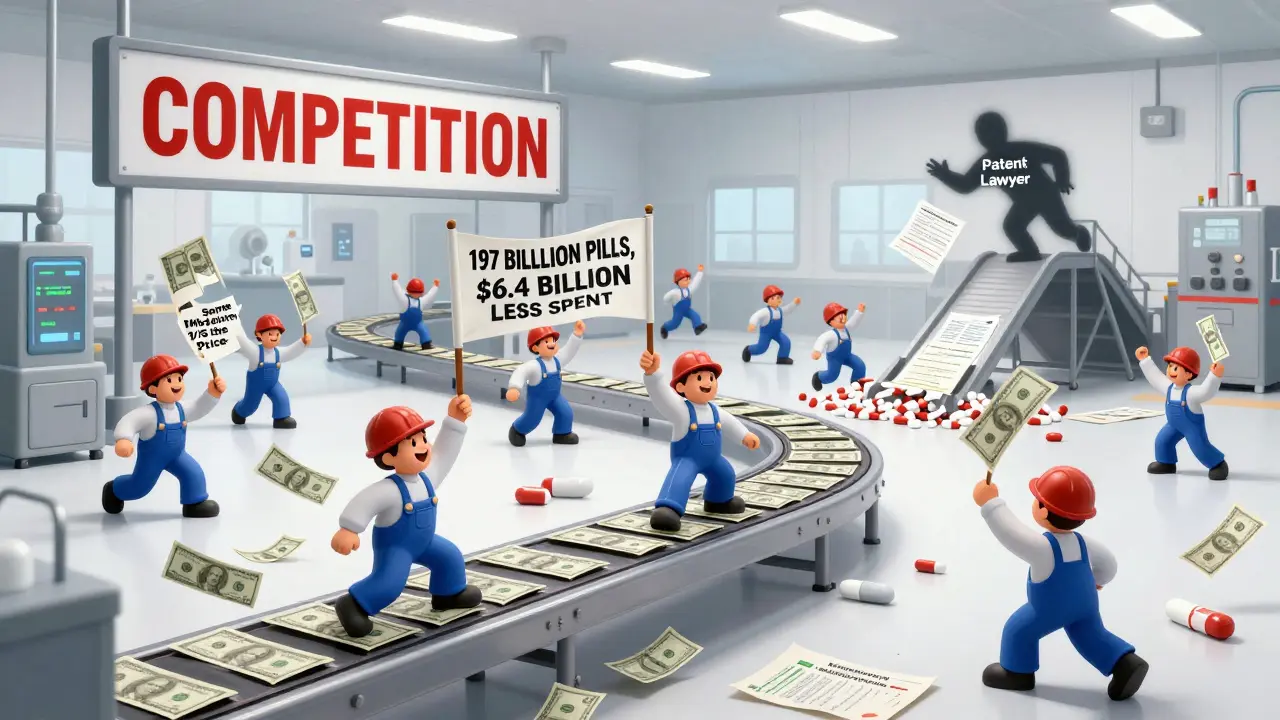
This is where it gets counterintuitive. Between 2015 and 2024, the number of generic pills sold in the U.S. jumped from 167 billion to 197 billion. That’s a 15% increase in volume. Yet, total spending on all generic drugs dropped by $6.4 billion during that same period. That’s right - more pills, less money spent. How? Because manufacturers are competing harder. When one company starts selling a generic at $1, the next one drops to 80 cents. Then 60. Then 40. Eventually, the price plateaus at a fraction of the brand-name cost.This isn’t just theory. Data from April to July 2025 shows a clear trend: in May, $40 million in generic drugs dropped in price while only $26 million went up. That’s a net deflation of $14 million. In June? $45 million deflated versus $29 million inflated - a $17 million net drop. These aren’t one-off events. They’re the new normal. The generic market doesn’t just keep prices low - it actively drives them down.
What’s Driving Up Brand-Name Costs?
While generics keep getting cheaper, brand-name drugs are doing the opposite. In January 2025, major pharmaceutical companies raised prices on 250 drugs by a median of 4.5%. That’s nearly double the overall inflation rate in the U.S. Some hikes were even more extreme. One drug, Vasostrict, saw its list price drop 76% after generic competition kicked in. But that’s the exception - not the rule. Most brand-name drugs just keep climbing.Why? Because they don’t have real competition. Patents, legal tactics like "product hopping" (where companies tweak a drug slightly just to reset patent clocks), and pay-for-delay deals - where brand companies pay generic makers to stay off the market - keep prices high. A study found these pay-for-delay deals cost the system $12 billion a year. Medicare alone loses $3 billion annually because of them. Eliminating these practices could save $45 billion over 10 years.
The Hidden Threat: Can Generic Manufacturers Survive?
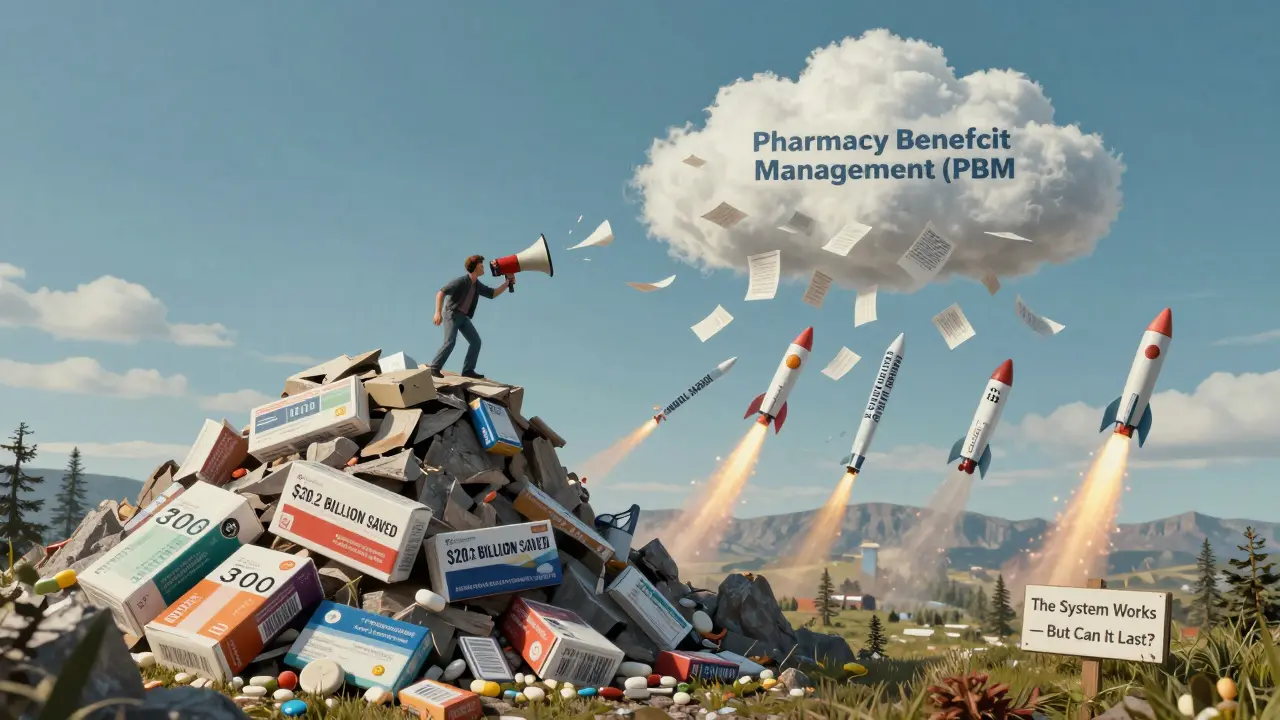
Here’s the uncomfortable truth: the system that saves you hundreds of dollars a year might be on the brink. The same price pressure that makes generics affordable is squeezing manufacturers dry. Companies are making so little profit per pill that some are quitting the market entirely. The Biosimilars Council warns this could lead to shortages - or worse, entire drugs vanishing from shelves.Imagine a life-saving blood pressure pill that costs 20 cents a dose. Now imagine the company that makes it can’t cover its factory costs, payroll, or regulatory fees. It shuts down. No one else steps in. Suddenly, you can’t find it. And the brand-name version? Still priced at $300. That’s not hypothetical. It’s already happening with some older generics. The problem isn’t lack of demand. It’s lack of profit.
Experts say the fix isn’t to raise prices - it’s to fix the system. Streamlining FDA approvals, stopping patent abuse, and removing barriers from pharmacy benefit managers (PBMs) and Medicare policies are critical. Without changes, the savings we enjoy today could become a memory.
Where Do We Go From Here?
The math is simple: generics work. They save money. They’re safe. They’re everywhere. In 2024, they saved Medicare $142 billion. They saved patients billions more. And yet, the biggest threat to their future isn’t science - it’s policy.When you pick up a generic, you’re not just getting a cheaper pill. You’re participating in one of the most successful cost-saving systems in modern healthcare. But that system needs support - not more price hikes, not more legal games, not more delays. It needs smart policy that protects competition, not blocks it.
If you’re on a generic drug, you’re already saving. But if you’re not asking why your prescription costs what it does - or why some drugs are suddenly unavailable - you’re missing the bigger picture. The next time you pay $7 for a prescription instead of $30, remember: that’s not magic. It’s market forces. And it’s worth fighting to keep.
How much do generic drugs save the average American each year?
The average Medicare beneficiary saved $2,643 in 2024 just from using generic drugs. For individuals without insurance, switching from a brand-name drug to its generic equivalent can save hundreds - sometimes over $1,000 - per year on out-of-pocket costs alone.
Are generic drugs as effective as brand-name drugs?
Yes. The FDA requires generic drugs to have the same active ingredient, strength, dosage form, and route of administration as the brand-name version. They must also meet the same strict standards for quality, purity, and performance. Studies consistently show they work the same way in the body. The only differences are in color, shape, or inactive ingredients - none of which affect how the drug works.
Why are some generic drugs hard to find?
Some generic drugs are hard to find because manufacturers can’t make enough profit to stay in business. When a drug’s price drops too low - sometimes below $1 per pill - companies stop producing it. This is especially common with older, low-cost generics. It’s not a shortage of demand - it’s a shortage of profit. Regulatory hurdles and supply chain issues can also contribute.
What’s the difference between a generic and a biosimilar?
Generics are exact copies of simple chemical drugs - like aspirin or metformin. Biosimilars are highly similar versions of complex biological drugs - like Humira or Enbrel - made from living cells. They’re not identical, but they’re proven to work the same way with no safety differences. Biosimilars take longer and cost more to develop, but they’ve saved over $56 billion since 2015.
Why do brand-name drugs cost so much more?
Brand-name drugs cost more because their manufacturers hold patents and face little to no competition. They also use tactics like "product hopping" and pay-for-delay deals to block generics. Once patents expire, prices usually drop - but until then, companies can charge whatever the market will bear. That’s why the same drug can cost $300 in the U.S. and $30 in Canada.

One comment
So let me get this straight - we’re saving $467 BILLION a year because people are willing to buy pills with different colors and packaging? And we call this a victory?
Meanwhile, my cousin in Canada pays $12 for the exact same drug and doesn’t even need a prescription. We’re not saving - we’re just pretending the system isn’t broken.
Generics work. They’re safe. They’re cheaper. Stop overcomplicating it.
bro the fact that a pill that cost 300 bucks last year is now 7 bucks because some company figured out how to make it without the fancy logo is wild
like we literally just cut out the marketing and the hype and the bs and now its affordable? what a concept
The structural inefficiencies in the U.S. pharmaceutical supply chain are not anomalies - they are systemic failures rooted in profit-driven monopolies. The fact that biosimilars have saved over $56 billion since 2015 without a single documented safety issue demonstrates that regulatory barriers, not scientific limitations, are the true impediment to equitable healthcare access.
America needs to stop being soft. India makes 60% of the world's generics. We’re literally outsourcing our healthcare savings to *them* while we whine about patents.
Stop crying. Start manufacturing. Or get used to paying $300 for aspirin.
I don’t care how much you save. I’ve been waiting three weeks for my generic blood pressure med because the factory in Ohio shut down. The company that made it? Went out of business. No one else wanted to make it because the price is 18 cents a pill. So now I’m stuck with the brand-name version that costs $290. This isn’t a savings story. This is a horror story.
And before you say ‘just switch to another drug’ - try telling that to someone with 3 comorbidities who’s been on this exact med for 12 years. The system doesn’t care about your stability. It only cares about margins.
Generics are the only thing keeping me alive and I still have to pay 15% of my paycheck for them
they save billions but i still cant afford them
The real story here isn’t the $467 billion - it’s the invisible infrastructure. We’re talking about a market that operates like a hyper-competitive commodity exchange - but for life-saving medication.
Manufacturers are squeezed by PBMs, Medicare reimbursement caps, and FDA delays. Meanwhile, brand-name companies use patent thickets and product hopping like a legal loophole bingo card.
And yet somehow, we’re still getting 90% of prescriptions at 12% of the cost. That’s not luck. That’s a market working *despite* the system.
The fix isn’t price controls - it’s dismantling the middlemen and letting competition breathe. But that’s not sexy. So we just keep buying pills and pretending it’s all fine.