
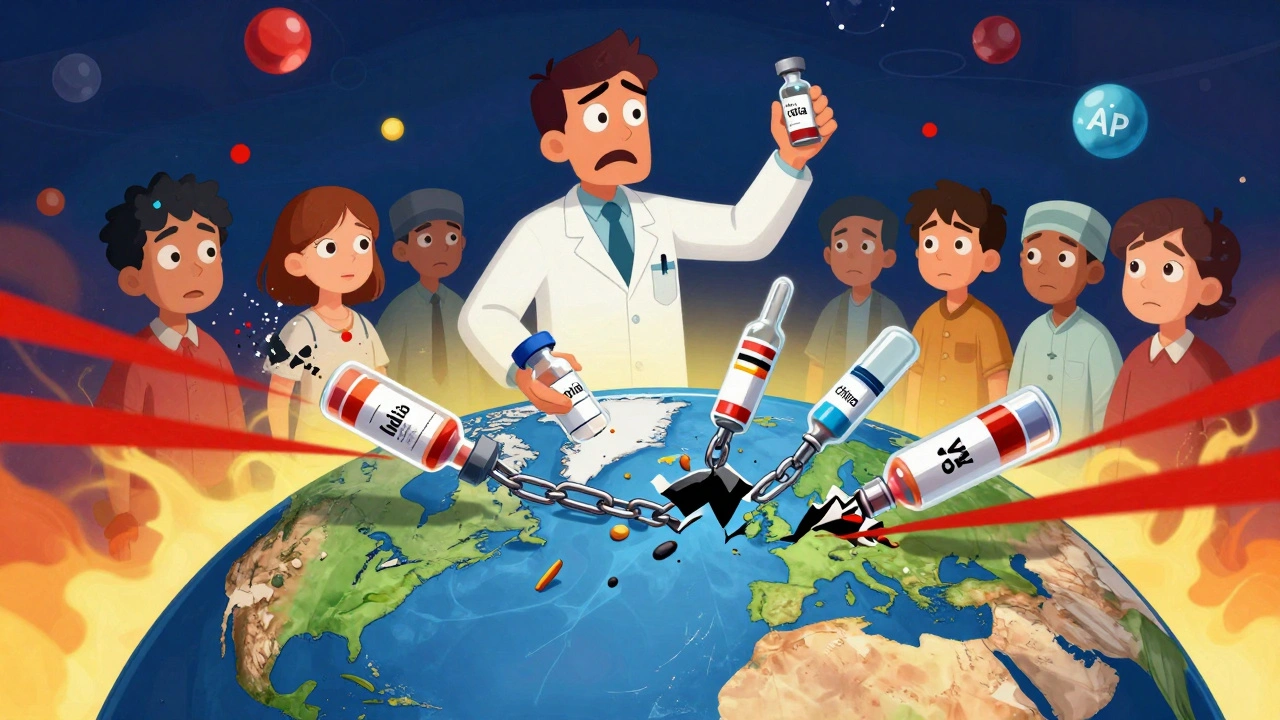
Drug shortages aren’t random accidents. They’re the result of fragile systems that were built for efficiency, not survival. When a single factory in India shuts down for regulatory issues, or a shipping container gets stuck in the Red Sea, patients in the U.S. and Europe can suddenly go without life-saving antibiotics, insulin, or heart medications. The truth is, we’ve been lucky so far. But luck isn’t a strategy. Building a resilient pharmaceutical supply chain isn’t about avoiding disruption-it’s about preparing for it so that when it happens, patients still get their medicine.
Why the Current System Keeps Failing
The global pharmaceutical supply chain was designed to cut costs, not reduce risk. For decades, companies moved production to the cheapest locations, often in China and India, where active pharmaceutical ingredients (APIs)-the core chemical components of drugs-are made. Today, 80% of APIs and 40% of finished drugs consumed in the U.S. come from overseas. China alone supplies 45% of these critical ingredients, and India adds another 23%. That means a weather event, political tension, or even a labor strike halfway across the world can ripple through hospitals and pharmacies in Birmingham, Atlanta, or Chicago. It’s not just about geography. The system is thin. Many manufacturers run with just-in-time inventory, meaning they keep only a few days’ worth of stock. When a supplier delays, there’s no backup. The FDA reported in 2025 that only 28% of essential medicine APIs are made domestically. For sterile injectables, it’s worse-only 12% are produced in the U.S. That’s not resilience. That’s a waiting game.What Resilience Actually Means
Resilience isn’t about bringing everything back home. It’s about having options. The U.S. Department of Health and Human Services defines it clearly: the ability to anticipate, prepare for, respond to, and recover from disruptions while keeping critical drugs flowing. That’s the goal. And it’s achievable-if you stop treating supply chains like a spreadsheet and start treating them like a lifeline. Leading companies now map their supply chains across 12 to 15 tiers of suppliers. That means knowing not just who makes the API, but who supplies the raw chemicals to that company, who provides the packaging, and who maintains the equipment. Most still don’t do this. And when a disruption hits, they’re blind.Three Practical Steps to Build Resilience
Buffer stock isn’t waste-it’s insurance. For the most critical medicines-like epinephrine, heparin, or cancer drugs-keeping 60 to 90 days of inventory isn’t excessive. It’s essential. The U.S. government is now funding a Strategic Active Pharmaceutical Ingredients Reserve to stockpile 150 essential drugs with 90-day coverage by 2027. But hospitals and pharmacies can’t wait for federal action. They need to start building their own emergency stockpiles now, especially for drugs with long lead times or single-source suppliers. Dual-sourcing isn’t optional-it’s basic risk management. If you rely on one factory for a key API, you’re one inspection away from a crisis. Top performers now dual-source 70 to 80% of their critical components. That means having two approved suppliers, ideally in different regions. One in India, one in the U.S. One in Europe, one in Southeast Asia. It costs more upfront. But when a supplier fails, you don’t shut down. You switch. And you keep treating patients. Regional manufacturing networks beat global centralization. You don’t need a factory in every state. But you do need at least three geographic zones for production. North America, Western Europe, and Southeast Asia are now the core clusters. Companies are investing in modular, container-based manufacturing units that can be deployed in 12 to 18 months-compared to 3 to 5 years for traditional plants. These units can scale from 50kg to 2,000kg of API output. They’re flexible. They’re faster. And they reduce dependence on any single country.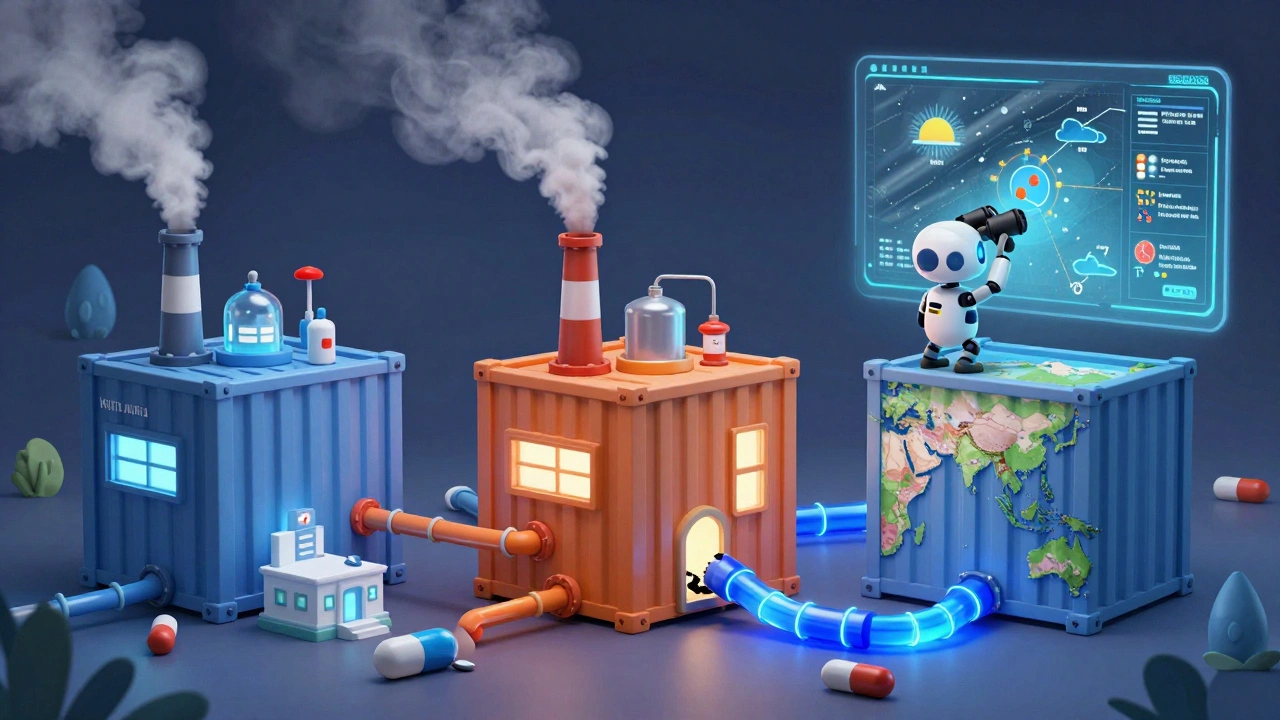
Technology That’s Actually Making a Difference
Forget hype. The real tech breakthroughs are quiet, practical, and already working. Continuous manufacturing is replacing old batch processes in a handful of FDA-approved facilities. It cuts facility size by 30-40%, reduces energy use by 20-25%, and cuts material waste by 15-20%. It also produces drugs more consistently, with fewer quality issues. The FDA has approved only 12 such systems so far-out of over 10,000 batch facilities. But approval timelines have dropped from 3 years to under 18 months. That’s a sign things are changing. AI is helping companies predict disruptions before they happen. By analyzing weather patterns, port congestion, political unrest, and supplier financial health, AI models can now forecast supply risks with 85-90% accuracy 60 to 90 days in advance. That’s enough time to shift orders, activate backup suppliers, or ramp up inventory. Blockchain systems are cutting counterfeit drugs by 70-75% in pilot programs. When every pill can be traced from raw material to patient, it’s harder for fake or contaminated products to slip through. That’s not just about safety-it’s about trust.The Cost of Doing Nothing
Building resilience costs money. Continuous manufacturing facilities run $50 million to $150 million. Dual-sourcing adds 8-12% to the cost of goods. Buffer stock ties up capital. But what’s the alternative? Companies that invested in resilience saw 23% higher operational continuity during disruptions. That translates to $14.7 million in avoided losses per major event. For a hospital, it means no canceled surgeries. For a cancer patient, it means no missed chemo doses. For a family, it means no panic buying of insulin because the shelf is empty. The National Academies of Sciences warn that over-investing in domestic production alone could raise drug costs by 20-30% without improving safety. The goal isn’t to make everything in America. It’s to make sure that when something goes wrong, there’s always another way.Who’s Leading-and Who’s Falling Behind
Large pharmaceutical companies with over $10 billion in revenue have a 85% adoption rate for comprehensive resilience programs. Mid-sized firms? Only 42%. Small companies? Just 18%. That’s a dangerous gap. Smaller manufacturers supply half of all generic drugs in the U.S. If they collapse under supply chain stress, the entire system buckles. The government is stepping in-with $1.2 billion from the CHIPS and Science Act and another $800 million proposed in 2025. But public funding won’t fix broken business models. Companies need to stop treating supply chain resilience as a compliance task and start treating it as a core business function.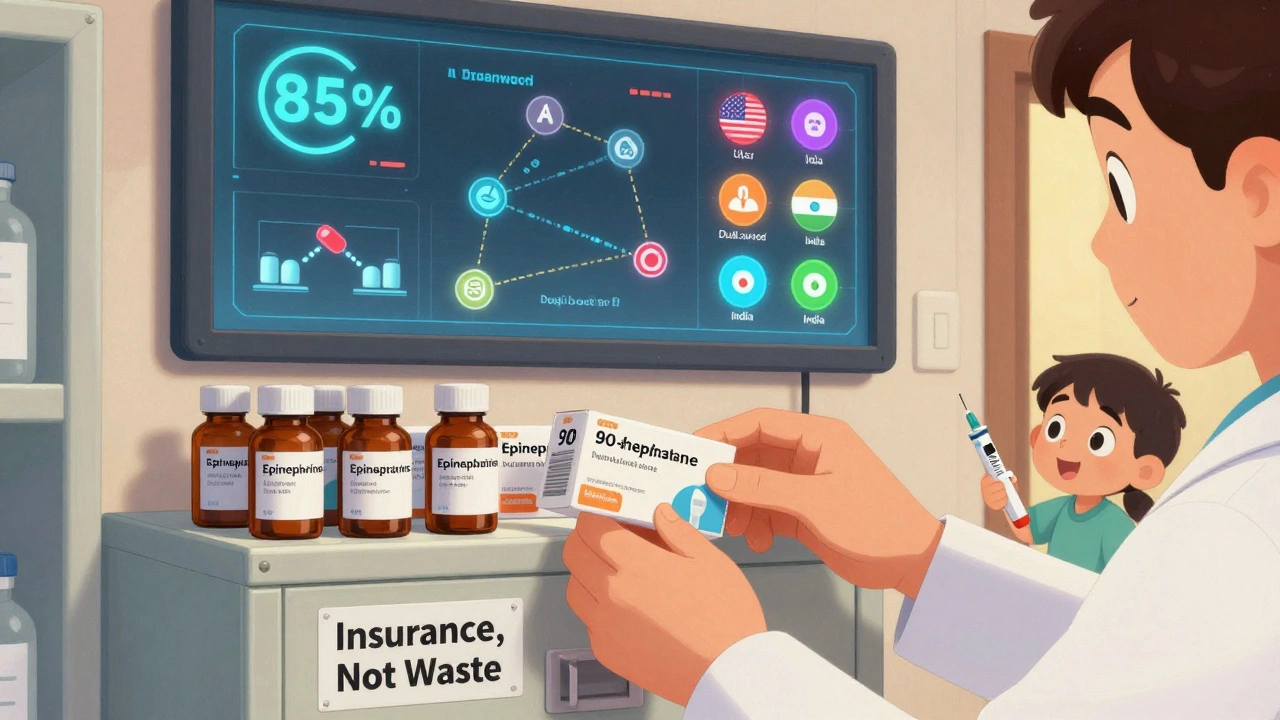
The Future Isn’t About One Solution
There’s no magic bullet. You can’t just tariff your way to security. You can’t just build more factories in the U.S. and call it done. The answer is layered:- Buffer stock for the most critical drugs
- Dual-sourcing for 70-80% of key components
- Regional manufacturing clusters across three continents
- Continuous manufacturing for high-volume, high-risk products
- AI-driven risk forecasting
- Blockchain traceability
What You Can Do Today
If you’re a pharmacist, hospital administrator, or policy maker, you don’t need to wait for corporate HQ or Congress to act.- Identify your top 10 most critical drugs. Check their suppliers. Are they all from one country?
- Ask your distributors: Do you have backup suppliers for these? How long would it take to switch?
- Push for 30-60 days of buffer stock for essential medications-especially injectables and antibiotics.
- Support local manufacturers. Even small domestic suppliers can be vital backups.
- Ask your pharmacy benefit manager: Are they incentivizing resilient sourcing, or just the cheapest bid?
What’s the biggest cause of drug shortages today?
The biggest cause is over-reliance on single-source suppliers, especially in China and India, combined with minimal inventory buffers. When a factory faces regulatory issues, natural disasters, or export restrictions, there’s no backup. The system was built to save money, not prevent shortages.
Is bringing drug manufacturing back to the U.S. the answer?
Not alone. Bringing all manufacturing home would raise drug prices by 20-30% and still leave gaps in capacity. The better approach is strategic domestic production for critical drugs-like sterile injectables and antibiotics-combined with diversified global sourcing. Resilience means having multiple options, not just one.
How long does it take to build a new pharmaceutical manufacturing facility?
Traditional facilities take 3 to 5 years. But new modular, container-based systems can be deployed in 12 to 18 months. These are smaller, scalable, and easier to regulate. They’re becoming the preferred option for building regional supply chain capacity.
What’s the role of AI in preventing drug shortages?
AI analyzes global data-weather, shipping delays, political unrest, supplier financial health-to predict disruptions 60 to 90 days in advance. This gives companies time to shift orders, activate backup suppliers, or increase inventory before a shortage hits. Early systems are already 85-90% accurate.
Why aren’t more companies doing this already?
Because resilience costs money upfront, and shortages feel distant. Many companies still optimize for short-term cost savings. Organizational silos, lack of data sharing, and regulatory uncertainty also slow progress. But large firms with comprehensive programs are already seeing a 1.8x return on investment within three years through avoided losses.
Can small pharmacies or hospitals make a difference?
Absolutely. Even small institutions can identify their top 5 critical drugs, ask distributors about backup suppliers, and request 30-60 days of buffer stock. They can also advocate for purchasing policies that prioritize resilient sourcing over the lowest price. Collective action from smaller players can shift market demand and push manufacturers to build better systems.



One comment
This isn't just about drugs. It's about who we are as a society. If we let people die because we chose cheap over reliable, we've already lost. No more excuses. Start stockpiling now.
lol why are we even talking about this like its a big deal. just print more pills bro. its not that hard. also why do we even need all these fancy ai thingys when we got like 3 guys in ohio who can fix anything with duct tape and a screwdriver 🤡
I work in a rural ER. Last month we ran out of epinephrine for 11 days. Parents were crying. Nurses were crying. We used expired vials because we had no choice. This isn't theory. This is blood on the floor. Start building buffers. Now. Not next fiscal quarter.
The structural vulnerability exposed here is profound. While technological solutions like AI forecasting and blockchain traceability offer promise, the true pivot lies in redefining value: shifting from cost-per-unit to survival-per-patient. The market must reward resilience, not just efficiency. Regulatory frameworks must incentivize redundancy, not penalize it.
Let's be real. This whole 'resilient supply chain' thing is just Big Pharma's cover for creating artificial scarcity so they can jack up prices. The FDA is in bed with the manufacturers. The 'strategic reserve'? A shell game. They want you to think they're helping while quietly monopolizing the market. 🤫💊
I’ve been in pharma logistics for 22 years. The system is broken because nobody owns the problem. Supply chain? Logistics? Regulatory? Finance? All siloed. The moment someone gets P&L responsibility for continuity-not just cost-you’ll see change. Until then? We’re just rearranging deck chairs.
YALL. I JUST STARTED A SMALL CLINIC AND I’M DOING THIS. I REACHED OUT TO 3 LOCAL SUPPLIERS. GOT 2 BACKUPS FOR MY TOP 5 DRUGS. ORDERED 60-DAY STOCK FOR INSULIN. IT COST ME $12K BUT I’M NOT WAITING FOR SOME CEO TO CARE 😭💖 #ResilienceIsPossible
You talk about dual-sourcing and buffer stock like it’s a moral imperative. But you ignore the root: capitalism. The system isn’t failing-it’s working exactly as designed. Profit over people. Efficiency over survival. You can’t fix a rotten foundation with duct tape and AI. We need to dismantle the model, not patch it. The next shortage won’t be fixed by more factories. It’ll be fixed when we stop treating medicine like a commodity.
India and China are not 'manufacturing hubs' they are US puppets. The whole pharma supply chain is controlled by CIA and NSA to keep us docile. You think they want you healthy? Nah. They want you buying insulin every month. The 'modular factories'? Just a distraction. Real solution: go off-grid. Make your own meds from herbs. I did. My blood pressure is normal now. 🌿🫁
Man, I read this whole thing and I just want to hug someone. This isn’t about supply chains. It’s about showing up for each other. The pharmacist who stays late. The nurse who finds a backup. The grandma who shares her extra insulin. That’s the real resilience. The tech? Cool. But it’s people who keep us alive. Thanks for writing this. I’m sharing it with my book club. 🤝❤️