

Fall Risk Medication Checker
Medication Fall Risk Assessment
This tool helps identify medications that may increase fall risk for older adults. Based on the American Geriatrics Society's guidelines, select medications you or your loved one is taking.
Select Medications
Check all medications currently taken that match the categories below:
Your Fall Risk Assessment
Recommended Actions
Every year, nearly one in three adults over 65 falls. For many, it’s not just a stumble-it’s a fracture, a hospital stay, or worse. And while poor balance, dim lighting, or loose rugs get all the attention, one of the biggest hidden dangers is something many seniors are taking every day: their medications.
Medications That Make Falls More Likely
It’s easy to assume that if a doctor prescribed it, it’s safe. But the truth is, some common drugs-especially when taken together-can turn a steady walk into a dangerous gamble. The American Geriatrics Society calls these fall risk-increasing drugs (FRIDs), and they’re behind up to 93% of fall-related injuries in older adults, according to a major 2013 meta-analysis.Here are the top drug classes linked to higher fall risk:
- Antidepressants - Both tricyclics (like amitriptyline) and SSRIs (like sertraline) can cause dizziness, low blood pressure, and slowed reaction time. Studies show they have the strongest link to falls among all medication classes.
- Benzodiazepines - Drugs like diazepam (Valium), lorazepam (Ativan), and alprazolam (Xanax) are prescribed for anxiety or sleep, but they linger in the body, causing daytime drowsiness and poor coordination. Long-term use-even for just a few months-can double fall risk.
- Sedative-hypnotics - Zolpidem (Ambien), eszopiclone (Lunesta), and zaleplon (Sonata) may help you fall asleep, but they can leave you groggy, confused, or even sleepwalking. The CDC warns these drugs are especially dangerous because people often don’t feel fully awake when they get up at night.
- Antipsychotics - Used for dementia-related behaviors, these drugs (like haloperidol or risperidone) can cause stiffness, tremors, and sudden drops in blood pressure. First-generation types carry the highest risk.
- Opioids - Painkillers like oxycodone or hydrocodone cause dizziness, confusion, and slow reflexes. The higher the dose, the greater the risk. High-potency opioids can increase fall risk by up to 80%.
- Diuretics and antihypertensives - Water pills and blood pressure meds can cause sudden drops in blood pressure when standing up, leading to lightheadedness or fainting. This is called orthostatic hypotension.
- NSAIDs - Ibuprofen and naproxen aren’t just for pain-they can interfere with blood pressure control and kidney function, indirectly increasing fall risk.
- Anticholinergics - Found in many over-the-counter sleep aids, bladder medications, and allergy pills, these drugs cause dry mouth, blurred vision, and mental fogginess. Many seniors don’t realize their daily allergy pill could be making them unsteady.
- Muscle relaxants - Baclofen, in particular, is strongly linked to falls. It causes deep sedation and weakens coordination more than other muscle relaxants.
Why This Is Worse Than You Think
Most people don’t take just one of these drugs. The average older adult in the U.S. takes four prescription medications. Nearly half take five or more. And when you stack them-say, an antidepressant, a benzodiazepine, and a diuretic-the risk doesn’t just add up. It multiplies.A 2023 JAMA Health Forum study found that 45% of older adults were taking at least one medication classified as “potentially inappropriate” for their age group. Many of these were prescribed years ago and never re-evaluated. People assume if it worked before, it’s still fine. But aging changes how your body processes drugs. Your liver and kidneys slow down. Your brain becomes more sensitive. What was safe at 70 can be dangerous at 80.
And here’s the quiet crisis: most seniors don’t know they’re at risk. A 2023 study in the Journal of Geriatric Physical Therapy found that 63% of older adults taking multiple fall-risk drugs had no idea their meds could make them fall. Only 15% ever brought it up with their doctor.
Real Stories Behind the Numbers
On Reddit, a caregiver named Jane shared that her 78-year-old mother fell three times in two months after starting Ambien. The third fall broke her hip. She needed surgery and never walked without a cane again. Another user on GoodRx, age 72, said after taking Xanax for anxiety for six months, she became so unsteady she installed grab bars in every room. “I didn’t think the anxiety medicine was the problem,” she wrote. “I thought I was just getting older.” These aren’t rare cases. The CDC estimates that nearly 36,000 older Americans die each year from falls-and many of those deaths are tied to medications. The financial toll is just as heavy: medication-related falls cost the U.S. healthcare system $11 billion annually.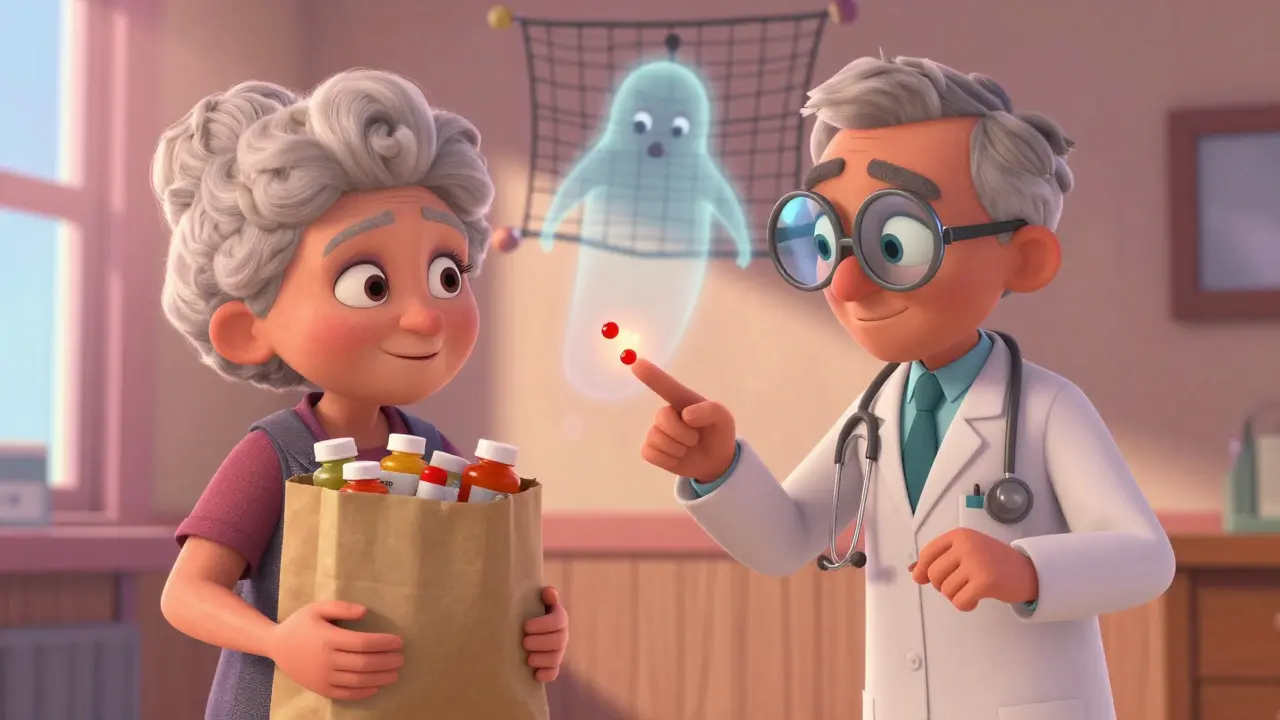
What You Can Do: The STOP, SWITCH, REDUCE Plan
The CDC’s STEADI program gives a clear, practical roadmap: STOP, SWITCH, REDUCE.- STOP - Ask your doctor: “Is this medication still necessary?” Many prescriptions are never reviewed after they’re started. A 2024 study showed that 40% of seniors are still taking medications they no longer need.
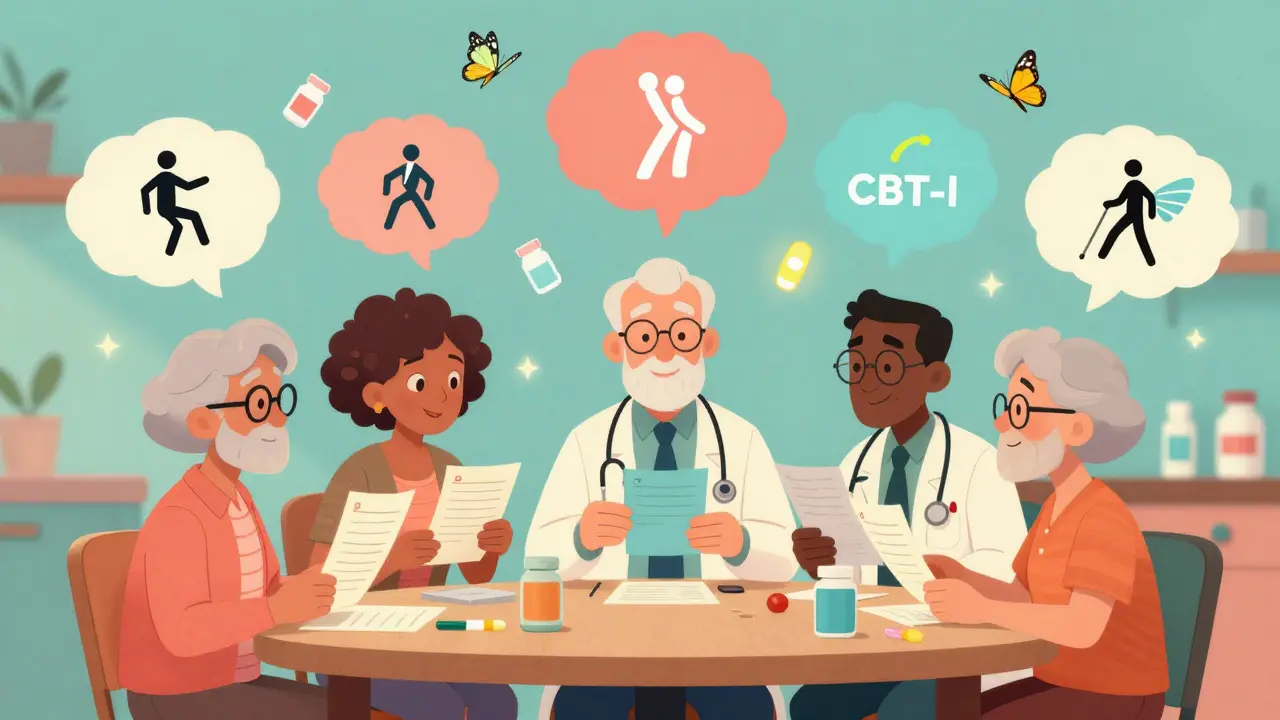
- SWITCH - If a drug is risky, ask if there’s a safer alternative. For insomnia, cognitive behavioral therapy (CBT-I) works better than sleep pills and has no fall risk. For anxiety, non-benzodiazepine options like buspirone carry less risk.
- REDUCE - Sometimes, lowering the dose helps. For benzodiazepines, tapering slowly over 8-12 weeks reduces withdrawal and keeps you safer. Never stop cold turkey.
Bring all your meds to every appointment-prescription, over-the-counter, vitamins, and herbal supplements. Use the “brown bag method.” Many people don’t realize their daily antihistamine or sleep aid is part of the problem.
Who Should Be Involved
This isn’t just your doctor’s job. Pharmacists are key. A CDC study found that when pharmacists lead medication reviews, fall risk drops by 22%. They catch interactions doctors miss. They know which drugs are outdated or dangerous for seniors.Geriatricians specialize in this. If your doctor doesn’t regularly treat older adults, consider asking for a referral. The American Geriatrics Society reports a 35% increase in geriatric consultations between 2018 and 2023-more people are realizing this is a solvable problem.
What’s Changing for the Better
Medicare Part D now penalizes doctors who overprescribe high-risk meds to seniors. That’s pushing change at the system level.New tools are emerging, too. AI-powered systems can now scan a patient’s full medication list and flag dangerous combinations with 89% accuracy. In 2024, the American Geriatrics Society updated its Beers Criteria to include newer drugs and their fall risks. And the National Institute on Aging has invested $15 million into research on safe ways to stop unnecessary medications.
Some safer alternatives are available-like non-benzodiazepine anxiolytics-but they’re expensive. A month’s supply can cost $450, compared to $30 for a generic benzodiazepine. That’s a barrier, but safety should come before cost when balance and independence are on the line.
Don’t Wait for a Fall
Falls aren’t accidents. They’re warning signs. If you or someone you love is over 65 and taking any of these medications, don’t assume it’s normal to feel dizzy or unsteady. That’s not aging-that’s a side effect.Start the conversation. Ask your doctor: “Could any of my medications be making me more likely to fall?” Bring your brown bag. Get a pharmacist’s opinion. Consider a medication review.
It’s not about cutting all meds. It’s about keeping only what’s truly necessary-and replacing the risky ones with safer options. That’s how you protect not just your body, but your freedom to live independently, safely, and without fear.



One comment
Wow, this is eye-opening-I had no idea my dad’s nightly Ambien was putting him at risk like this! He’s been on it for years, and we just thought he was getting ‘clumsy with age.’ I’m bringing his whole med list to his next appointment tomorrow. Thanks for laying this out so clearly!
It’s statistically indefensible that physicians continue prescribing benzodiazepines to geriatric populations without mandatory polypharmacy reviews. The Beers Criteria have been updated since 2019, yet 78% of primary care providers in India still default to prescribing lorazepam for insomnia. This isn’t medical care-it’s institutional negligence.
My grandma took five meds for years and never questioned any of them. She fell once and broke her wrist. We didn’t connect the dots until her pharmacist flagged three of them as high-risk. Now she’s on CBT-I for sleep and gabapentin for nerve pain instead of the old stuff. She walks better than she has in a decade. It’s not about stopping meds-it’s about swapping them right.
Wait-so over-the-counter sleep aids with diphenhydramine are anticholinergics? That’s wild. I’ve been giving my mom Benadryl for allergies and sleep because it’s ‘natural.’ Are you telling me that’s actually making her more likely to fall? I need to check her cabinet right now.
People think aging means slowing down. But if your medicine is making you dizzy, that’s not aging-that’s poison in a pill. I saw my uncle walk like a drunk man after starting Xanax. He said he felt ‘calm.’ But calm shouldn’t mean falling down the stairs. We need to stop romanticizing pills as comfort.
My aunt just got her meds reviewed by a geriatric pharmacist last month. They cut out two things she’d been on since 2010. She says she feels like a new person-no more ‘brain fog’ and she’s not afraid to walk to the mailbox anymore. Why isn’t this standard? Why do we wait for a fall to act?
THIS IS A MASSACRE. Doctors are killing our grandparents with prescriptions. My mom’s doctor gave her three fall-risk drugs at once and said ‘it’s fine, you’re fine.’ She fell. Broke her pelvis. Now she’s in a nursing home. And the doctor? Still prescribing the same crap to others. Someone needs to sue. Someone needs to burn this system down.
I never realized my mom’s ibuprofen was part of the problem. She takes it daily for arthritis. I thought it was harmless. Now I’m checking every single thing she’s on-even the herbal stuff. I’m making a list. Brown bag day is coming.
Just shared this with my mom’s whole family 😢❤️ We’re all bringing our meds to the next family dinner and having a ‘meds chat.’ No shame. Just safety. 💊🪑👵👴 #MedicationReview #DontWaitForAFall
Let’s be honest: this isn’t about medication safety. It’s about the pharmaceutical industry’s failure to fund non-drug alternatives. CBT-I costs $450 a month? That’s a scam. The real issue is profit-driven medicine. If a $30 pill keeps people dependent, why would they push a $450 therapy? This isn’t healthcare-it’s a business model.
While the data presented is compelling, one must consider the broader context of Western medical over-reliance on pharmacological intervention. In the United Kingdom, we have long-standing guidelines from NICE that emphasize non-pharmacological interventions for elderly patients. The failure to implement similar protocols in the U.S. reflects a systemic deficiency in preventive geriatric care.
There’s a quiet dignity in aging well. But we’ve replaced that with a culture of quick fixes. A pill for sleep. A pill for anxiety. A pill for pain. We’ve forgotten that sometimes, the most powerful medicine is time, patience, and a conversation with someone who truly listens. Maybe the real cure isn’t in the bottle-it’s in the asking.