

Imagine you start a new medication and feel terrible two days later. Is it just your body adjusting, or is your immune system attacking the drug? This confusion is more common than you might think, and it has real consequences. According to the CDC's Medication Safety program, adverse drug events account for approximately 1.3 million emergency department visits annually in the United States alone. The problem isn't just that these reactions happen; it's that patients often don't know how to describe them accurately to their care team. When you mix up a side effect with an allergy, doctors may keep you off a medication that would have worked perfectly, leading to less effective treatments and higher costs.
The good news? You can fix this with better communication. By learning the specific differences between these two types of reactions and using structured ways to report your symptoms, you become a much more effective partner in your own health. Here’s how to make sure your doctor hears exactly what you need to say.
Understanding the Core Difference
To talk effectively, you first need to understand what you’re dealing with. Side effects and allergic reactions are physiologically different beasts, even if they both make you feel bad.
Side Effects are predictable, dose-related responses to medications that occur in 5-20% of patients taking common drugs like statins or antibiotics. They are essentially the price of admission for the medication working. For example, gastrointestinal upset from NSAIDs affects 15-30% of users, while drowsiness from first-generation antihistamines like diphenhydramine hits 50-60% of people. These effects usually show up within hours to days of starting the med and often fade as your body adjusts. In fact, 60-70% of initial side effects resolve within 2-4 weeks.
Allergic Reactions are immune system activations that can occur at any dose and affect 7-10% of the population. These are unpredictable. Your immune system mistakes the drug for a threat and attacks it. Symptoms typically appear within minutes to hours and include hives, swelling, or potentially life-threatening anaphylaxis. Unlike side effects, true allergies require immediate discontinuation and permanent avoidance of that specific drug class.
| Feature | Side Effect | Allergic Reaction |
|---|---|---|
| Mechanism | Predictable physiological response | Immune system activation |
| Timing | Hours to days after starting | Minutes to hours after exposure |
| Dose Relationship | Often dose-dependent | Can happen at any dose |
| Common Symptoms | Nausea, dizziness, fatigue | Hives, swelling, breathing issues |
| Resolution | Often improves with time (2-4 weeks) | Requires stopping the medication |
| Prevalence | 5-20% of users | 7-10% of population |
Why does this distinction matter so much? Dr. Clifford Bassett, Medical Director of Allergy & Asthma Care of New York, notes that confusing the two leads to unnecessary avoidance of effective medications. For instance, penicillin allergy labels cause patients to receive 63% more broad-spectrum antibiotics, which increases antibiotic resistance risks. If you tell your doctor you're "allergic" to amoxicillin because it gave you a stomach ache once, they might prescribe a stronger, less targeted antibiotic next time you have an infection.
Why Miscommunication Happens
You’re not alone if you’ve ever felt unsure about whether to call your doctor. A Kaiser Permanente patient survey conducted in Q2 2023 found that 52% of patients delayed reporting symptoms due to uncertainty about whether they should contact their provider. On average, people waited 5.7 days to report side effects but only 1.2 days for suspected allergic reactions. That gap shows we instinctively know allergies are urgent, but we hesitate on side effects, thinking maybe we should just tough it out.
This hesitation creates a feedback loop. Pharmacists at the University of California San Francisco Medical Center found that patients incorrectly label 70% of medication intolerances as allergies. Why? Because “allergy” sounds more serious and gets a faster response from providers. But this mislabeling leads to suboptimal treatment choices. If your medical chart says you have a penicillin allergy when you actually just had diarrhea, every future provider will avoid penicillins, limiting your options unnecessarily.
There’s also a memory factor. Dr. Jennifer Le, Professor of Clinical Pharmacy at the University of California San Diego, published research in 2021 showing that patients who brought written symptom logs to appointments reduced miscommunication by 37% compared to those relying on memory alone. Our brains are bad at recalling exact timelines and severity levels, especially when we’re feeling unwell. Without data, we guess. And guesses lead to errors.
How to Prepare for Your Appointment
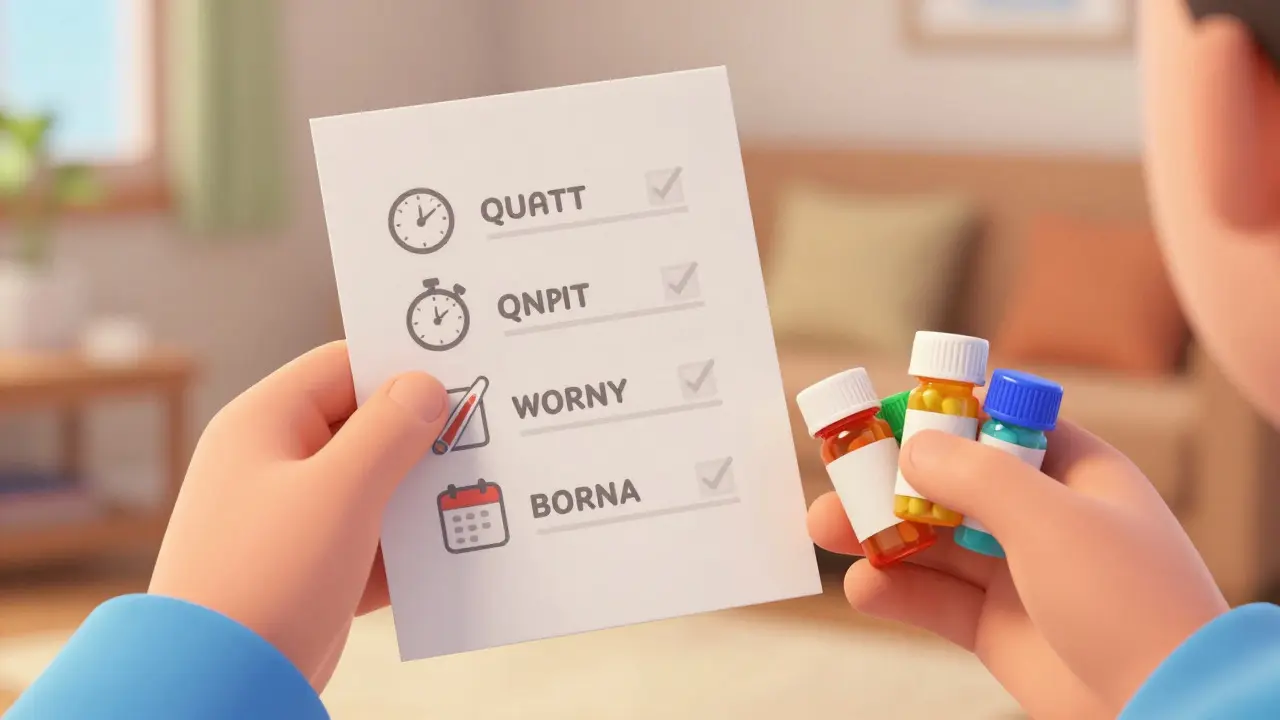
Don’t walk into your appointment hoping to remember everything. Preparation is key. The APG Health guide recommends creating a simple symptom log. You don’t need fancy software-just a notebook or a note in your phone. Track four things:
- Medication Timing: When did you take the dose?
- Symptom Onset: How long after taking it did you feel sick?
- Severity: Rate it from 1 to 10.
- Duration: How long did it last?
Patients who track symptoms for 72 hours before appointments are 3.2 times more likely to receive appropriate medication adjustments, according to APG Health’s analysis of 1,200 patient encounters. This isn’t about being obsessive; it’s about giving your doctor the data they need to make a quick, accurate decision.
Also, bring all your medication bottles to the appointment. UCLA Health’s 2022 protocol found that physical verification of medications reduces communication errors by 28% compared to verbal descriptions alone. It’s easy to misremember a brand name or dosage, but the bottle doesn’t lie. Seeing the actual pill helps your pharmacist or doctor identify potential interactions or look up specific side effect profiles instantly.
Questions to Ask Your Care Team
When you sit down with your doctor or pharmacist, use specific language. Vague statements like “I feel weird” don’t help. Instead, try these questions based on guidelines from Harvard Health and the American Liver Foundation:
- “What are the most common side effects of this medication?” Ask specifically about effects occurring in more than 10% of users. This sets expectations. If nausea is listed as a common side effect, you won’t panic when it happens-you’ll know it’s likely temporary.
- “What symptoms would indicate a true allergic reaction requiring immediate discontinuation?” Get clear red flags. Usually, this includes hives, facial swelling, or difficulty breathing. Knowing the difference keeps you safe without overreacting to minor discomforts.
- “Is this symptom a known side effect or could it be an allergic reaction?” Bring up your specific issue. For example: “I got a mild rash two days after starting this. Is that typical for this drug, or should I worry about an allergy?”
- “Are there alternative medications in different chemical classes that might avoid this issue?” If a side effect is bothersome but not dangerous, ask if switching to a similar drug with a different profile is an option. This opens up solutions rather than just ending the conversation.
Dr. Adriane Fugh-Berman, Professor of Pharmacology at Georgetown University Medical Center, emphasizes that distinguishing between bothersome but expected effects versus true allergic reactions is crucial. Patients who accurately describe their symptoms reduce mislabeling by 45%. So, be precise. Say “nausea” instead of “stomach trouble.” Say “mild headache” instead of “head hurts.” Specificity saves time and prevents errors.
Using Structured Reporting Methods
If you want to sound professional and ensure nothing gets missed, try the S.O.A.P. documentation method recommended by the CDC’s Medication Safety program. It stands for Subjective, Objective, Assessment, and Plan. Here’s how to apply it to your medication concerns:
- Subjective: Describe what you feel. “I feel dizzy and my heart is racing.”
- Objective: Include measurable facts. “It started 30 minutes after taking my 10mg dose. My blood pressure was 150/90.”
- Assessment: Offer your best guess based on timing. “Since it happened quickly, I’m worried it might be an allergy, but it didn’t involve hives.”
- Plan: State what you want to happen. “Should I stop taking it until we speak, or continue and monitor?”
A Johns Hopkins study in 2023 showed this approach improves provider understanding by 41%. It turns a chaotic story into a clear clinical picture. Even if you don’t write it all down, mentally organizing your thoughts this way helps you speak more clearly during the appointment.
Pharmacists at Mayo Clinic report that patients who specify “I experienced [symptom] within [timeframe] after taking [dose] of [medication]” receive accurate assessments 89% of the time. Compare that to 52% when descriptions lack these specific elements. The difference is huge. One sentence structure can nearly double the accuracy of your diagnosis.

The Cost of Getting It Wrong
This isn’t just about comfort; it’s about money and public health. A 2023 analysis by the Institute for Safe Medication Practices found that incorrect allergy labeling increases healthcare costs by $1,200 to $2,500 per patient annually. Why? Because alternative medications are often more expensive, require more monitoring, or are less effective, leading to longer hospital stays or additional tests.
There’s also a broader impact on antibiotic resistance. Research published in the Journal of General Internal Medicine in August 2023 demonstrated that structured patient-provider communication about medication responses reduced unnecessary antibiotic use by 27% in primary care settings. When patients correctly identify side effects instead of allergies, doctors are less likely to switch to broader-spectrum antibiotics. This directly addresses antimicrobial resistance concerns highlighted by the World Health Organization.
So, when you clarify your reaction type, you’re not just helping yourself. You’re contributing to a healthier healthcare system and saving money for everyone involved.
Tools to Help You Keep Track
You don’t have to do this entirely manually anymore. The American Pharmacists Association launched the 'Medication Reaction Tracker' mobile app in January 2023. It has been downloaded over 87,000 times and guides users through distinguishing side effects from allergies using validated clinical criteria. It’s a free resource that walks you through the right questions to ask yourself before calling your doctor.
Additionally, the FDA’s 2023 Drug Safety Communication initiative now requires patient medication guides to clearly differentiate between common side effects (occurring in >1% of users) and allergic reaction symptoms requiring immediate attention. This affects over 1,200 prescription medications. So, read the insert that comes with your new meds. Look for the section titled “Adverse Reactions” or “Allergic Reactions.” They are separate lists for a reason.
Frequently Asked Questions
How soon should I report a possible side effect?
For side effects that are mild and expected (like mild nausea), you can wait a few days to see if they improve, but track them closely. For any symptom that feels severe, persistent, or unusual, call your provider within 24-48 hours. For suspected allergic reactions involving hives, swelling, or breathing issues, seek immediate medical attention.
Can a side effect turn into an allergy?
Not typically. Side effects are predictable responses to the drug itself. Allergies are immune responses. However, if you stop a medication due to a side effect and restart it later, you might experience the side effect again. If you develop new symptoms like hives or swelling upon re-exposure, that could indicate a developing allergy, so consult your doctor immediately.
What if my doctor thinks it’s an allergy but I think it’s a side effect?
Bring your symptom log and specific timeline. Ask for a referral to an allergist for testing if the stakes are high (e.g., penicillin). Studies show that 90% of patients who believe they have penicillin allergies can safely take the medication after proper evaluation. Don’t let a vague label limit your treatment options forever.
Do I need to tell every new doctor about old side effects?
Yes, but be specific. Instead of saying “I have lots of allergies,” say “I had nausea with Metformin but tolerated it after two weeks.” This distinction helps the new doctor decide if the medication is still an option for you. Accurate history prevents unnecessary changes in your treatment plan.
Is it worth getting tested for drug allergies?
If the medication is critical for your health (like penicillin for infections), yes. Testing can remove false allergy labels and expand your treatment options. For less critical drugs, simply avoiding the specific agent might be enough. Discuss the cost-benefit with your specialist.




One comment
It is, however, worth noting that the distinction between a pharmacological side effect and an immunological hypersensitivity reaction is, strictly speaking, quite binary in its clinical definition. One is predictable; the other is not. To conflate the two is to invite unnecessary therapeutic inertia. We must be precise. Precision saves lives. Or at least prevents the inconvenience of switching prescriptions needlessly. Do not be lazy with your vocabulary. Use the correct terms. It shows respect for the science.
Chill. Just write down when you took the pill and how you felt. That's it. No conspiracy needed. If you feel weird, note it down. If you break out in hives, call 911. Simple as that.
oh so we're supposed to trust the doctor who barely looks at us for 5 minutes to distinguish between a rash from a new laundry detergent and a penicillin allergy? great plan
i agree with the logging idea. i did this last year for my blood pressure meds and it helped so much. just keep it simple. dont overthink it. its just notes.
This is a very useful framework. In my experience working in community health, patients often hesitate to report minor issues because they fear being judged as 'difficult.' The S.O.A.P. method simplifies this by giving them a script. It empowers them without requiring medical jargon. I would recommend adding a column for 'Mood' as well, since anxiety can sometimes mimic physical symptoms of drug reactions. A holistic view is always better.
YES! Finally someone says it! Stop letting doctors guess! I had a 'penicillin allergy' label for 20 years until I got tested. It was just diarrhea! Now I take amoxicillin like a champ. Get tested people! Don't let a bad memory ruin your healthcare options. This article is gold. Share it everywhere!
Oh, you think tracking symptoms is hard? Wait until you try explaining to your insurance company why you need a specialist referral. They will deny it. They always do. I spent three months getting approval for a simple allergy test. My therapist said I'm too emotional about it. Well, maybe I am. Because the system is broken. And these little apps? They are just another way for corporations to sell our data. Wake up. The real enemy isn't the medication, it's the bureaucracy. Don't let them gaslight you into thinking a notebook solves everything. It doesn't. Nothing does. But at least you'll feel better writing it down. Probably. Maybe. Who knows?
The pharmacokinetic profile of most small molecule therapeutics suggests that idiosyncratic reactions are statistically negligible compared to dose-dependent toxicity. Yet, the prevailing narrative insists on an immune-mediated etiology for almost any adverse event. This is epistemically lazy. Unless one has undergone specific IgE testing or a graded challenge protocol, labeling a reaction as 'allergic' is speculative at best. The burden of proof should lie with the patient to demonstrate immunologic engagement, not the provider to assume it based on anecdotal recall. Until then, we remain in a state of diagnostic ambiguity that serves no one but the malpractice attorneys.
Good tips. I am from Canada. Here we also use electronic records. But paper is good too. Bring your bottles. It helps the pharmacist. Simple advice works best. Thank you for sharing.