
When you're taking an ACE inhibitor like lisinopril or enalapril to control your blood pressure, you might not think twice about eating a banana or a baked potato. But here’s the thing: those foods could be quietly raising your potassium levels - and that’s not always safe.
Why ACE Inhibitors Make Potassium Build Up
ACE inhibitors work by blocking a hormone that tightens blood vessels. That helps lower blood pressure. But there’s a side effect you probably haven’t heard much about: they mess with how your kidneys handle potassium. Normally, your kidneys flush out extra potassium through urine. But when you’re on an ACE inhibitor, your body holds onto more of it. That’s because these drugs reduce aldosterone, a hormone that tells your kidneys to let potassium go.This isn’t a problem for everyone. If your kidneys are healthy, your body usually manages the extra potassium fine. But if you have diabetes, chronic kidney disease, or are over 65, your kidneys don’t work as well. That’s when dietary potassium starts adding up. Studies show that patients with stage 3 or 4 kidney disease have a 12.7% annual risk of dangerous high potassium levels - over 10 times higher than those with normal kidney function.
What Counts as a High-Potassium Food?
You don’t need to avoid all fruits and veggies. But some foods pack a serious potassium punch. Here’s what to watch out for:- Bananas: One medium banana has about 326 mg of potassium
- Avocados: Half an avocado contains around 507 mg
- White potatoes: One medium baked potato has 379 mg - sweet potatoes are even higher at 670 mg per 100g
- Tomatoes and tomato products: Tomato sauce, paste, and juice are loaded - 193 mg per 100g, but you usually eat more than that
- Dried fruits: Apricots, raisins, and prunes are concentrated sources
- Salt substitutes: Products like Nu-Salt contain 525 mg of potassium in just 1.25 grams - a tiny pinch can add up fast
- Coconut water: One cup can have over 1,500 mg of potassium - more than four bananas
That’s not a no-go list. It’s a caution list. You can still eat these foods - but you need to be smart about how much and how often.
How Much Is Too Much?
The average adult needs about 2,600-3,400 mg of potassium daily for good health. But if you’re on an ACE inhibitor, especially with kidney issues, even normal amounts can become risky. Research shows that eating a single high-potassium meal - say, a baked potato with tomato sauce and a banana - can spike your blood potassium by 0.3 to 0.8 mmol/L within just a few hours.Doctors consider serum potassium above 5.0 mmol/L to be high. Above 6.0 mmol/L? That’s an emergency. Symptoms can be subtle at first: muscle weakness, nausea, irregular heartbeat, or just feeling off. But without treatment, it can lead to cardiac arrest.
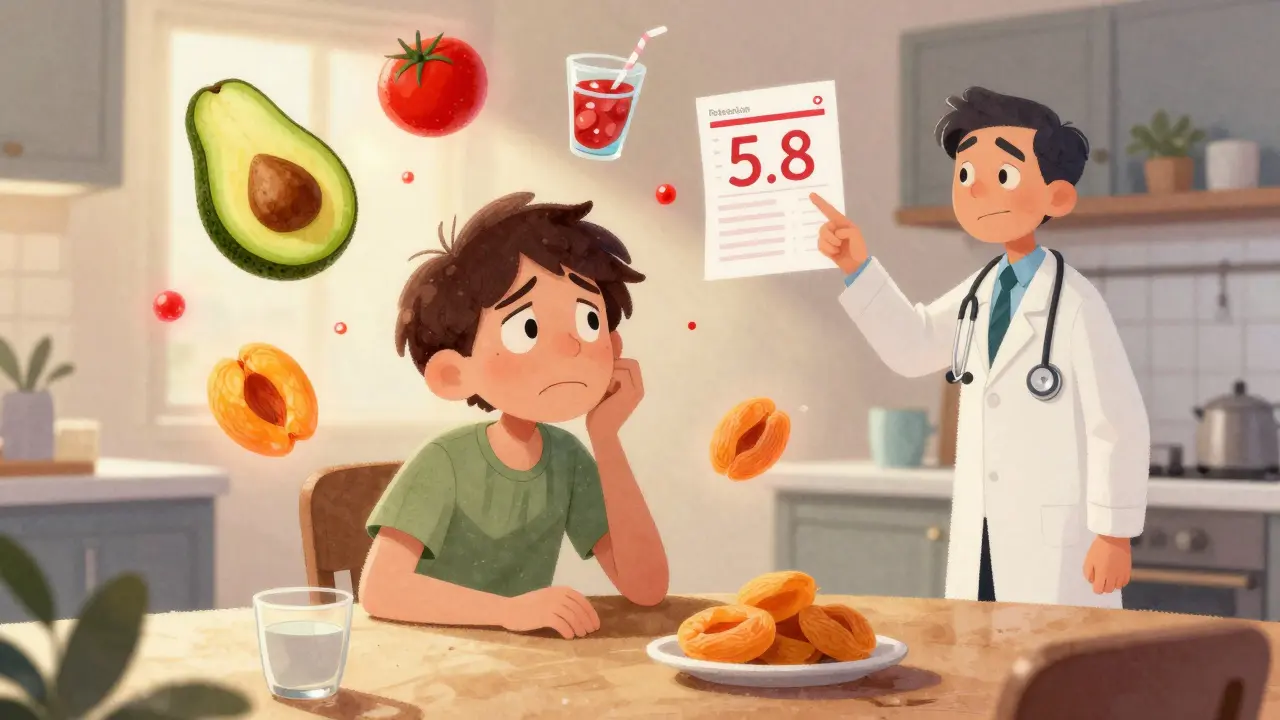
Here’s the catch: many people don’t know they’re at risk. A patient on Drugs.com reported their potassium shot up to 5.8 after eating two bananas a day - and their doctor never mentioned it. That’s not unusual. Many providers assume patients know the risks. They don’t.
Who’s Most at Risk?
Not everyone on ACE inhibitors needs to change their diet. Risk depends on three big factors:- Kidney function: If your eGFR is below 60, you’re in the high-risk group. About half of people over 65 have some kidney decline.
- Diabetes: Diabetics on ACE inhibitors have over three times the risk of hyperkalemia compared to non-diabetics.
- Other meds: Taking a potassium-sparing diuretic like spironolactone or eplerenone with an ACE inhibitor? Your risk jumps by 300-400%.
Even if you’re young and healthy, if you’re on multiple medications or have a history of heart failure, don’t assume you’re safe. A 2023 study found that people with a certain genetic variation (WNK1 gene) are five times more likely to develop high potassium on ACE inhibitors - even with normal kidneys.
What About Other Blood Pressure Meds?
Not all blood pressure drugs act the same. ACE inhibitors have about 2.3 times the risk of causing hyperkalemia compared to ARBs (like losartan or valsartan). ARBs still carry risk - about 60% of ACE inhibitor levels - but they’re often preferred for people with borderline kidney function.Calcium channel blockers and thiazide diuretics actually lower potassium. If you’re struggling with high potassium, your doctor might consider switching you - but only if your blood pressure stays controlled.
When to Eat Potassium-Rich Foods
Timing matters. A 2021 study found that eating high-potassium foods two hours before or after taking your ACE inhibitor reduces the peak potassium spike by about 25%. That’s a simple trick that doesn’t require cutting out foods - just spreading them out.Also, don’t crush your pills or take them with a potassium-rich smoothie. Take them with water, and wait a couple of hours before having your avocado toast.
Monitoring Is Key
You can’t feel high potassium. That’s why blood tests are non-negotiable.- Get a baseline potassium test before starting an ACE inhibitor
- Test again at 1-2 weeks after starting or changing the dose
- If your levels are normal and your kidneys are fine, check every 3-6 months
- If you have kidney disease or diabetes, get tested every month
Many people skip these tests because they feel fine. That’s exactly when things can go wrong. Remote monitoring programs - where you get a simple blood test at a local lab and your results are sent directly to your doctor - have cut hospitalizations by 28% in recent studies.
What About Potassium-Binding Medications?
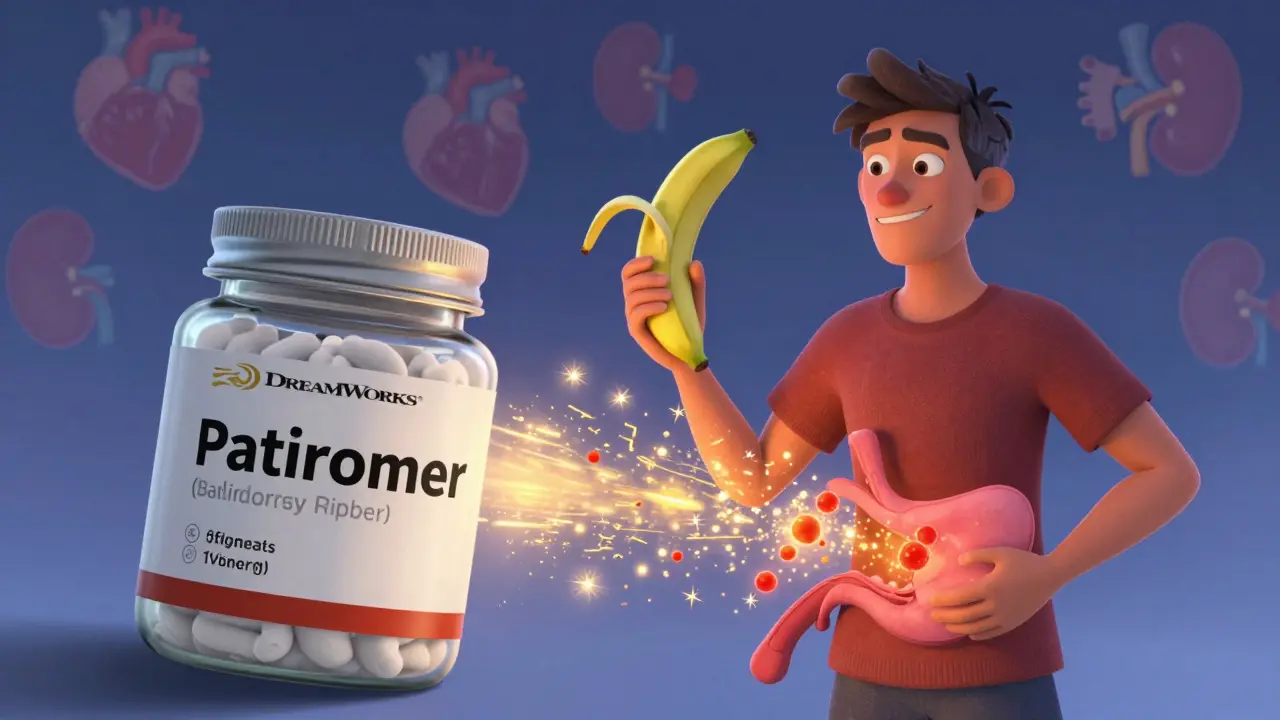
If you’ve had a high potassium episode and your doctor still wants you on an ACE inhibitor, there’s a solution: patiromer (Veltassa). It’s a powder you mix with water that binds potassium in your gut so it doesn’t get absorbed. Clinical trials show it lets 89% of patients stay on their ACE inhibitor without needing to cut out healthy foods.It’s not cheap, and it’s not for everyone. But for people with heart failure or diabetic kidney disease who can’t switch meds, it’s a game-changer.
Don’t Cut Out Potassium Completely
Here’s the twist: avoiding potassium-rich foods isn’t always the answer. A 2016 study in the Journal of the American College of Cardiology found that people on ACE inhibitors who ate 3,400-4,700 mg of potassium daily - the recommended amount for heart health - didn’t develop hyperkalemia if their kidneys were working normally.Potassium helps lower blood pressure, reduces stroke risk, and protects your bones. Cutting it out too much can hurt more than help. The goal isn’t zero potassium. It’s balance.
Focus on portion control. One banana a day? Probably fine. Two? Maybe not. A sweet potato for dinner and tomato sauce on pasta? Watch it. Skip the salt substitute. Drink water, not coconut water, unless your doctor says it’s safe.
Bottom Line: Know Your Risk, Check Your Levels
ACE inhibitors save lives. But they need careful management. You don’t need to live in fear of your groceries. You need to know your numbers.If you’re on an ACE inhibitor:
- Ask your doctor if your kidney function is normal
- Get your potassium checked - don’t wait until you feel sick
- Track how much potassium you’re eating, especially if you have diabetes or kidney disease
- Don’t use salt substitutes without talking to your doctor
- Spread out high-potassium foods - don’t eat them all at once
There’s no one-size-fits-all rule. But if you’re proactive, you can stay on your medication - and still enjoy your food.

One comment
So I just realized I’ve been eating avocado toast every morning with a banana on the side… and I’m on lisinopril. 😅
Guess I’m switching to oatmeal. Not because I’m scared, but because I don’t want my heart to throw a surprise party without me.
Also, coconut water? I thought it was healthy. Turns out it’s basically potassium juice. Who knew?
Thanks for the wake-up call. I’m getting my blood checked next week.
Also, I’m gonna start timing my meals around my meds. Like a little potassium ballet. 🕺
People still don’t read the damn pamphlets that come with their prescriptions? Seriously?
It’s not rocket science. If you’re on an ACE inhibitor and you’re eating like you’re on a tropical vacation, of course your potassium’s gonna spike.
Stop blaming doctors. Start reading. Or at least Google it before you post about it on Reddit.
And no, ‘I felt fine’ isn’t a medical excuse. You don’t feel a heart attack coming either, until it’s too late.
I didn’t know any of this. My grandma’s on this med and she loves her sweet potatoes. Now I’m gonna tell her to eat ’em one at a time and not all in one meal.
Also, she’s 72 and has diabetes. This is scary. Thanks for explaining it simple.
Just wanted to say you made me care. That’s a lot.
in india we eat a lot of bananas and potatoes and we don’t die
maybe your doctors are too scared to let you eat anything
we have real food here not this fear based dieting
also my uncle on blood pressure medicine eats 3 bananas a day and he’s fine
maybe your kidneys are weak not the food
It’s so sad how we’ve turned medicine into a game of Russian roulette with our groceries.
You take a pill to live longer… and then you’re told not to eat the things that make life worth living.
It’s not just about potassium-it’s about autonomy.
Why do we have to be punished for enjoying food?
And why do we assume everyone’s body is a broken machine that needs constant correction?
Maybe the real problem is that we’ve outsourced our health to pills and panic.
Just saying. 🤷♀️
OMG I just ate a baked potato with butter and sour cream like 20 minutes after taking my pill 😳
Should I panic? Should I go to the ER? Is my heart gonna explode?
Also, what’s patiromer? Sounds like a spaceship.
And why does everyone keep saying ‘your doctor should’ve told you’? My doctor talks for 3 minutes and then hands me a prescription.
Who’s supposed to be the adult here?
Okay but coconut water = 4 bananas??? 🤯
That’s wild. I thought it was like, hydrating and pure and stuff.
Also, I didn’t know salt substitutes had potassium. I use them because I’m trying to cut sodium.
So now I’m confused. Do I go back to regular salt? 😅
Also, I’m getting tested next week. I’m scared but also… kinda proud I’m finally doing this.
Thanks for the info. 🙏❤️
Western medicine always overcomplicates everything
in india we eat banana with milk every day since childhood
no one dies
your doctors are scared of lawsuits not science
you are afraid of food not medicine
stop listening to fear
eat your food
My dad’s on lisinopril and he’s 74 with diabetes. We started tracking his potassium after he had a scare last year.
He still eats his sweet potatoes - just one, not two.
And he waits 3 hours after his pill.
He also drinks water, not coconut water. 🤓
It’s not about giving things up. It’s about being smart.
And yeah, he gets his labs every month. No excuses.
He’s still alive. Still cooking. Still eating. Just… better.
I’m a nurse and I see this all the time.
Patients think ‘natural’ means ‘safe’ - but potassium isn’t a vitamin you can just take more of.
And honestly? Most people don’t know how to read a lab result.
I always tell them: if your potassium’s above 5.0, you’re playing with fire.
But if you’re careful? You can still have your banana.
Just not with your coffee and your salt substitute.
Small changes. Big difference.
This is the kind of post that should be required reading for anyone prescribed an ACE inhibitor.
Not just a pamphlet tucked in a bag - a real, clear, compassionate explanation.
And thank you for not scaring people into never eating fruit again.
Balance isn’t deprivation. It’s awareness.
Also, the timing trick? Genius. I’m going to try that tomorrow.
And yes - I’m scheduling my potassium check. No more ‘I feel fine.’
You’ve done a real service here.