Dependence vs. Addiction: Self-Assessment Tool
Disclaimer: This tool is for educational purposes only and does not provide a medical diagnosis. It is designed to illustrate the concepts discussed in the article regarding Physical Dependence versus Opioid Use Disorder (OUD). Always consult a healthcare professional for medical advice.
Symptoms Check: Stopping Medication
Select any symptoms you are experiencing after stopping or reducing your dose:
Behavioral Check: Usage Patterns
Select behaviors that apply to you over the last 12 months:
You take your prescribed pain medication exactly as directed. You feel better. But then you stop taking it for a day, and suddenly you feel terrible-sweating, anxious, and nauseous. Your first thought might be, "I’m addicted." It’s a scary realization, but here is the truth that many doctors still struggle to communicate clearly: feeling sick when you stop a medication does not automatically mean you have an addiction. It means your body has become physically dependent on it.
Confusing physical dependence with addiction creates unnecessary fear, stigma, and often leads people to stop life-saving treatments prematurely. The distinction between these two states is critical for anyone managing chronic pain or recovering from surgery. Understanding where the line lies can change how you view your treatment, reduce anxiety, and help you make safer decisions about your health.
The Biological Reality of Physical Dependence
Physical dependence is a normal physiological adaptation that occurs when the body adjusts to the repeated presence of a substance. Think of it like moving to a new time zone. When you travel across several time zones, your internal clock gets out of sync. You feel tired, confused, and maybe a bit sick until your body adjusts to the new schedule. If you fly back home immediately, you get jet lag again. That discomfort isn’t a disease; it’s just your body reacting to a sudden change in environment.
Opioids work by binding to mu-opioid receptors in the brain, specifically in an area called the locus ceruleus, which regulates stress and autonomic functions like heart rate and breathing. When opioids are present constantly, they inhibit norepinephrine release. To compensate, the brain increases its own excitability and signaling pathways (like cAMP) to maintain balance. This creates a new baseline for your nervous system.
If you abruptly remove the opioid, that compensatory mechanism is left unchecked. The result is withdrawal. According to data from the Clinical Opiate Withdrawal Scale (COWS), common symptoms include nausea (seen in 92% of cases), vomiting (85%), sweating (78%), and anxiety (89%). These symptoms are uncomfortable, sometimes even painful, but they are temporary. They typically resolve within days or weeks as the brain readjusts to functioning without the drug. Crucially, physical dependence can develop in nearly 100% of patients who take opioids for more than 30 days, regardless of whether they have any addictive behaviors.
Defining Addiction: More Than Just Needing the Drug
Addiction, now clinically referred to as Opioid Use Disorder (OUD) is a complex brain disease characterized by compulsive drug seeking and use despite harmful consequences. Unlike physical dependence, which is a predictable bodily response, addiction involves pathological changes in the brain’s reward circuitry.
In addiction, the issue isn't just about avoiding withdrawal; it's about the drive to use the drug for euphoria, escape, or relief from emotional distress, even when it destroys relationships, careers, or health. Neuroimaging studies show that individuals with OUD have persistent changes in the mesolimbic dopamine pathway, particularly in the nucleus accumbens and prefrontal cortex. These areas control decision-making, impulse control, and reward processing.
The Diagnostic and Statistical Manual of Mental Disorders (DSM-5) lists 11 criteria for diagnosing OUD. A person must exhibit at least two of these symptoms within a 12-month period to receive a diagnosis. Key indicators include:
- Craving the substance intensely.
- Loss of control over use (taking more than intended).
- Continued use despite social or interpersonal problems caused by the drug.
- Giving up important social, occupational, or recreational activities.
- Using the substance in hazardous situations (like driving).
Only about 8% of patients taking opioids for chronic pain develop OUD, according to a 2017 study published in *Pain Medicine*. This statistic highlights a vital point: most people who become physically dependent do not become addicted.
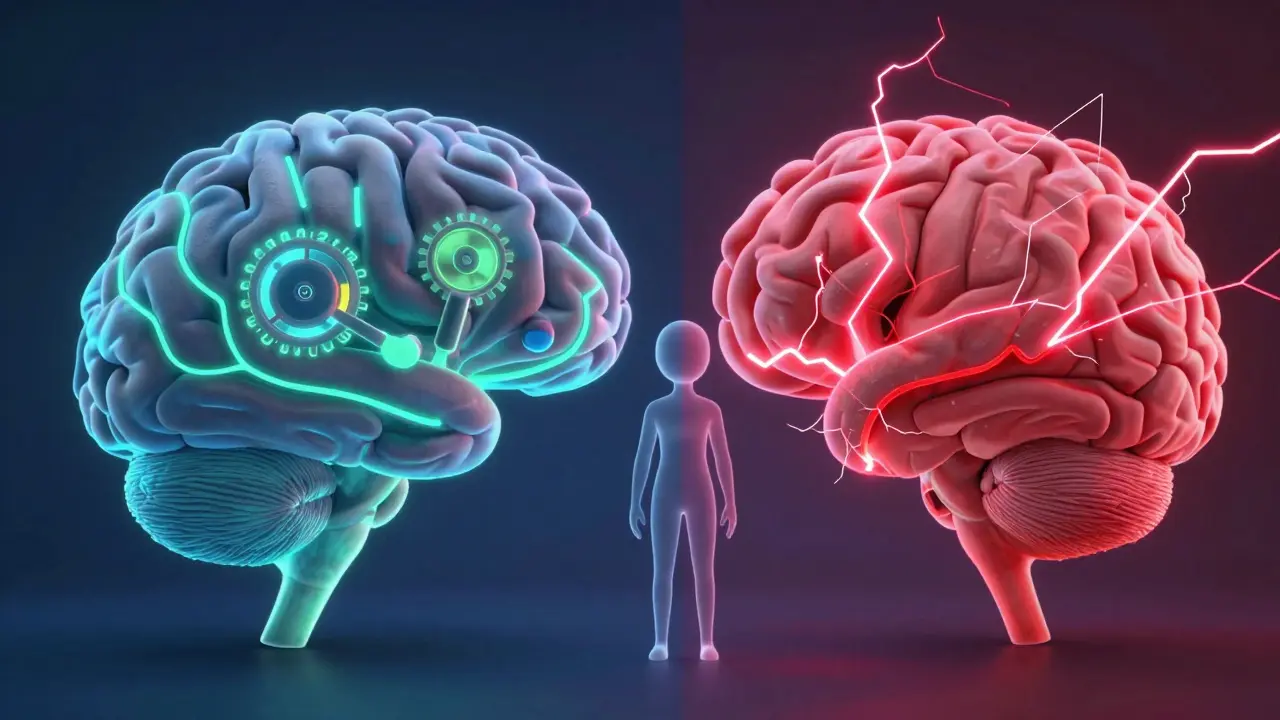
Key Differences Between Dependence and Addiction
To navigate your treatment safely, you need to know what to look for. Here is a breakdown of how these two conditions differ in practice.
| Feature | Physical Dependence | Addiction (OUD) |
|---|---|---|
| Core Mechanism | Physiological adaptation to maintain homeostasis | Pathological changes in brain reward circuits |
| Primary Driver | Avoiding withdrawal symptoms | Compulsive craving and pursuit of euphoria/relief |
| Behavioral Impact | No impairment in decision-making or daily function | Significant impairment in work, relationships, and safety |
| Response to Cessation | Withdrawal symptoms (nausea, anxiety, pain) | Intense cravings, relapse risk, psychological distress |
| Treatment Approach | Gradual tapering, symptom management | Medication-Assisted Treatment (MAT), behavioral therapy |
| Prevalence in Chronic Pain Patients | Nearly 100% after long-term use | Approximately 8% |
One of the most telling differences is intent. A person with physical dependence takes their medication to manage pain and avoid sickness. They do not seek a "high." A person with addiction may continue using even when the pain is gone, or they may use other substances to enhance the effect. Dr. Nora Volkow, Director of the National Institute on Drug Abuse (NIDA), emphasizes that physical dependence is a normal biological process, while addiction reflects a loss of control over behavior.
Why the Confusion Matters for Your Health
Mixing up these terms has real-world consequences. In 2021, the American Medical Association passed a resolution urging physicians to distinguish between the two to prevent inappropriate discontinuation of necessary therapies. Why? Because fear of addiction often drives patients to stop taking opioids prematurely.
A 2020 study in the *Journal of Pain Research* found that 68% of chronic pain patients incorrectly believed that experiencing withdrawal meant they were addicted. As a result, 42% of chronic pain patients discontinued prescribed opioids due to this fear, according to the 2021 National Pain Strategy Report. This abrupt cessation can lead to unmanaged pain, increased disability, and ironically, a higher risk of turning to illicit substances if legitimate care is cut off.
Furthermore, mislabeling physical dependence as addiction adds stigma. It frames a patient’s normal biological response as a moral failing or a character flaw. This stigma can deter people from seeking help for genuine OUD or from discussing their pain openly with doctors. Recognizing that dependence is a side effect, not a disorder, helps normalize the conversation around long-term pain management.

How Doctors Assess Risk and Manage Care
If you are prescribed opioids, your healthcare provider should be monitoring you for both dependence and signs of OUD. The Centers for Disease Control and Prevention (CDC) updated its guidelines in 2022 to emphasize person-centered care. Instead of one-size-fits-all limits, doctors are encouraged to assess individual risk factors.
Tools like the Opioid Risk Tool (ORT) help identify patients at higher risk for developing OUD before prescribing begins. For those already on medication, regular check-ins focus on functional outcomes: Is the pain manageable? Are you able to work and socialize? Are there signs of misuse?
If physical dependence develops and you wish to stop the medication, the standard of care is a slow, medically supervised taper. The CDC recommends reducing doses by 5-10% every 2-4 weeks. For patients on high doses (>100 morphine milligram equivalents per day), the taper may be even slower (5% monthly) to minimize withdrawal severity. During this process, medications like clonidine or lofexidine (approved by the FDA in 2023 for withdrawal management) can help alleviate symptoms.
If OUD is diagnosed, the approach shifts entirely. Medication-Assisted Treatment (MAT) becomes the gold standard. This involves using FDA-approved medications like buprenorphine or methadone, combined with counseling. MAT has been shown to reduce mortality rates by 50-80% compared to no treatment. It stabilizes brain chemistry and reduces cravings, allowing patients to rebuild their lives.
What You Can Do to Stay Safe
Knowledge is your best defense against both unmanaged pain and potential addiction. Here are practical steps to protect your health:
- Have Honest Conversations: Tell your doctor if you feel anxious about becoming addicted. Ask them to explain the difference between dependence and addiction in your specific case.
- Monitor Your Behavior: Check yourself regularly. Are you taking your medication exactly as prescribed? Or are you finding ways to get more, hiding your use, or neglecting responsibilities? Be brutally honest with yourself.
- Don’t Stop Abruptly: Never quit opioids cold turkey without medical advice. Withdrawal can be severe and dangerous. Work with your doctor to create a tapering plan if you want to discontinue use.
- Use Non-Opioid Therapies: Integrate physical therapy, cognitive behavioral therapy (CBT), acupuncture, or NSAIDs into your pain management plan. Reducing reliance on opioids lowers the risk of both dependence and OUD.
- Know the Warning Signs: If you notice yourself using opioids to cope with stress rather than pain, or if you’ve had close calls with overdose, seek help immediately. Resources like SAMHSA’s National Helpline (1-800-662-4357) offer confidential support.
Understanding the biology behind your body’s reaction to medication empowers you to take control of your health. Physical dependence is not a failure; it’s a physiological fact. Addiction is a treatable disease. By keeping these concepts separate, you can navigate your treatment with clarity, confidence, and compassion.
Can you be physically dependent on opioids without being addicted?
Yes, absolutely. Physical dependence is a normal biological response to long-term opioid use, affecting nearly all patients who take them for extended periods. Addiction (Opioid Use Disorder) involves compulsive behavior and loss of control, which only affects a small percentage (around 8%) of chronic pain patients. You can experience withdrawal symptoms when stopping the drug without having any addictive behaviors.
How long does it take to develop physical dependence on opioids?
Physical dependence can begin to develop within 7 to 10 days of continuous opioid therapy, especially at doses exceeding 30 morphine milligram equivalents (MME) per day. However, significant dependence usually becomes apparent after several weeks or months of regular use. The timeline varies based on dosage, type of opioid, and individual metabolism.
What are the early signs of opioid addiction versus withdrawal?
Early signs of addiction include taking more than prescribed, seeking multiple prescriptions from different doctors, using drugs to cope with emotions rather than pain, and continuing use despite negative consequences. Withdrawal symptoms, indicative of physical dependence, include nausea, vomiting, sweating, diarrhea, muscle aches, anxiety, and insomnia, which occur when the drug is stopped or reduced.
Is it safe to taper off opioids if I am physically dependent?
Yes, tapering is the standard and safest way to discontinue opioids if you are physically dependent. The CDC recommends reducing the dose by 5-10% every 2-4 weeks under medical supervision. This gradual approach minimizes withdrawal symptoms and allows your body to adjust slowly. Always consult your doctor before making changes to your medication regimen.
Does developing tolerance mean I am addicted?
No, tolerance is distinct from addiction. Tolerance means your body requires a higher dose to achieve the same pain-relieving effect because the receptors have adapted. It often accompanies physical dependence. Addiction involves behavioral changes like compulsive use and loss of control. Many patients develop tolerance without ever developing an addiction.
What is Medication-Assisted Treatment (MAT) for Opioid Use Disorder?
MAT is the use of FDA-approved medications, such as buprenorphine, methadone, or naltrexone, combined with counseling and behavioral therapies. It is the gold standard for treating Opioid Use Disorder. MAT helps stabilize brain chemistry, block the euphoric effects of opioids, and relieve physiological cravings, significantly reducing the risk of relapse and overdose death.