
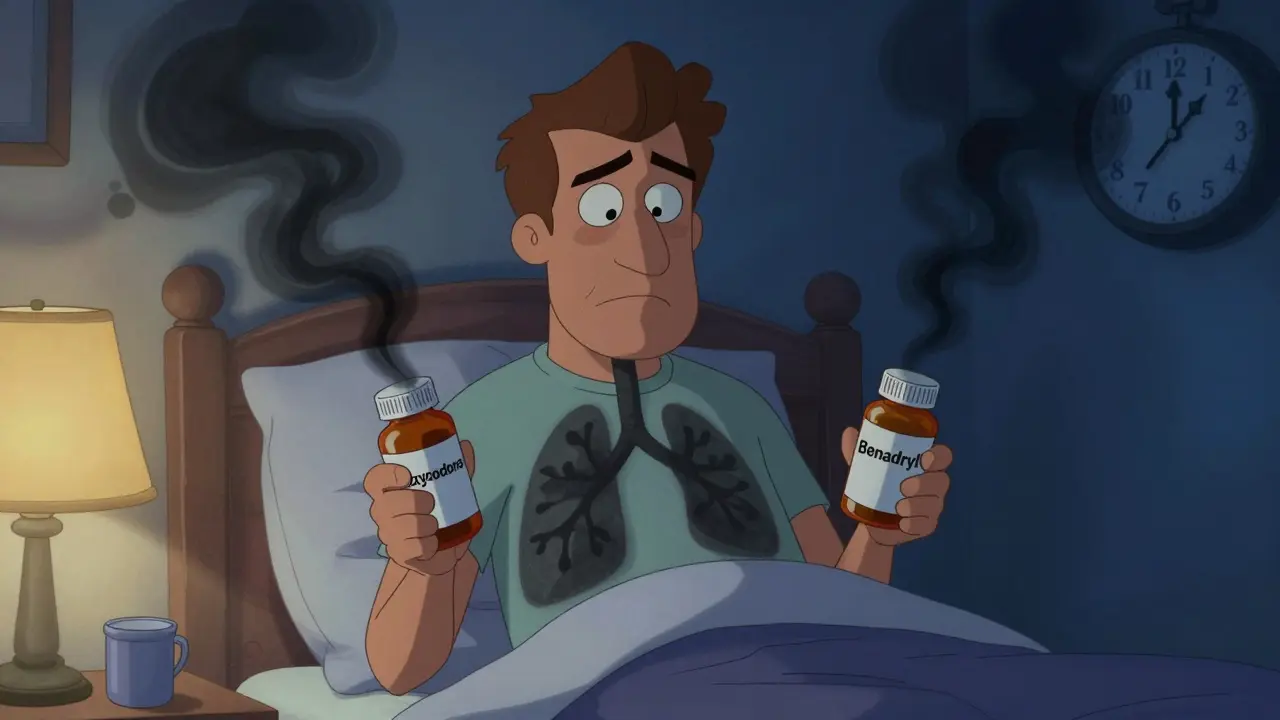
It’s easy to think of antihistamines as harmless - after all, they’re sold over the counter for allergies, colds, or even trouble sleeping. But when you’re taking opioids for pain, combining them with certain antihistamines can turn a simple remedy into a life-threatening mix. The result? Extreme drowsiness, slowed breathing, coma, or even death.
How These Two Drugs Work Together to Slow You Down
Opioids like oxycodone, hydrocodone, and morphine work by attaching to special receptors in your brain and spinal cord. They reduce pain, yes - but they also slow down your breathing and make you sleepy. That’s why many people feel foggy or nod off after their first dose. About 20% to 60% of patients on opioids report sedation, especially when starting treatment or increasing the dose. First-generation antihistamines - diphenhydramine (Benadryl), hydroxyzine (Atarax), and doxylamine (Unisom) - do something similar. They cross into your brain and block histamine, a chemical that keeps you alert. But because they’re designed to cross the blood-brain barrier, they cause strong drowsiness. Some studies show up to 70% of diphenhydramine reaches brain tissue. That’s a huge contrast to second-generation antihistamines like loratadine or fexofenadine, which barely enter the brain at all. When you take both together, their effects don’t just add up - they multiply. Both drugs depress the part of your brainstem that controls breathing. Opioids make your body less sensitive to rising carbon dioxide levels. Antihistamines suppress the drive to breathe even further. The result? Your breathing gets slower, shallower, and eventually stops.The Real Danger: It’s Not Just Prescription Drugs
Many people don’t realize they’re putting themselves at risk because they think over-the-counter meds are safe. A 68-year-old patient in North Carolina ended up in the ICU after taking hydrocodone for back pain and Benadryl for itching. It took 36 hours to fully wake up. Another person fractured their hip after falling asleep while on oxycodone and hydroxyzine - their doctor never warned them about the combo. A 2023 survey of doctors on Sermo recorded 147 cases of dangerous sedation from opioid-antihistamine use in just six months. Over a third of those cases needed naloxone, the opioid reversal drug. The Institute for Safe Medication Practices received 87 reports of serious harm from this mix between 2019 and 2022 - 12 of them ended in death. The problem is simple: patients don’t tell their doctors about OTC meds. A National Institutes of Health survey found that 68% of people never mention they’re taking something like Benadryl or Unisom. Doctors assume they’re safe. Patients assume they’re harmless. Neither side realizes the danger.Who’s Most at Risk?
Not everyone reacts the same way. Certain groups face much higher risks:- Elderly patients: Their bodies process drugs slower. They’re more sensitive to sedation. The Beers Criteria - a trusted guide for safe prescribing in older adults - lists diphenhydramine and hydroxyzine as potentially inappropriate because of their strong anticholinergic effects, which can cause confusion, falls, and urinary retention.
- People with COPD or sleep apnea: Their lungs already struggle to get enough oxygen. Adding a breathing depressant pushes them past the edge. Studies show opioid-induced respiratory depression happens most often in the first 24 hours after surgery - especially in patients with lung or heart conditions.
- Those on high opioid doses: The higher the opioid dose, the greater the risk. But even low doses become dangerous when mixed with sedating antihistamines.
Why There’s No Easy Fix
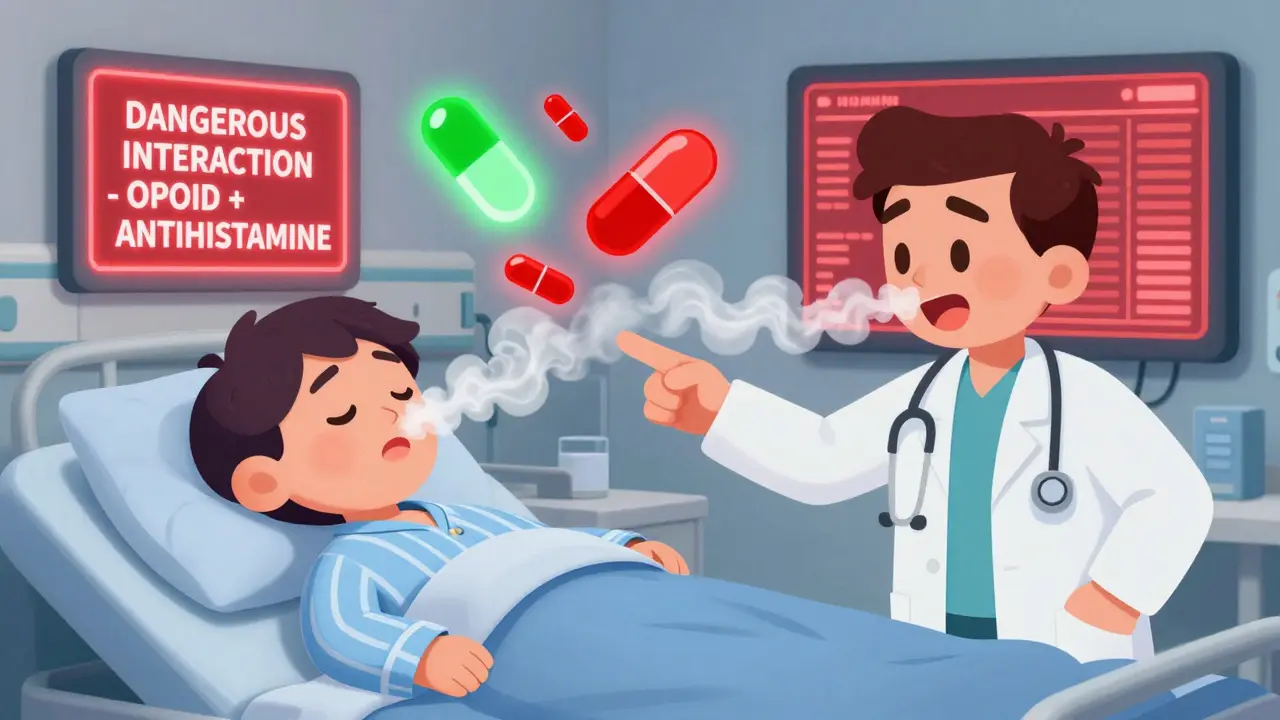
If someone overdoses on opioids and benzodiazepines, doctors can give flumazenil to reverse the benzodiazepine. But there’s no antidote for antihistamine-induced CNS depression. Once breathing slows, the only options are supportive care: oxygen, ventilation, and waiting for the drugs to clear. This makes prevention absolutely critical. The FDA warned in 2016 that combining opioids with other CNS depressants - including antihistamines - can lead to coma or death. They’ve repeated that warning multiple times since. The CDC’s 2022 opioid prescribing guidelines say: avoid combining opioids with other sedatives whenever possible. If you must, use the lowest dose for the shortest time.What You Can Do Instead
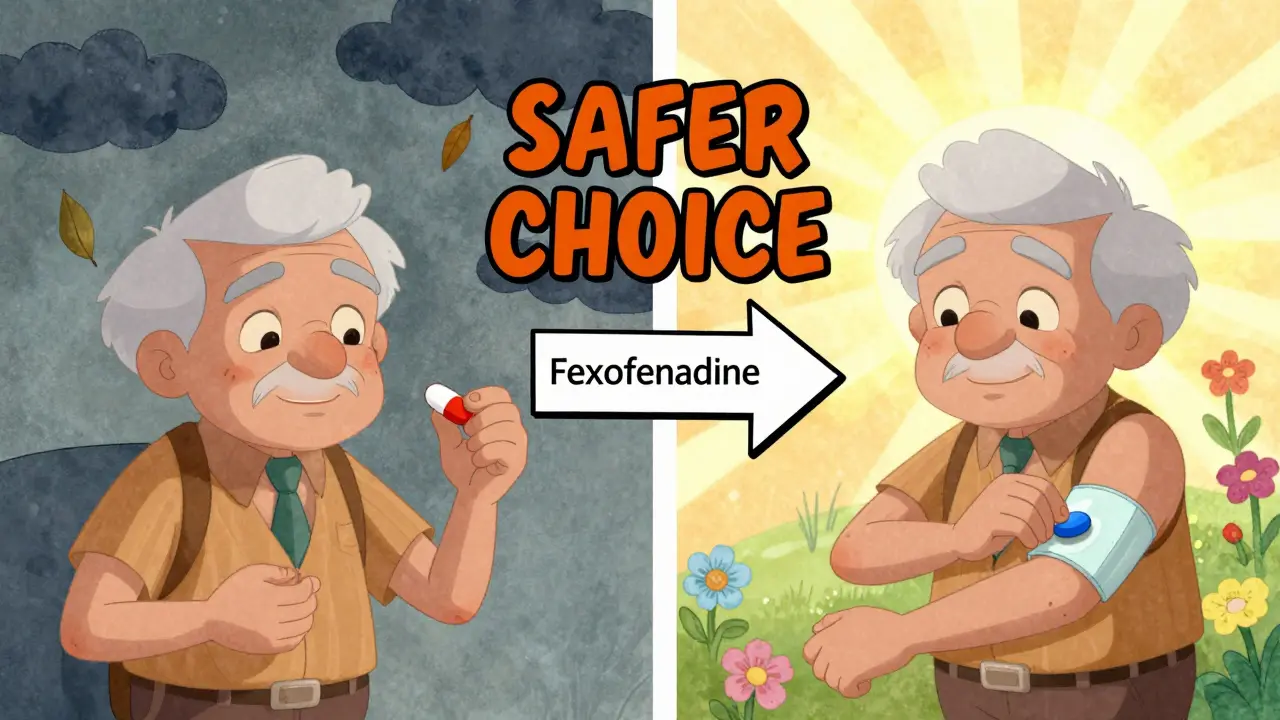
You don’t have to suffer through allergies or itching just because you’re on opioids. Safer alternatives exist:- Switch to non-sedating antihistamines: Fexofenadine (Allegra), loratadine (Claritin), and cetirizine (Zyrtec) have minimal brain penetration. At standard doses, they cause little to no drowsiness.
- Use topical treatments: For itching, try hydrocortisone cream or cool compresses instead of oral meds.
- Ask about non-histamine options: If you’re taking hydroxyzine for anxiety or nausea, ask your doctor about alternatives like ondansetron or low-dose SSRIs.
What Doctors Are Doing to Prevent This
Hospitals and clinics are starting to catch on. The University of Michigan Health System installed alerts in their electronic health record system that flag opioid-antihistamine combinations. After implementation, adverse events dropped by 42%. Epic Systems, which powers 92% of U.S. hospitals, now includes hard-stop alerts for high-risk combinations. Pharmacists are required to review opioid prescriptions for interactions under the FDA’s Risk Evaluation and Mitigation Strategy (REMS). And since 2023, all opioid medication guides must include warnings about CNS depressants - including antihistamines. But these systems aren’t perfect. They can’t catch every case. Many patients still buy antihistamines without telling anyone. And not all providers are trained to ask about OTC use.What You Should Do Right Now
If you’re taking an opioid for pain:- Check every medication you take. Look at the active ingredients in anything you use for sleep, allergies, or colds. If it says “diphenhydramine,” “hydroxyzine,” or “doxylamine,” stop taking it unless your doctor says it’s safe.
- Tell your doctor about every OTC drug. Even if you think it’s “just a little,” it matters. Write it down before your appointment.
- Ask for alternatives. Say: “I’m on opioids. Is there a non-sedating option for my allergies or trouble sleeping?”
- Watch for signs of trouble. If you feel unusually drowsy, confused, or have trouble breathing - call 911. Don’t wait.
There’s no shame in asking for help. Many people don’t know this risk exists - but now you do. And knowing could save your life.
What’s Changing in the Future
The FDA released new draft guidance in May 2023 specifically targeting opioid interactions with all CNS depressants - not just benzodiazepines. This means clearer warnings, better labeling, and more training for prescribers. The National Institute on Drug Abuse is funding $15.7 million in research to find new ways to prevent overdoses from drug combinations. Some companies are already testing genetic panels to see how your body metabolizes opioids. Tests like Genelex’s Opioid Risk Panel look at genes like CYP2D6 and CYP2C19 to predict if you’re more likely to have bad side effects. While still expensive ($349), these tools could become standard in high-risk cases. But the biggest change won’t come from labs or laws. It’ll come from patients speaking up - asking questions, sharing what they take, and refusing to accept “it’s just a little drowsiness” as normal.Can I take Benadryl with my opioid painkiller?
No. Taking diphenhydramine (Benadryl) with opioids like oxycodone or hydrocodone greatly increases the risk of extreme drowsiness, slowed breathing, and overdose. Even one dose can be dangerous, especially in older adults or those with lung conditions. Use non-sedating antihistamines like fexofenadine (Allegra) or loratadine (Claritin) instead.
Are all antihistamines dangerous with opioids?
No. Only first-generation antihistamines like diphenhydramine, hydroxyzine, and doxylamine pose a serious risk because they cross into the brain. Second-generation antihistamines - such as fexofenadine, loratadine, and cetirizine - have very little effect on the central nervous system and are much safer to use with opioids. Always check the active ingredient, not just the brand name.
Why don’t doctors warn me about this?
Many doctors assume patients know the risks or don’t realize how common OTC antihistamine use is. A 2022 CDC report found only 34% of patients prescribed opioids receive full counseling about drug interactions. This gap is slowly closing thanks to new FDA requirements and hospital alerts, but you still need to speak up. Don’t wait for your doctor to ask - tell them everything you’re taking.
What should I do if I feel too sleepy after taking both?
If you feel unusually drowsy, confused, or have slow or shallow breathing, call 911 immediately. Do not wait. Naloxone can reverse opioid effects, but it won’t help with antihistamine sedation. Emergency care is needed to support breathing until the drugs leave your system. This is a medical emergency.
Is it safe to use antihistamines at night if I take opioids during the day?
No. The risk isn’t about timing - it’s about the total effect on your brain and breathing. Even if you take them hours apart, the drugs stay in your system and continue to depress your central nervous system. The combination can still lead to dangerous breathing problems, especially overnight when your body’s natural breathing drive is lower. Avoid mixing them entirely.


One comment
Been on oxycodone for years after my back surgery. Never realized Benadryl was a ticking time bomb. Just took it last week for allergies and felt like I was floating. Scary stuff.
Thanks for the heads up.
Oh wow, so people are still alive after taking Benadryl with opioids? 🤦♀️
Let me guess - you also drink grapefruit juice with your statins and think ‘natural’ means ‘safe.’
Maybe if you didn’t treat your body like a drug store, you wouldn’t need a warning label.
This is one of the most important public health messages I’ve read in years. In India, many elderly patients mix diphenhydramine with tramadol for pain and sleep - no one warns them. The cultural belief that ‘OTC = harmless’ is deadly here too.
Doctors need to be trained to ask about OTC meds as routinely as they ask about smoking. This isn’t just an American problem - it’s global.
So now we’re telling people they can’t take Benadryl? Next they’ll ban aspirin because it ‘interacts’ with warfarin.
Look, if you’re dumb enough to mix opioids with sleep aids, you deserve what you get. I’ve been on hydrocodone for 12 years and take Zyrtec - not Benadryl. I’m not a moron. Why are we coddling people who can’t read a label?
Man, I just took Unisom last night with my pain meds... and woke up feeling like I’d been hit by a truck. Thought it was just bad sleep.
Turns out I was lucky I didn’t stop breathing. Thanks for this - I’m switching to Allegra tomorrow. Canada’s got the same problem. We’re all just winging it with OTC stuff.
As a South African healthcare worker, I can confirm this is a silent epidemic. Many patients here use antihistamines for insomnia because they can’t afford sleep specialists. And opioids? Often obtained without prescriptions. The lack of education is catastrophic. This needs to be broadcast on radio, TV, community centers - not just Reddit.
It’s not the drugs that are dangerous - it’s the illusion of control.
We think we’re in charge because we’re ‘just taking a little something’ - but the brain doesn’t care about your intentions. It just responds to chemistry.
There’s a reason ancient cultures used rituals for medicine. We forgot the reverence.
Now we treat pills like candy. And then we’re shocked when we die.
Why is everyone acting like this is news? Benadryl makes you sleep. Opioids make you sleep. Put em together = dead man walking. Duh.
People need to stop being lazy and read the damn leaflet.
Also Zyrtec is better anyway. Why are you still on Benadryl in 2025?
Good post. Just switched to Claritin. No more drowsiness. No more fear.
Also - don’t be that guy who says ‘I’m fine.’ You’re not.
My mom took hydroxyzine with her oxycodone after knee surgery. She didn’t wake up for 18 hours. They had to intubate her. She’s fine now but won’t touch anything OTC without checking with her pharmacist. This needs to be screamed from the rooftops.
Bro I used to mix Unisom and codeine for ‘chill nights’... until I woke up on the floor with my cat licking my face. That was my wake-up call.
Now I use melatonin and a weighted blanket. Life’s better. Less zombie mode.
Ugh. Another ‘medical article’ pretending to be deep. Everyone knows this. Just stop taking dumb drugs.
Why are we even talking about this? It’s not rocket science.
There’s a deeper philosophical layer here we rarely touch. We live in an age of hyper-individualized medicine - where every pill is a personal solution, and every symptom a problem to be erased. But the body is not a machine with interchangeable parts. It’s a symphony. And when you throw in a discordant note - like combining CNS depressants - the entire harmony collapses.
It’s not just about drowsiness. It’s about our hubris. We think we can control nature with a pharmacy receipt. But nature doesn’t care about your schedule, your intentions, or your ‘I’ll just take one.’
Maybe the real danger isn’t the drugs - it’s the belief that we’re exempt from consequence.