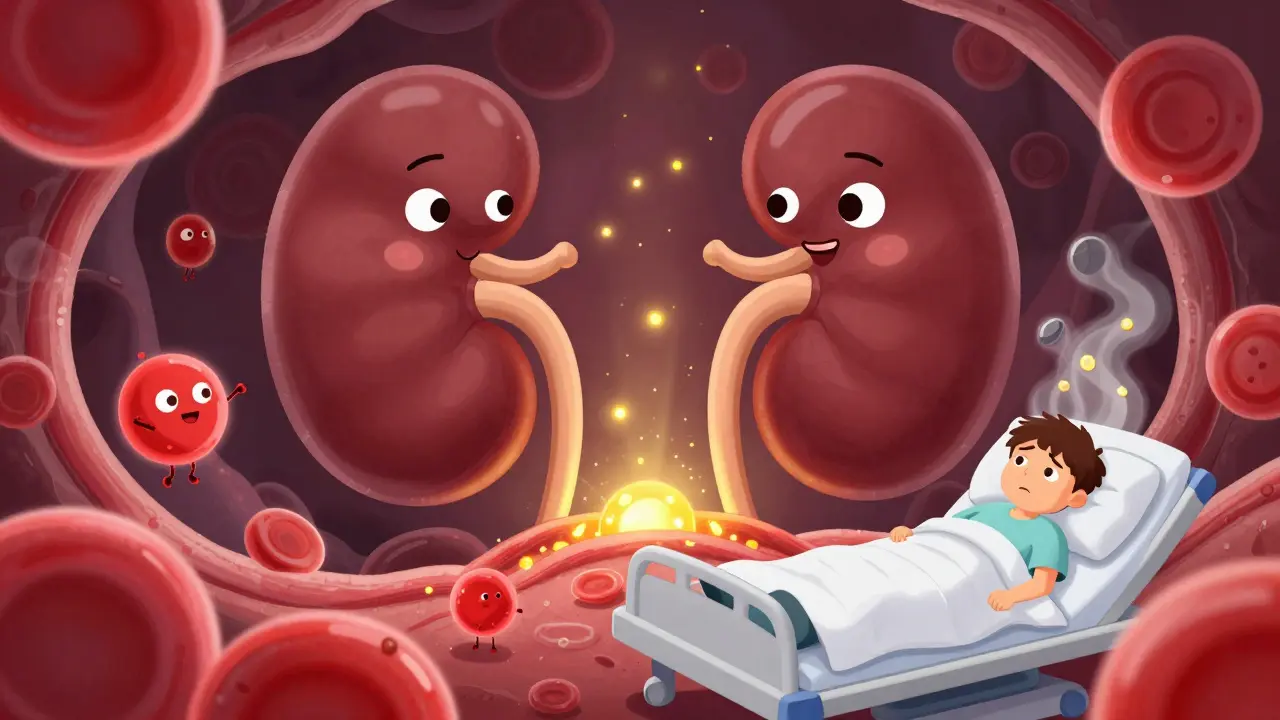
When your kidneys start to fail, they don’t just stop filtering waste-they also stop making a key hormone that tells your body to produce red blood cells. That hormone is erythropoietin. Without it, even if you eat plenty of iron, your body can’t make enough red blood cells. The result? Anemia. It’s not just feeling tired. It’s struggling to walk up stairs, dizziness when you stand, and heart racing for no reason. For people with chronic kidney disease (CKD), this isn’t rare-it’s common. Up to 90% of those on dialysis have it. And it’s not something you can fix with a multivitamin. It needs targeted treatment: erythropoietin and iron, working together.
Why Kidney Disease Causes Anemia
Your kidneys make erythropoietin, a hormone that signals bone marrow to churn out red blood cells. When kidney function drops below 30%, that production plummets. But it’s not just the lack of hormone. Inflammation from kidney disease blocks iron use. Even if you have iron in your blood, your body can’t access it. This is called functional iron deficiency. And oral iron pills? They barely work. The gut can’t absorb them properly when inflammation is high. That’s why intravenous iron isn’t just an option-it’s often the only way to get iron where it’s needed.
Erythropoietin Therapy: What It Is and How It Works
Since the late 1980s, doctors have used lab-made versions of erythropoietin to treat this. These are called erythropoiesis-stimulating agents, or ESAs. Common ones include epoetin alfa, darbepoetin alfa, and biosimilars like Retacrit. They’re given either as shots under the skin (for non-dialysis patients) or through an IV during dialysis. These drugs mimic your natural hormone. They tell your bone marrow: make more red blood cells now.
Most people see their hemoglobin rise by 1 to 2 grams per deciliter within 2 to 6 weeks. That’s the difference between barely getting through the day and being able to walk the dog or play with grandkids. But here’s the catch: pushing hemoglobin too high is dangerous. Studies like the TREAT trial showed that targeting levels above 11.5 g/dL increases stroke risk by 32%. That’s why current guidelines, like the 2025 KDIGO draft, recommend keeping hemoglobin between 10 and 11.5 g/dL. Not 12. Not 13. Just enough to feel better without risking a heart attack or clot.
Iron Therapy: Why IV Beats Oral Every Time
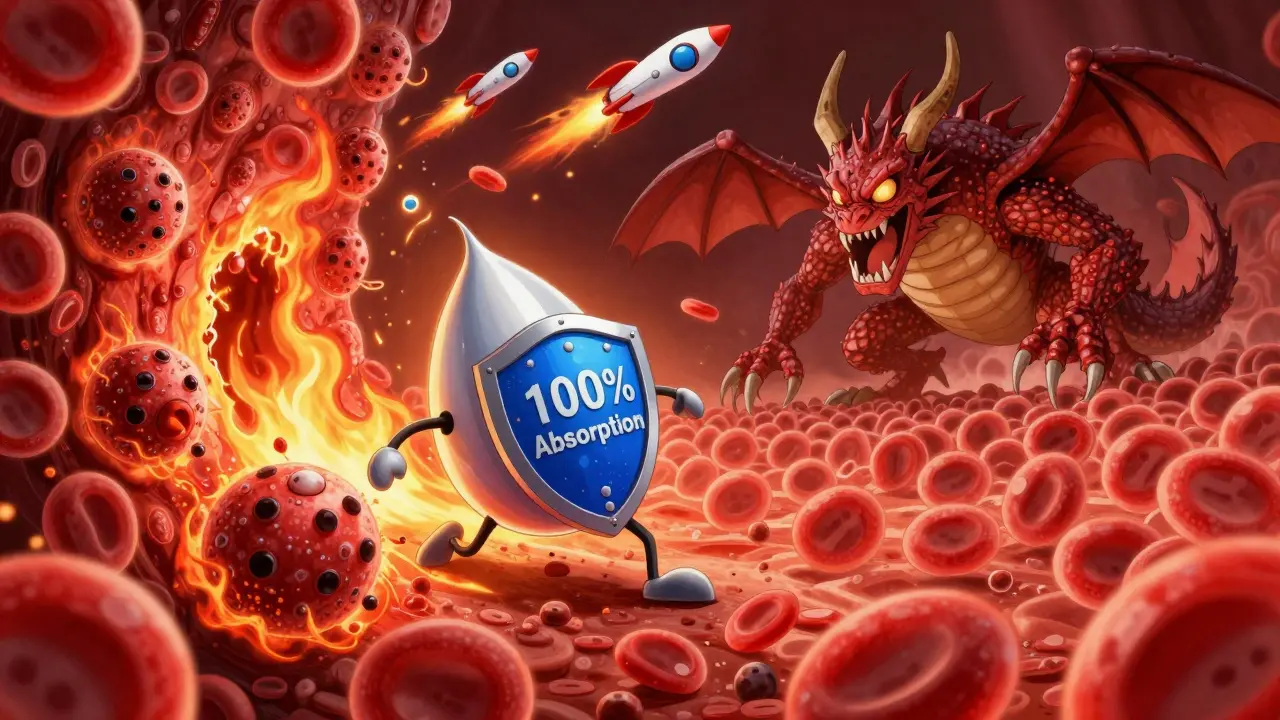
Iron is the fuel for red blood cells. But in CKD, your body hoards iron like a dragon. Hepcidin, an inflammation-driven protein, locks iron inside storage cells. Oral iron can’t break through that lock. Studies show only 30-40% of oral iron gets absorbed. IV iron? Almost 100%. That’s why guidelines now say: if you’re on dialysis, start IV iron before even thinking about ESAs.
There are two main signs your body needs iron: ferritin below 100 mcg/L (absolute deficiency) or ferritin between 100-500 mcg/L with transferrin saturation (TSAT) under 20-30% (functional deficiency). For hemodialysis patients, the UK Kidney 2020 guideline recommends 400 mg of IV iron sucrose monthly unless ferritin is above 700 or TSAT over 40%. That’s a standard dose. Some patients need more. Some need less. But the key is regular monitoring-not just once a year, but every month.
Side effects? IV iron can cause a metallic taste or flu-like symptoms in about a quarter of patients. Rarely, it triggers allergic reactions-about 1 in 500. But compared to the 40% of people who get nausea, constipation, or stomach pain from oral iron, IV wins by a landslide.
What Happens If You Don’t Treat It?
Untreated anemia in CKD doesn’t just make you tired. It strains your heart. Your heart has to pump harder to carry less oxygen. Over time, that leads to left ventricular hypertrophy-thickening of the heart muscle. That’s a direct path to heart failure. It also raises your risk of hospitalization. One study found patients with hemoglobin below 10 g/dL were 40% more likely to be admitted for heart problems than those with levels above 11 g/dL.
And here’s something many don’t realize: anemia makes dialysis harder. Low red blood cell count means less oxygen delivery to tissues. That can worsen muscle cramps, fatigue during treatment, and even reduce the effectiveness of dialysis itself. Treating anemia isn’t just about feeling better-it’s about making your main treatment work better.
The New Frontier: HIF-PHIs
There’s a new player on the field: HIF-PH inhibitors. These are oral drugs like roxadustat and daprodustat. They work differently. Instead of replacing erythropoietin, they trick your body into making more of it naturally. They also improve iron absorption and reduce hepcidin. That’s a double win.
Roxadustat got FDA approval in December 2023 after years of safety reviews. It’s the first oral option in the U.S. for CKD anemia. Early data shows it raises hemoglobin just as well as ESAs, with fewer spikes in blood pressure. It’s especially promising for patients who hate needles or struggle with frequent IV access.
But it’s not perfect. There are still concerns about cancer risk-especially in patients with a history of tumors. The FDA placed clinical holds on some HIF-PHIs between 2018 and 2020 over this. Long-term data is still being collected. For now, they’re reserved for patients who don’t respond well to ESAs or can’t tolerate injections.
How Treatment Actually Works in Real Life
Here’s how it plays out in a typical clinic:
- Diagnosis: Hemoglobin under 13 g/dL for men, under 12 for women. Blood tests check ferritin and TSAT.
- Fix the basics: Rule out vitamin B12 or folate deficiency. Treat infection or inflammation if present.
- Start IV iron: If ferritin is below 500 and TSAT under 30%, give iron first. Wait 4-6 weeks.
- Add ESA: If hemoglobin hasn’t climbed above 10 g/dL after iron, start epoetin or darbepoetin.
- Monitor monthly: Adjust dose based on hemoglobin trends. Never let it jump more than 1 g/dL in 2 weeks.
Doctors who follow this step-by-step approach see fewer complications. One Mayo Clinic case from 2022 showed a 62-year-old diabetic patient go from 8.2 to 10.5 g/dL in 8 weeks using darbepoetin and weekly IV iron. He went from needing naps after lunch to helping his wife garden.
Why Guidelines Differ-and What That Means for You
Not all guidelines agree. KDIGO (2025 draft) says: keep hemoglobin under 11.5. KDOQI (U.S. guidelines) still allows up to 12. The European Renal Best Practice group recommends monthly IV iron for all dialysis patients, regardless of iron levels. The U.S. Centers for Medicare & Medicaid Services (CMS) bundle anemia care into dialysis payments, which has cut ESA use by 35% since 2011.
This isn’t just paperwork. It affects your treatment. If your doctor follows KDIGO, you’ll get lower ESA doses. If they follow older KDOQI, you might be pushed toward higher targets. Ask: Which guideline are you using? And why? Your goal isn’t a number on a lab sheet-it’s feeling stronger, safer, and more alive.
What Patients Say
On patient forums, stories are mixed. Sixty-eight percent say they feel more energy within a month of starting ESAs. One Reddit user wrote: "I can finally play with my grandchildren without getting winded." But 32% report worse high blood pressure. A quarter say their injection sites burn or swell. IV iron users complain of metallic taste (45%) and fatigue (28%).
But the real win? Avoiding transfusions. Before ESAs and IV iron, many CKD patients needed blood transfusions every few weeks. That meant more hospital visits, higher infection risk, and iron overload. Now, transfusions are rare. That’s progress.
What to Watch For
Not everyone responds. About 10% of patients are ESA-hyporesponsive. That means even high doses don’t raise hemoglobin. Why? Usually because iron wasn’t fully corrected, inflammation is still high, or aluminum buildup from old dialysis fluids is poisoning the bone marrow. If your hemoglobin hasn’t moved after 12 weeks of proper dosing, your doctor needs to dig deeper.
Also, don’t ignore your blood pressure. ESAs can raise it. If you’re on three or more blood pressure meds already, your doctor might hold off on ESA or lower the dose. It’s a balancing act.
Where the Field Is Headed
The future is personalization. Mayo Clinic is testing machine learning models that predict the exact ESA dose you need based on your weight, age, inflammation levels, and past response. Early results show a 22% drop in dose adjustments. That means fewer side effects and more stable hemoglobin.
Minihepcidins-new drugs that block the iron-locking protein-are in early trials. If they work, they could make oral iron effective again. That would be huge for people who can’t tolerate IV infusions.
For now, the standard is clear: IV iron first, ESA second, keep hemoglobin between 10 and 11.5, and monitor every month. It’s not glamorous. But it works. And for thousands of people with kidney disease, it means the difference between surviving-and living.
Can I take iron pills instead of IV iron if I have kidney disease?
Oral iron pills rarely work for people with chronic kidney disease. Inflammation blocks iron absorption in the gut, so even if you take them daily, your body can’t use most of it. Studies show only 30-40% absorption compared to nearly 100% with IV iron. Guidelines now recommend IV iron as the first-line treatment for dialysis patients and most non-dialysis patients with CKD-related anemia.
Why is my hemoglobin target 10-11.5 g/dL and not higher?
Targeting hemoglobin above 11.5 g/dL increases the risk of stroke, heart attack, and blood clots. The TREAT trial showed a 32% higher stroke risk when aiming for 13 g/dL versus 9-11 g/dL. While higher levels might seem better, the dangers outweigh the benefits. Current guidelines, including KDIGO 2025, recommend 10-11.5 g/dL because it improves energy and quality of life without raising serious risks.
How long does it take for iron or erythropoietin therapy to work?
IV iron usually starts raising hemoglobin within 2-4 weeks, with full effect around 4-6 weeks. Erythropoietin therapy typically shows a 1-2 g/dL increase in hemoglobin within 2-6 weeks. Monthly blood tests are needed to track progress and adjust doses. Don’t expect overnight results-this is a slow, steady process.
Are HIF-PHIs better than erythropoietin injections?
HIF-PHIs like roxadustat are oral drugs that stimulate your body’s own erythropoietin and improve iron use. They’re effective and avoid injections, which many patients prefer. They also tend to cause less high blood pressure than ESAs. But they’re newer, more expensive, and carry potential cancer risks in certain patients. They’re not first-line for everyone-usually reserved for those who don’t respond to or can’t tolerate ESAs.
What if my anemia doesn’t improve with treatment?
If your hemoglobin doesn’t rise after 12 weeks of proper iron and ESA therapy, you may have ESA hyporesponsiveness. Common causes include uncorrected iron deficiency, ongoing inflammation, vitamin deficiencies, or aluminum toxicity. Your doctor should check your ferritin, TSAT, inflammation markers (like CRP), and possibly run tests for aluminum or parathyroid hormone levels. Sometimes, switching to a different ESA or adding HIF-PHI helps.