
Every year, millions of people in the U.S. reach for an OTC medicine to treat a headache, cold, or upset stomach. But how many of them actually know what’s in that pill or liquid? If you’ve ever taken two different cold medicines and ended up feeling worse, you’re not alone. The problem isn’t the medicine-it’s the label. The OTC drug facts label is designed to keep you safe, but only if you know how to read it.
What’s on the OTC Drug Facts Label?
The OTC drug facts label isn’t just a random list of text. It’s a government-mandated format created by the FDA to make it easier for you to understand what you’re taking. Since 2017, every single over-the-counter medicine sold in the U.S. must use this exact layout. There are seven sections, and they always appear in the same order. Skipping even one can put you at risk.Let’s walk through each section, what it really means, and why it matters.
Active Ingredients: The Real Power Behind the Brand
This is the most important part of the label-and the most commonly misunderstood. The active ingredient is the chemical that actually does the work. It’s not the brand name. Tylenol? That’s just the brand. The active ingredient is acetaminophen. Advil? Brand name. Active ingredient: ibuprofen.Look for the exact amount listed. For example: Acetaminophen 325 mg. That’s 325 milligrams per tablet. If you’re taking two tablets, you’re getting 650 mg. If you’re also taking a cold medicine that says Acetaminophen 325 mg on its label, you’re doubling your dose. And that’s dangerous.
Acetaminophen overdose is the leading cause of acute liver failure in the U.S. The FDA says the maximum safe daily dose is 4,000 mg. But many people hit that limit without realizing it because they’re mixing products. A 2023 CDC study found that 67% of people who checked the active ingredient avoided accidental overdoses. Those who didn’t? Three times more likely to end up in the ER.
Purpose: What This Medicine Is Supposed to Do
This section tells you exactly what the medicine treats. No marketing fluff. No vague claims like “boosts immunity.” It says: “Pain reliever/fever reducer” or “Cough suppressant” or “Nasal decongestant.”Use this to match your symptoms. If you have a sore throat and fever, you might need a medicine that treats both. But if you only have a runny nose, you don’t need something that also contains a pain reliever. Taking extra ingredients you don’t need increases your risk of side effects-and doesn’t help you feel better faster.
Uses: What Symptoms It’s Approved to Treat
This section is more specific than “Purpose.” It lists the exact symptoms the FDA has approved the medicine to treat. For example: “Temporarily relieves minor aches and pains due to headache, toothache, backache, menstrual cramps, minor arthritis, or common cold.”Notice the word “temporarily.” OTC medicines don’t cure anything. They manage symptoms. If your pain lasts more than 10 days or your fever goes above 102°F for more than 48 hours, you need to see a doctor-not take more pills.
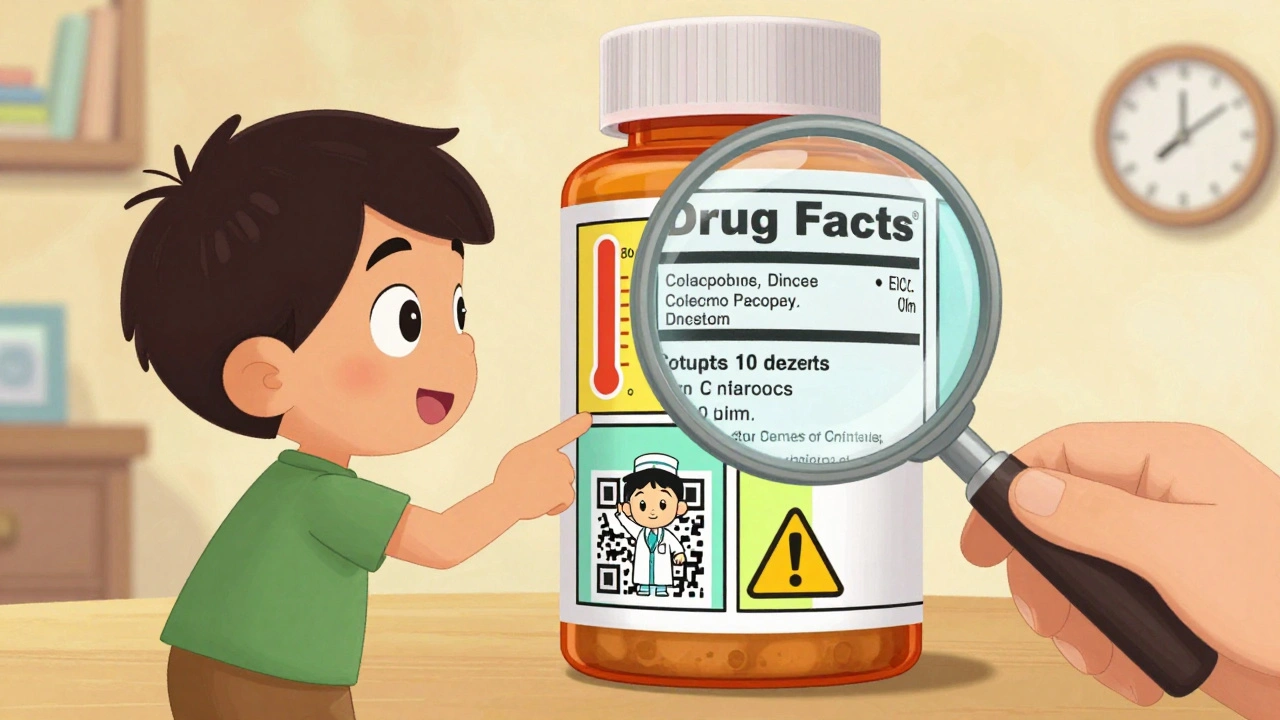
Warnings: The Part You Can’t Afford to Skip
This is where the label saves lives. The Warnings section tells you when NOT to take the medicine. It includes:- Allergy alerts: “Do not use if you’ve ever had an allergic reaction to this medicine.”
- Drug interactions: “Ask a doctor before use if you’re taking blood thinners like warfarin.”
- Health conditions: “Liver warning: This product contains acetaminophen. Severe liver damage may occur if you take more than directed.”
- Age restrictions: “Do not use in children under 12 unless directed by a doctor.”
- Special warnings: “May cause drowsiness. Do not operate machinery.”
A 2023 survey by the American Pharmacists Association found that 89% of pharmacists say the Warnings section is the most critical part of the label. Why? Because people ignore it. One woman in Alabama took two cold medicines at once-both had acetaminophen. She didn’t realize it until she was rushed to the hospital with liver damage. She survived. But she didn’t need to go through that.
Directions: How Much, How Often, How Long
This section gives you the exact instructions. It’s not a suggestion. It’s a rule.Look for:
- Dosage: “Adults and children 12 years and older: 2 caplets every 4 to 6 hours.”
- Maximum per day: “Do not take more than 12 caplets in 24 hours.”
- Duration: “Do not use for more than 10 days unless directed by a doctor.”
People often misread this. “Every 4 to 6 hours” doesn’t mean “take it as often as you can.” That’s 4 doses max in 24 hours if you take it every 6 hours. If you take it every 4 hours, that’s 6 doses. But if each dose is 2 pills, you’re hitting 12 pills in a day. That’s the max. Go over that, and you risk overdose.
Also watch for “per 5 mL.” That’s one teaspoon. A 4-ounce bottle of Children’s Motrin holds about 118 mL. That’s 23.6 doses. Don’t assume the whole bottle is one dose. Always use the measuring cup or syringe that comes with it. Kitchen spoons vary too much to be reliable.
Inactive Ingredients: The Hidden Triggers
These aren’t the medicine. They’re the fillers, dyes, and preservatives that hold the pill together or make the liquid taste better. But for some people, they’re dangerous.If you’re allergic to gluten, dyes, or lactose, this section matters. Look for things like:
- Croscarmellose sodium
- FD&C Red No. 40
- Polysorbate 80
- Lactose monohydrate
A 2023 study found that 12% of adults with food allergies accidentally took OTC medicine containing an ingredient they were allergic to-because they never checked the inactive list. If you have allergies, this section is your first line of defense.
Other Information: Storage and Extras
This tiny section tells you how to store the medicine and sometimes includes nutritional info like sodium content. For example: “Store between 68°F and 77°F.” That’s room temperature. Don’t keep it in the bathroom-heat and moisture ruin medicine.Some labels list sodium content: “Each tablet contains 2 mg sodium.” That’s not much. But if you’re on a low-sodium diet and take 10 tablets a day, that’s 20 mg. For people with heart failure or kidney disease, even small amounts add up.
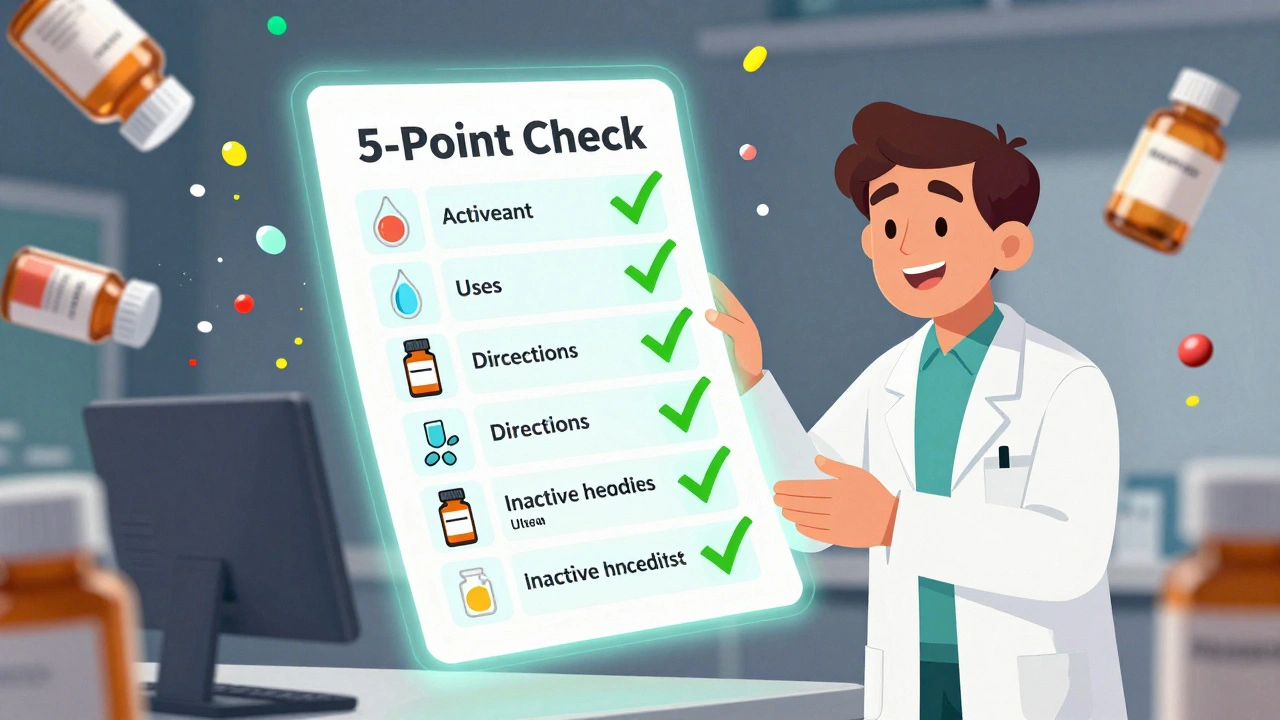
How to Use the Label Like a Pro: The 5-Point Check
Pharmacists at CVS Health developed a simple method called the “5-Point Check.” It takes about 50 seconds. Do this every time you pick up an OTC medicine:- Identify the active ingredient. Write it down if you need to. Don’t rely on the brand name.
- Verify the uses match your symptoms. If you’re treating a cough, don’t take something meant for headaches.
- Read all warnings. Look for liver, stomach, or allergy alerts. If you have high blood pressure, diabetes, or liver disease, this is critical.
- Check directions for age and weight. Kids and seniors need different doses. Don’t guess.
- Review inactive ingredients. If you have allergies or dietary restrictions, this is your safety net.
A 2024 study by the BeMedWise Program found that people who used this method reduced medication errors by 68%. That’s not just a number. That’s avoiding ER visits, hospital stays, and long-term damage.
What’s Changing in 2025?
The FDA isn’t done improving the label. Starting in 2025, new rules will require:- Larger font for active ingredient concentrations
- Color-coded sections (red for warnings, green for directions)
- Simple icons for common risks (like a liver icon for acetaminophen)
These changes are based on research showing that people understand visuals faster than text. A pilot program in 150 pharmacies cut pediatric dosing errors by 52% using these new designs.
Some brands are already ahead of the game. Tylenol and Aleve now include QR codes on their boxes. Scan them with your phone, and you’ll get a short video explaining the label in plain language.
When in Doubt, Ask
You don’t have to figure this out alone. Pharmacists are trained to help you read these labels. Walgreens reported a 40% increase in OTC consultations after launching their “Label Literacy” campaign in 2023. You can walk in, hand them the bottle, and say: “Can you help me make sure this is safe for me?”There’s also a free app from the FDA called the Drug Label Decoder. It lets you scan a barcode and instantly see a breakdown of the label in plain English. It’s been downloaded over 1.2 million times since 2023.
OTC medicines are powerful tools. But like any tool, they can hurt you if you don’t use them right. The label isn’t there to confuse you. It’s there to protect you. Take 50 seconds. Read it. Understand it. Then take the medicine with confidence.
What’s the difference between active and inactive ingredients?
Active ingredients are the chemicals that treat your symptoms-like acetaminophen for pain or diphenhydramine for allergies. Inactive ingredients are everything else: fillers, dyes, flavors, and preservatives. They don’t help with your symptoms, but they can cause allergic reactions in some people. Always check both if you have allergies.
Can I take two OTC medicines at the same time?
Only if you’re sure they don’t contain the same active ingredient. Many cold and flu medicines include acetaminophen, ibuprofen, or antihistamines. Taking two with the same active ingredient can lead to overdose. Always compare the active ingredient lists before combining medicines.
Why do some labels say “extra strength”?
“Extra strength” means the medicine has a higher dose of the active ingredient than the regular version. For example, regular Tylenol has 325 mg of acetaminophen per tablet. Extra Strength Tylenol has 500 mg. That means you can take fewer pills-but you’re also at higher risk of overdose if you take too many. Always check the exact amount on the label.
What does “per 5 mL” mean on liquid medicine?
It means each teaspoonful (5 mL) contains that amount of active ingredient. A 4-ounce bottle holds about 118 mL, which equals roughly 23 doses. Never use a kitchen spoon-always use the measuring cup or syringe that came with the medicine. Kitchen spoons vary too much in size to be accurate.
Are OTC labels the same in the UK and other countries?
No. The Drug Facts Label format is specific to the United States and mandated by the FDA. Other countries, including the UK, use different labeling systems. If you’re using medicine from another country, don’t assume the label works the same way. Always check with a pharmacist or local health authority for guidance.
What should I do if I think I took too much?
Call Poison Control immediately at 1-800-222-1222. Don’t wait for symptoms. Even if you feel fine, overdose damage can be silent at first. Have the medicine bottle with you when you call-they’ll need the active ingredient name and how much you took. In the UK, call 111 for urgent medical advice.

One comment
OMG this is such a *vital* read 🙌 I literally just took two cold meds last week and nearly ended up in the ER-acetaminophen overload is REAL. The FDA’s 2025 color-coding changes? Long overdue. Why are we still reading tiny font like it’s 2003? 🤦♂️ Also, ‘per 5 mL’ should be in neon. Like, literally. I’ve seen people use soup spoons. 😭
This is so helpful. I never realized how many people mix meds without checking the active ingredients. I work at a pharmacy and see it all the time. I always tell folks: ‘It’s not about the brand, it’s about the chemical.’ If you’re not sure, just ask. No judgment. We’re here to help. 😊
Let’s be real-most people don’t read labels because they’re lazy. The FDA can slap neon signs on it, but if you’re the type to take ‘just one more’ because ‘I still feel bad,’ you’re gonna die. This isn’t rocket science. It’s basic math. 325 x 4 = 1300. 1300 x 4 = 5200. That’s over the limit. Stop being dumb.
Thank you for writing this so clearly. I shared it with my mom-she’s 72 and takes 5 different OTC meds a day. She didn’t know ‘inactive ingredients’ could trigger her allergies. We printed it out and went through it together. Small changes like this save lives. 🙏
Look, I’ve been reading these labels since I was 16 and my dad had a heart attack from mixing ibuprofen and aspirin. I’m not exaggerating-he was in ICU for three days. Ever since then, I treat every OTC bottle like it’s a live grenade. The ‘Warnings’ section? That’s the only part I read. Everything else is marketing. I don’t care what the ‘Purpose’ says-I care about what’ll kill me. And yes, I’ve called Poison Control twice. Both times, I was lucky. Don’t be like me. Read the label before you take it. Period.
‘Per 5 mL’ = one teaspoon. But here’s the kicker: most measuring cups that come with meds are broken or lost. I’ve seen parents wing it with kitchen spoons. One guy used a coffee spoon-big mistake. That’s like 20 mL. That’s 4x the dose. And no, ‘I only gave it once’ doesn’t fix it. The liver doesn’t care about your intentions.
THIS. RIGHT. HERE. I’ve been teaching my high school students how to read these labels for two years now. We do a ‘Medicine Label Scavenger Hunt’ in class. They think it’s boring-until they realize their cousin overdosed on cold syrup last winter. Now they’re obsessed. Let’s make this mandatory in health class. No more ‘I didn’t know.’ Knowledge is power. And power saves lives.
Wait, so you’re telling me I can’t just take three Advil and a Tylenol because I have a ‘bad headache’? But I’ve been doing it since college! This is just government fear-mongering. Also, why does ‘inactive ingredients’ matter? I’m not allergic to sugar. And why is there a QR code now? Next they’ll be putting TikTok filters on pill bottles. 🤡
Stop overcomplicating this. Just don’t take more than one OTC med at a time. Done. The rest is noise. You don’t need a 5-point checklist. You don’t need a QR code. You don’t need to know what croscarmellose sodium is. Just pick one. Take it. Don’t mix. If you feel worse, stop. If you’re still sick, see a doctor. Simple. Why is this even a thing?
Excellent resource. I have distributed this guide to all patients in my community health clinic. Many elderly patients rely on family members to read labels for them-and often, those family members misunderstand the dosing. We now include a printed version in our discharge packets. Thank you for making this accessible and accurate. 🙏