
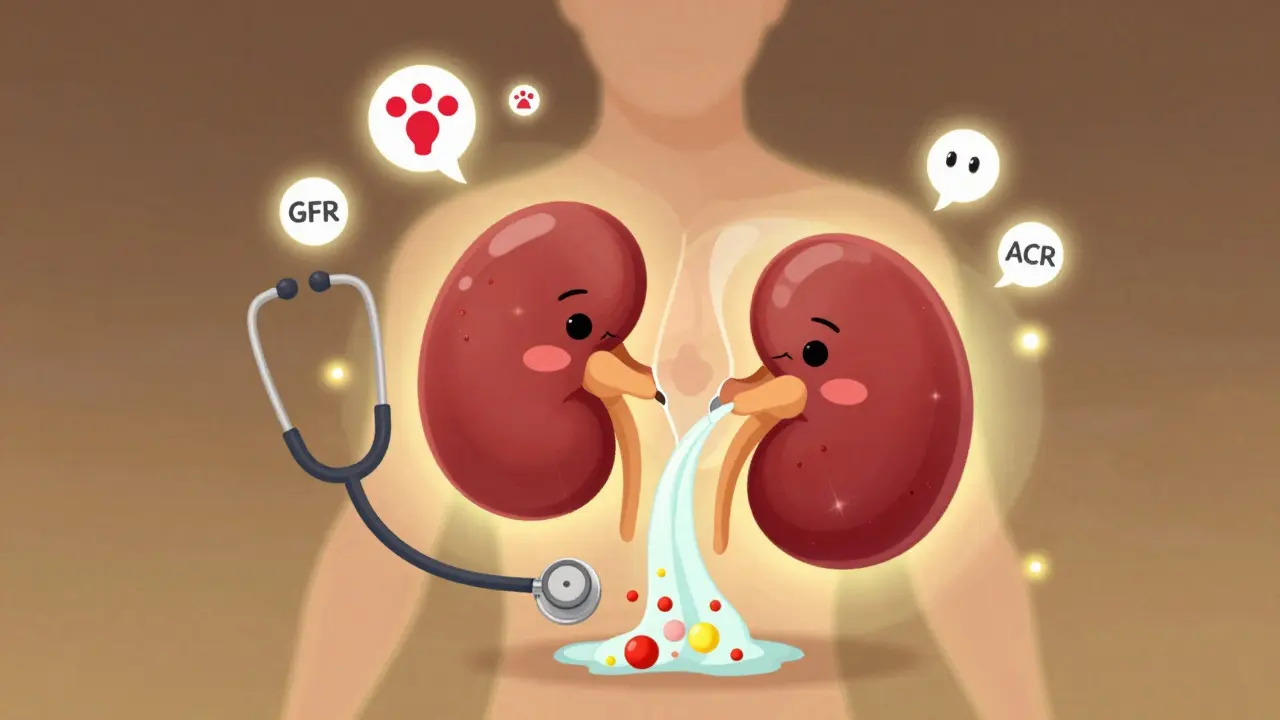
When your doctor says you need a kidney function test, it’s not just another routine checkup. It’s a quiet but powerful way to catch problems before they become serious. Most people don’t think about their kidneys until something goes wrong-like swelling in the ankles, fatigue, or high blood pressure. But by then, up to half the kidney’s filtering power might already be gone. That’s why tests for creatinine, GFR, and urinalysis matter. They don’t just measure waste in your blood or protein in your urine. They tell you how well your kidneys are doing their job: cleaning your blood, balancing fluids, and keeping your body running smoothly.
What Creatinine Tells You About Your Kidneys
Creatinine is a waste product your muscles make every day as they break down energy. Healthy kidneys filter it out of your blood and send it into your urine. If your kidneys aren’t working right, creatinine builds up. That’s why doctors look at your serum creatinine level in a blood test.
But here’s the catch: creatinine doesn’t rise until your kidneys have lost at least 50% of their function. That makes it a late warning sign, not an early one. Someone with strong muscles-like an athlete or a bodybuilder-might have naturally higher creatinine levels, even with perfectly healthy kidneys. On the other hand, an older person with low muscle mass might have normal creatinine even if their kidneys are failing. That’s why creatinine alone isn’t enough. It’s a clue, not a diagnosis.
In the UK, labs report creatinine in micromoles per litre (µmol/L). Normal ranges vary by age and sex, but generally, men have levels between 60-110 µmol/L, and women between 45-90 µmol/L. If your result is above that, your doctor won’t panic right away. They’ll look at your age, sex, weight, and other factors before deciding what it means.
What Is GFR-and Why It’s the Real Measure of Kidney Health
Glomerular Filtration Rate, or GFR, is the gold standard for measuring how well your kidneys filter blood. It’s not something they measure directly. Instead, they calculate it using your creatinine level, age, sex, and sometimes race. The most accurate formula used today is the CKD-EPI equation, which replaced the older MDRD method around 2010. It’s more precise, especially for people with near-normal kidney function.
Your eGFR is given in millilitres per minute per 1.73 square metres of body surface area (ml/min/1.73 m²). Think of it like miles per gallon for your kidneys: the higher the number, the better your kidneys are filtering. Here’s what the numbers mean:
- 90 or above: Normal kidney function, even if there’s mild damage
- 60-89: Mildly reduced function-could be early kidney disease
- 45-59: Mild to moderate decline
- 30-44: Moderate to severe decline
- 15-29: Severe decline
- Below 15: Kidney failure-dialysis or transplant may be needed
These stages come from the UK Kidney Association and are used across the NHS. If your eGFR drops below 60 for three months or more, you’re officially diagnosed with chronic kidney disease (CKD), even if you feel fine. That’s why regular testing matters.
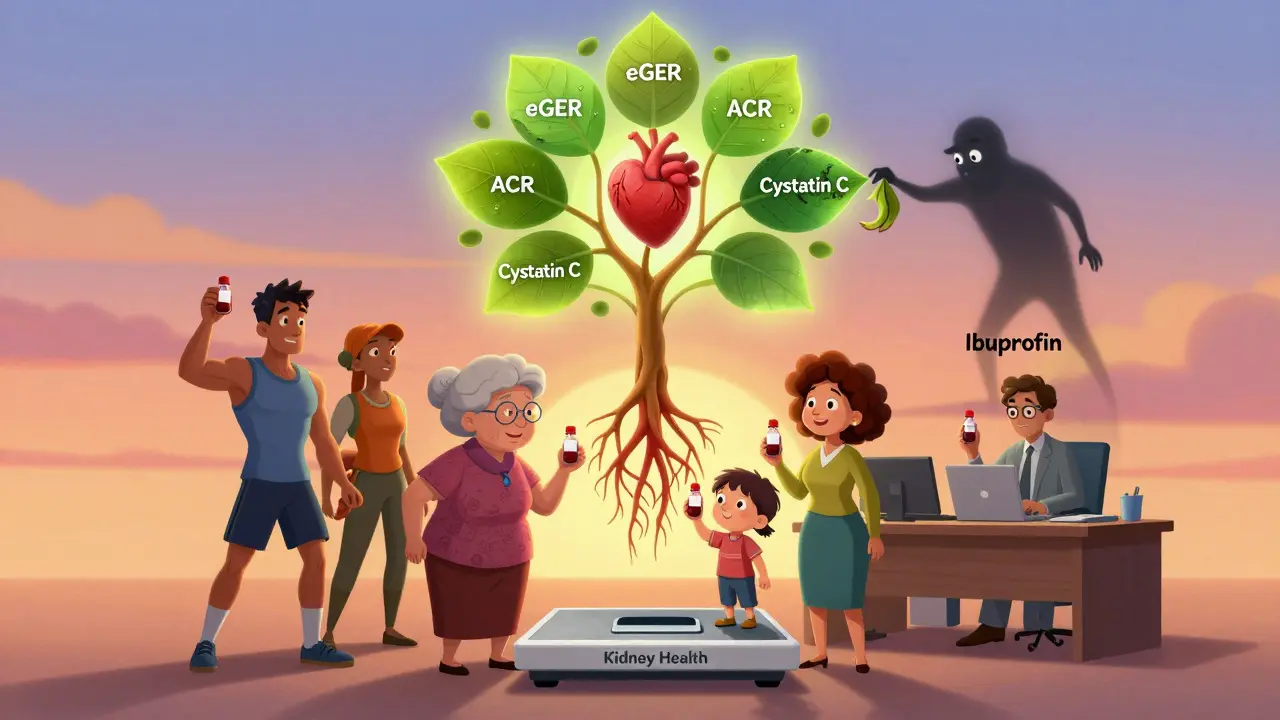
Some people-like those who are very muscular, pregnant, under 18, or very overweight-might get misleading eGFR results from creatinine. That’s when doctors turn to cystatin C, another blood marker. It’s less affected by muscle mass and gives a clearer picture of kidney function in tricky cases.
Urinalysis: The Silent Signal of Kidney Trouble
While blood tests tell you how well your kidneys are filtering, urine tests tell you what’s leaking out. The most important urine test today is the Albumin-to-Creatinine Ratio, or ACR. It measures how much albumin-a type of protein-is slipping through your kidneys into your urine.
Healthy kidneys don’t let protein out. If albumin shows up in your urine, it’s one of the earliest signs of kidney damage. This is especially true for people with diabetes or high blood pressure. In fact, the UK Kidney Association says ACR is now the first-line test for spotting kidney disease, not the old dipstick method.
Dipsticks-those little paper strips you pee on-are no longer recommended. They’re too vague. They might say “trace” or “1+” protein, but they can’t tell you how much. ACR gives you a precise number in milligrams of albumin per millimole of creatinine. Normal is under 3 mg/mmol. Between 3 and 70 is considered microalbuminuria-a warning sign. Above 70 means significant protein loss, and it’s time to act.
Here’s the key: you might have a normal eGFR but still have protein in your urine. That’s called “hidden kidney disease.” You feel fine, your blood looks normal, but your kidneys are already leaking. That’s why doctors always check both blood and urine together.
Other things urine tests can catch: blood (even invisible blood), sugar (a sign of uncontrolled diabetes), or signs of infection. If you’re told you have non-visible haematuria-blood you can’t see-you’ll likely be asked to repeat the test two or three times over a few weeks to confirm it’s real.

Who Needs These Tests-and How Often?
You don’t need a kidney test unless your doctor recommends it. But some people should get checked regularly:
- People with type 1 or type 2 diabetes
- People with high blood pressure
- Those with heart disease or a history of stroke
- Anyone who’s had acute kidney injury in the past
- People with a family history of kidney failure
- Those over 60, especially with other risk factors
The NHS recommends that people with diabetes or high blood pressure get an eGFR and ACR test at least once a year. If your results are normal, you might only need testing every two years. If they’re borderline or abnormal, you’ll likely be monitored every 3-6 months.
Even if you’re not in a high-risk group, it’s smart to get a basic metabolic panel-which includes creatinine and eGFR-once a year during your annual checkup. The CDC says this is one of the simplest ways to catch kidney problems early. And early detection means you can slow or even stop the damage.
What Happens If Your Results Are Abnormal?
If your eGFR is low or your ACR is high, your doctor won’t jump to conclusions. They’ll look at your full history: medications, diet, recent illness, fluid intake, and other blood results like sodium and potassium. Sometimes a single test is skewed by dehydration, infection, or a recent intense workout.
If the abnormal result holds up on a repeat test, you might be referred to a kidney specialist (nephrologist). They’ll look for the cause. Is it diabetes? High blood pressure? A rare autoimmune disease? Or something else?
Treatment isn’t always about drugs. Often, it’s about lifestyle: controlling blood sugar, lowering blood pressure, cutting salt, quitting smoking, and avoiding NSAIDs like ibuprofen if you’re at risk. A dietitian might help you adjust your protein intake. The goal isn’t to fix your kidneys-they can’t regenerate-but to protect what’s left.
And if your eGFR drops below 30? That’s when you start planning for the future. Dialysis or transplant options will be discussed, but many people live for years with stage 4 kidney disease if they’re managed well.
Myths About Kidney Tests
There are a lot of misunderstandings about these tests.
Myth: “I feel fine, so my kidneys must be okay.”
Truth: Kidneys are quiet organs. You can lose 70% of their function and still feel normal.
Myth: “Drinking more water will fix my high creatinine.”
Truth: Hydration can temporarily lower creatinine, but it doesn’t fix underlying damage. It might even hide the problem.
Myth: “Only older people get kidney disease.”
Truth: Diabetes and high blood pressure can damage kidneys at any age. More young adults are being diagnosed now than ever before.
Myth: “If my urine looks normal, I’m fine.”
Truth: Most early kidney damage doesn’t change the colour or smell of urine. Only a lab test can catch it.
What You Can Do Now
You don’t need to wait for symptoms. If you’re over 40, have high blood pressure, diabetes, or a family history of kidney disease, ask your GP for an eGFR and ACR test. It’s a simple blood draw and a urine sample. No fasting needed. No special prep.
Keep your blood pressure under 130/80. Control your blood sugar if you’re diabetic. Cut back on salt and processed foods. Stay active. Don’t take painkillers like ibuprofen or naproxen regularly unless your doctor says it’s safe.
Your kidneys work 24/7. They deserve a little attention. A simple test today could mean avoiding dialysis tomorrow.
What does a high creatinine level mean?
A high creatinine level usually means your kidneys aren’t filtering waste as well as they should. But it’s not always a sign of disease. Muscle mass, dehydration, or certain medications can raise creatinine. Doctors look at it along with your age, sex, and eGFR to get the full picture.
Can I check my kidney function at home?
You can’t accurately check kidney function at home. Urine dipstick tests sold online aren’t reliable for detecting early kidney damage. The only way to get accurate results is through a blood test for creatinine and eGFR, and a lab urine test for albumin-to-creatinine ratio (ACR). These require professional lab equipment.
Is cystatin C better than creatinine for measuring kidney function?
Cystatin C can be more accurate than creatinine in people with unusual muscle mass-like athletes, elderly people, or those with very low muscle tone. It’s not affected by diet or gender the way creatinine is. Some doctors use it alongside creatinine for a more precise eGFR, especially if results seem inconsistent with symptoms.
Why do I need both a blood test and a urine test?
Blood tests (like eGFR) show how well your kidneys are filtering. Urine tests (like ACR) show if they’re leaking important proteins. You can have normal eGFR but still have protein in your urine-this means early damage is happening. Both tests together give the full story. One alone isn’t enough.
How often should I get tested if I have diabetes?
If you have diabetes, you should get both an eGFR and ACR test at least once a year. If your results are normal, you might stretch it to every two years. If they’re abnormal, you’ll likely be tested every 3-6 months. Early detection is the best way to prevent kidney failure in people with diabetes.
If you’ve been told your kidney numbers are off, don’t panic. Most early kidney disease can be slowed-or even stopped-with the right care. The goal isn’t perfection. It’s progress. And the first step is knowing where you stand.



One comment
I had no idea kidneys could be failing and you'd still feel fine. My dad was diagnosed with stage 3 CKD last year-he was biking 10 miles daily and eating kale smoothies. He thought he was invincible. Turns out, his eGFR was 48 and ACR was 89. Scary how quiet this stuff is.
Now I get my bloodwork done yearly. No more skipping checkups. My doctor said if we caught it earlier, we could've slowed it down. Don't wait until you're swollen and tired.
Stop pushing this ‘early detection’ nonsense. The NHS and CDC are just trying to turn every American into a medical statistic. My creatinine’s 120-I’m a 38-year-old powerlifter. My kidneys are fine. Stop pathologizing muscle. You don’t need a test every year unless you’re on dialysis already. This is fear-mongering dressed as prevention.
There is a profound metaphysical truth embedded in the quiet labor of the kidneys: they do not announce their suffering. They do not demand applause. They filter silently, tirelessly, like the unseen architects of homeostasis-until, one day, the architecture begins to crumble, and the house floods.
We have become a civilization obsessed with metrics, yet blind to the poetry of physiology. The creatinine level is not merely a number-it is the echo of a body’s endurance. The ACR is not a diagnostic tool-it is a whisper from the soul of our biology, pleading to be heard before the silence becomes permanent.
Perhaps the true illness is not renal failure-but our collective amnesia toward the sanctity of our own organs.
Hey everyone, just wanted to say I’m from India and we see a lot of kidney issues here because of diabetes and high salt diets. My uncle had CKD and he didn’t know until his legs were swollen and he was dizzy all the time.
But here’s the good news-he started cutting sugar, walking daily, and drinking more water (not too much, just enough). His ACR dropped from 92 to 28 in 8 months! He’s still at stage 3 but feels like a new man.
Don’t give up if your numbers are off. Small changes matter. Talk to your doctor, get the tests, and don’t let fear stop you. You got this! 💪
Just got my ACR back-2.1. Normal! 😊 Stay hydrated, move more, skip the ibuprofen. Kidneys thank you!
Oh, so now we’re all supposed to panic because some lab technician typed ‘eGFR: 78’? How quaint. I’m sure the pharmaceutical lobby is thrilled. Let me guess-next we’ll be getting quarterly ‘kidney wellness’ emails from Blue Cross with a 10% discount on renal scans.
Meanwhile, my kidneys are doing just fine, thank you very much. I don’t need a spreadsheet to tell me I’m alive.
Let’s be real: this whole ‘kidney health’ movement is a scam. Creatinine? GFR? ACR? These are just fancy words invented by doctors to sell more tests. My cousin’s ‘eGFR’ was 55-he was told he had CKD. Turns out he was dehydrated from hiking. One glass of water and his numbers bounced back. They’re just looking for excuses to bill you.
And don’t even get me started on cystatin C. That’s just the next expensive blood test they’re pushing to replace creatinine. You’re being manipulated. Wake up.
My grandma got her first kidney test at 72. Normal eGFR, clean urine. 🙌 She’s still gardening and baking pies. Age ain’t a death sentence if you check in. ❤️
Why are we letting the government tell us how to live? Who authorized these tests? I’m not some lab rat. My body works fine. I don’t need some ‘NHS guideline’ to tell me to get a urine test. This is control. This is fear. This is the slippery slope to mandatory organ screenings.
And why are they always pushing this on people over 40? Are we becoming disposable at 40 now? I say NO. I’m not getting tested unless I’m vomiting blood.
Bro, I work in a lab in Mumbai and we see this every day. People think if they don’t have swelling or pain, they’re fine. Nope. ACR is the real MVP here. One guy came in with normal creatinine but ACR was 110-he had diabetes for 12 years and didn’t know. Now he’s on ACE inhibitors and losing weight.
Also, cystatin C? Yeah, it’s gold for athletes or elderly folks. Creatinine lies if you’re skinny or jacked. We use both now. And no, you can’t check this at home with a strip. Those Amazon tests are garbage. Save your cash. Go to a clinic. Simple blood + urine. Done.
And yes, NSAIDs are killers for kidneys. I’ve seen 28-year-olds with stage 3 CKD from taking ibuprofen every day for ‘back pain’. Stop it. Your kidneys don’t care about your gym gains.