
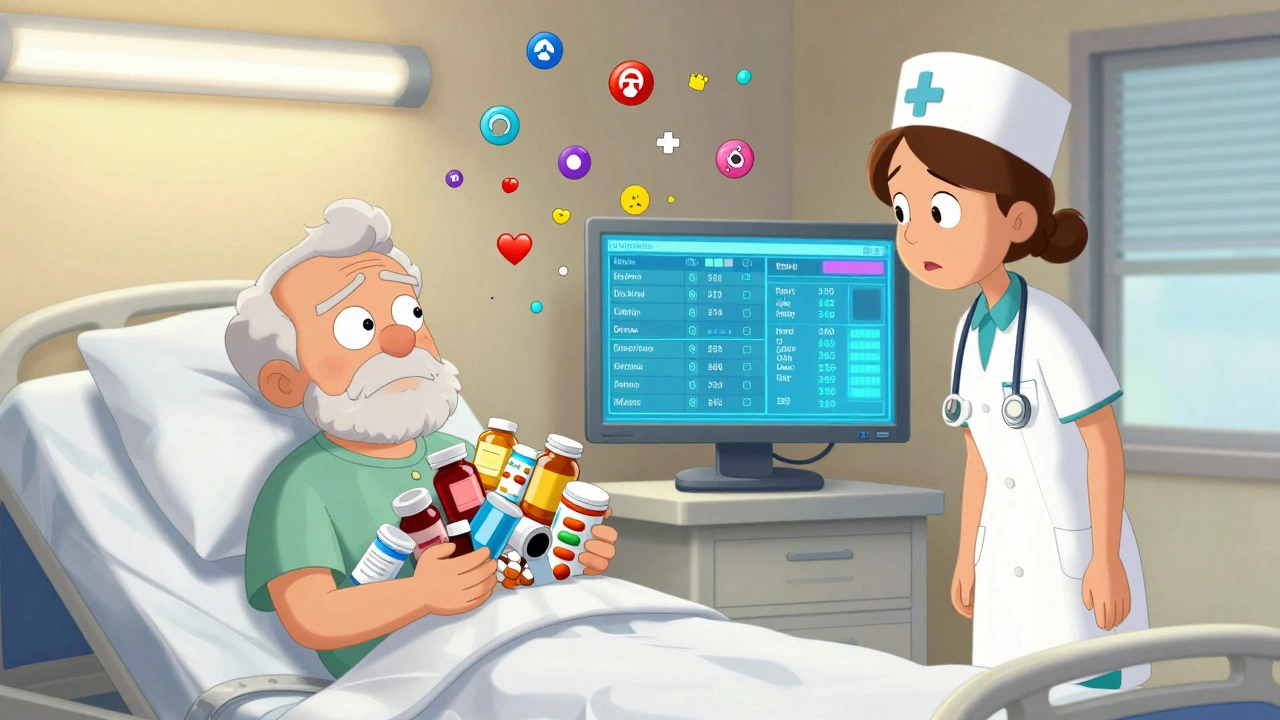
Medication errors during care transitions are one of the most common and dangerous problems in healthcare today.
Every year, hundreds of thousands of patients in the U.S. are harmed because their medication list gets lost, mixed up, or ignored when they move from hospital to home, or from one doctor to another. These aren’t small mistakes - they’re life-threatening. A patient gets sent home with a duplicate blood thinner. A senior forgets to mention their daily aspirin. A nurse misses a new allergy during admission. The result? Emergency visits, hospital readmissions, and sometimes death.
The good news? These errors are preventable. The best tool we have is medication reconciliation - a simple, proven process that makes sure every medication a patient takes is recorded, reviewed, and confirmed at every point they move between care settings.
What is medication reconciliation, and why does it matter?
Medication reconciliation isn’t just making a list. It’s a three-step safety check: first, get the most accurate list of everything the patient is taking - pills, patches, injections, even over-the-counter drugs and supplements. Second, compare that list to what the care team thinks they’re on. Third, fix any mismatches before giving a new dose or sending the patient out the door.
The Joint Commission has required this since 2005. The World Health Organization calls it a core part of their global push to cut medication harm by 50%. And it works. Studies show hospitals that do it well cut post-discharge errors by more than half. One 2023 study found patients who got full reconciliation were 38% less likely to be readmitted within 30 days.
But here’s the catch: most places only do it half-right. A 2024 survey found only 28% of facilities regularly involve patients in the process. That’s a huge problem. Patients often know their own meds better than anyone else. If you don’t ask them, you’re missing the most important source of truth.
Where do errors happen most - and why?
Medication errors spike during transitions. That’s when patients move between units, hospitals, nursing homes, or back home. The biggest breakdowns happen at discharge.
Why? Three reasons:
- Information doesn’t follow the patient. Only 37% of U.S. hospitals can electronically share medication lists with community pharmacies. That means discharge nurses often have to call pharmacies manually - and many don’t even have time to do that.
- Too many meds. Patients on 10 or more medications have a 65% chance of having at least one error during transition. Polypharmacy is the silent killer here. A pill that’s fine in the hospital might be dangerous at home, especially if it’s a new dose or a drug that interacts with something else.
- People aren’t clear on who’s responsible. A 2022 study found that when staff were trained to take medication histories but no one was assigned to own the process, errors went up by 15%. You can’t just hand off a clipboard and hope someone remembers.
And here’s a hidden danger: electronic health records (EHRs). They’re supposed to help. But when first implemented, they actually increased discrepancies by 18%. Why? Because they’re clunky. They auto-fill old meds. They don’t sync with outside systems. And they make providers rush - one resident reported adding 12-15 minutes per patient just to reconcile meds, so they start skipping steps.
What actually works? The evidence-backed approach
Not all programs are created equal. The AHRQ’s MATCH toolkit is the gold standard. It’s not just software - it’s a full system. It tells you who does what, when, and how. Organizations that follow all 11 workflow phases see a 63% drop in errors. EHR-only setups? Only 41%.
The biggest win comes from putting pharmacists in charge of transitions. Facilities with dedicated transition pharmacists see 53% fewer adverse drug events. Why? Pharmacists don’t just check lists - they ask questions. They spot interactions. They explain why a drug was stopped or changed. One pharmacist told me: “Catching a duplicate anticoagulant order that would’ve caused a major bleed is why I do this work.”
Technology helps - but only if it’s used right. Barcode scanning reduces errors by 48% in hospitals. AI tools like MedWise Transition, cleared by the FDA in 2024, cut discrepancies by 41% in pilot programs. But none of it matters if the system doesn’t connect with the community pharmacy or if the patient isn’t involved.
How to fix it: A practical 5-step plan
You don’t need a fancy system to start. You need a plan. Here’s what works in real clinics and hospitals:
- Start at admission. Get the full list from the patient or family - not just from the chart. Ask: “What do you take every day? Any new ones since your last visit? Any you stopped?”
- Verify with two sources. Cross-check the list with the pharmacy (if possible), the primary care provider, and the patient’s own pill bottles. The 2025 National Patient Safety Goals now require this for high-risk drugs like warfarin, insulin, and opioids.
- Assign ownership. Who’s in charge of reconciliation? It can’t be “everyone.” Designate a pharmacist, nurse, or trained technician. Make it their job - not an extra task.
- Reconcile at discharge - and explain it. Don’t just hand over a paper list. Sit down. Say: “Here’s what you’re taking now. Here’s what changed. Here’s why.” Use plain language. No jargon.
- Follow up. Call the patient 48 hours after discharge. Ask: “Did you get your meds? Did anything confuse you?” Simple calls cut readmissions by up to 20%.
Time is the biggest barrier. Most facilities give 8-10 minutes per patient. Experts say you need 15-20. Start small. Pick one unit. Train one team. Do it right for 10 patients. Then scale.
What’s holding you back - and how to overcome it
Resistance is real. A 2023 AHRQ survey found 63% of hospitals say physicians won’t participate. Why? They’re busy. They think it’s “nursing’s job.”
Solution? Embed it into existing workflows. Don’t add a new step. Make reconciliation part of the admission intake, the discharge checklist, the handoff report. Use checklists. Use alerts in the EHR. Make it automatic.
Another problem: poor communication between hospitals and pharmacies. Only 43% of hospitals consistently verify discharge meds with community providers. That’s unacceptable. Start by building partnerships. Call your local pharmacies. Ask what they need. Maybe they want a fax line. Maybe they need a portal. Meet them where they are.
And don’t forget the patient. Only 28% of facilities involve them. That’s a missed opportunity. Patients who understand their meds are 85% more confident - and far less likely to make mistakes at home.
The future is here - and it’s getting better
The global medication safety tech market is growing at 14.3% a year. New tools are emerging fast. AI-driven reconciliation systems are learning from millions of cases. Some can now flag interactions you’d never catch manually. The WHO’s new phase of Medication Without Harm targets transitions specifically, with a goal of cutting harm by 30% by 2027.
But technology won’t fix this alone. The real breakthroughs come from people: pharmacists who listen, nurses who ask, doctors who collaborate, and patients who speak up.
Every medication error during a transition is preventable. It doesn’t take a miracle. It takes a system. It takes accountability. And it takes making sure no one falls through the cracks.
What happens if you do nothing?
Costs are rising. CMS can reduce hospital payments by up to 1.5% for non-compliance with reconciliation standards. But more than money, lives are at stake. AHRQ estimates that full implementation of proven practices could prevent 800,000 medication errors in the U.S. each year - and save $2.1 billion.
That’s not a number. That’s 800,000 people who won’t end up back in the hospital. 800,000 families who won’t face a crisis because a pill got lost in the shuffle.
The tools exist. The evidence is clear. The question isn’t whether you can afford to do this - it’s whether you can afford not to.



One comment
Man this is so spot on I’ve seen this happen in my own family. Grandpa got sent home with two different blood thinners and no one told him which one to take. He ended up in the ER bleeding internally. The hospital said ‘it was on the paper’ but the paper was lost. Medication reconciliation isn’t optional anymore it’s survival.
I’m a nurse and I cry every time I see a patient get discharged with a 12-pill regimen and no one explains what half of it does. We’re not just handing out pills we’re handing out trust. And when we fail that trust? People die. I’m so tired of being told ‘we don’t have time.’ Time is the only thing that saves lives here.
There’s a reason WHO and AHRQ both prioritize this: it’s the lowest hanging fruit in patient safety. Pharmacists are the unsung heroes here. In my hospital we assigned a transition pharmacist to every discharge and within 6 months our 30-day readmissions dropped by 47%. The EHR didn’t fix it. The process did. And yes it takes time but so does treating a bleeding ulcer from a drug interaction you could’ve caught in 10 minutes.
So let me get this straight… we’ve had a proven system since 2005 but still only 28% of places ask the patient? That’s not negligence that’s comedy. I’m surprised we haven’t started charging hospitals for ‘medication roulette’.
my uncle got discharged with a new med and the paper said ‘take 1 tab qd’ but he thought qd meant ‘when you feel like it’… he didn’t take it for 3 days and then took 5 at once. now he’s in rehab. no one explained it. no one followed up. just a stack of papers and a ‘have a nice day’.
Look i’ve been in the trenches and let me tell you the real bottleneck isn’t the EHR or staffing its the damn physicians who think reconciliation is ‘below them’. They’ll do a 10-minute consult but won’t spend 2 minutes verifying meds with the pharmacist. It’s a culture problem. We need to make it part of their KPIs or just fire the ones who refuse.
OMG I just had to take my mom to the ER because she took her blood pressure med AND the one she was told to stop. The hospital sent her home with a list that said ‘discontinue’ but the pharmacy printed it as ‘continue’. The nurse didn’t even look at her pill bottles. I screamed for 20 minutes and they finally admitted it was their mistake. Now I’m on a mission to make every hospital do this right. This isn’t a policy it’s a moral obligation.
THIS. IS. EVERYTHING. 🙌 Let’s get pharmacists on the front lines. Let’s make patients feel heard. Let’s stop treating medication lists like paperwork and start treating them like lifelines. I’m sharing this with every nurse and doctor I know. We can fix this. We HAVE to fix this. 💪❤️
Barcoding works. I’ve seen it. But here’s the catch - if the barcode scanner is broken or the med bottle doesn’t have one? You’re screwed. We need better tech integration. And yeah patients need to be involved but most of them don’t even know what their meds are for. So we gotta teach them too. Simple. No jargon. Just ‘this pill stops your heart from exploding’.
Oh please. You think this is about ‘patient safety’? It’s about liability. CMS penalties. Hospital ratings. The fact that we’re only now ‘realizing’ this is a problem because it’s costing money not because people kept dying. We don’t care until the audit comes.
Implementing the MATCH toolkit isn’t a project - it’s a paradigm shift. You need to train not just staff but culture. Every discharge must include a pharmacist-led verbal reconciliation with a teach-back. No more ‘here’s your list’. You ask the patient to repeat it back. If they can’t? You don’t send them home. Period. That’s the standard. And if your org won’t adopt it? You’re not a healthcare provider - you’re a liability waiting to happen.
While the intentions behind the proposed interventions are undoubtedly commendable, one cannot help but observe that the implementation of such protocols remains contingent upon the availability of adequate human and technological resources - a luxury not universally accessible within the current fiscal and structural constraints of many healthcare institutions. Consequently, while theoretically optimal, the practical applicability of the outlined measures remains, in many contexts, aspirational rather than actionable.