
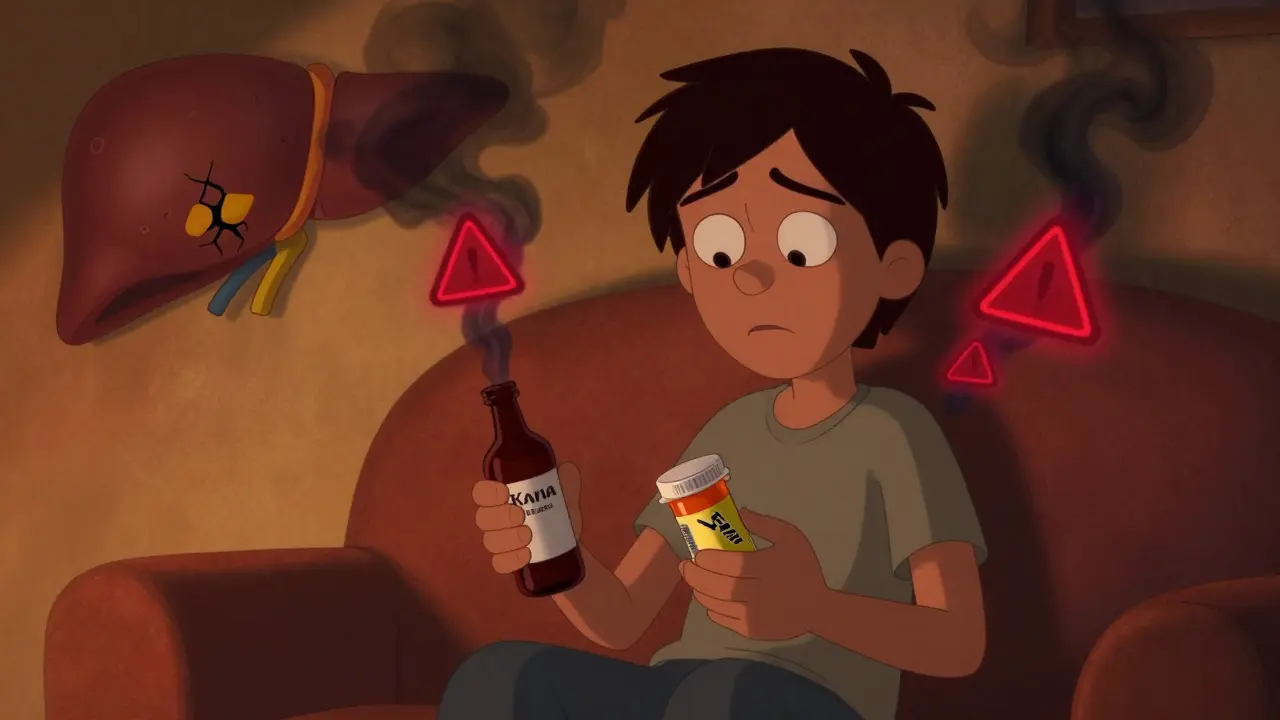
Combining kava with sedative medications can be dangerous-seriously dangerous. If you're taking anything that makes you drowsy-like Xanax, Valium, lorazepam, or even sleep aids-you need to understand what kava does to your body when mixed with them. This isn't just a "maybe" risk. It's a documented, life-threatening combo that has sent people to the hospital and, in some cases, required liver transplants.
What Exactly Is Kava?
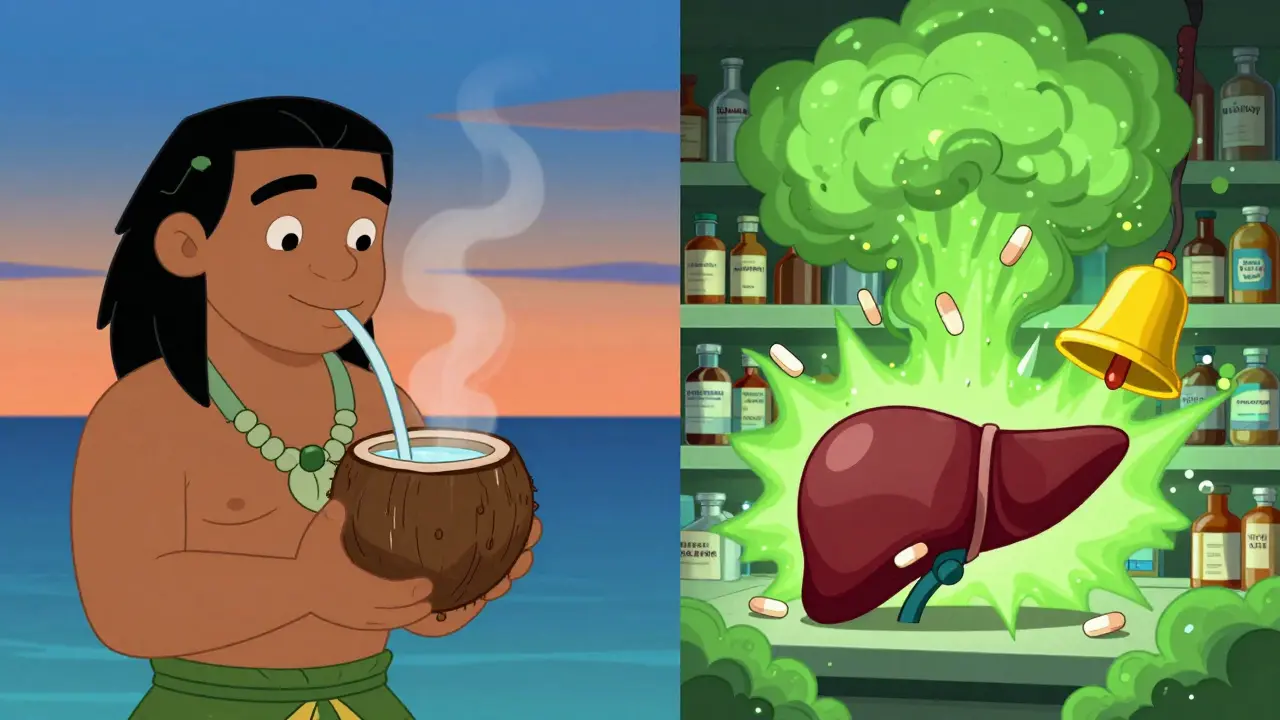
Kava, also called kava kava, comes from the roots of a plant native to the Pacific Islands. For centuries, people there have brewed it into a drink for ceremonies and relaxation. In the West, it became popular as a natural remedy for anxiety, stress, and insomnia. The active parts-called kavalactones-work on your brain to create calm, muscle relaxation, and mild sedation. A typical dose ranges from 70 to 250 mg per day, depending on how it's made.
But here’s the catch: not all kava is the same. Traditional Pacific Island preparations use water to extract kavalactones, which results in a safer, more predictable product. Most commercial supplements sold online, though, use alcohol or acetone to pull out more kavalactones faster. These extracts can contain up to 300 mg per dose-far higher than what’s traditionally consumed-and are linked to most of the serious side effects.
Why Kava and Sedatives Don’t Mix
Both kava and sedative medications slow down your central nervous system. When you take them together, the effect isn’t just added-it’s multiplied. Think of it like pressing the brake pedal and then having someone else push it too. You don’t just stop faster-you might lose control entirely.
Studies show kava can increase the blood levels of drugs like midazolam by 27% by blocking the liver enzyme CYP3A4, which is responsible for breaking down many sedatives. This means the medication stays in your system longer and stronger than intended. People have reported being unable to stand, slurring speech, or passing out after combining kava with even small doses of benzodiazepines.
The FDA has logged 37 reports of sedation-related emergencies tied to kava since 2019. Twelve of those cases required medical intervention. One Reddit user described being "unable to stand for eight hours" after taking kava with lorazepam. Another patient in Sacramento County ended up with a dangerously high INR (4.2)-a blood clotting level that puts you at risk of internal bleeding-after mixing kava with diazepam.
The Liver Risk Is Real-and Often Silent
While sedation is immediate, liver damage from kava is sneaky. It doesn’t come with a warning siren. You might feel fine for weeks or months. Then, suddenly, you’re exhausted, nauseous, your skin turns yellow, and your blood tests show liver enzymes skyrocketing.
Over 25 international cases of severe liver injury have been linked to kava, including hepatitis, cirrhosis, and acute liver failure requiring transplant. The FDA issued a warning in 2002 after these cases started piling up. Since then, the EU, Canada, the UK, and Switzerland banned kava as a medicinal product. The U.S. still sells it as a dietary supplement, with almost no oversight.
What’s worse? Most people don’t tell their doctors they’re taking kava. A 2023 study in Sacramento County found only 22% of patients with liver problems mentioned kava use when asked-until the doctors dug deeper. That means doctors are often flying blind when trying to diagnose the cause of liver damage.
Who’s at Highest Risk?
If you’re taking any of these, you’re playing with fire:
- Benzodiazepines: Xanax, Valium, Ativan, Klonopin
- Sleep meds: Ambien, Lunesta, zaleplon
- Antidepressants: Some SSRIs and tricyclics can also affect liver metabolism
- Alcohol: Even one drink with kava increases liver stress
- Other herbs: Valerian, passionflower, or melatonin may add to sedation
People with pre-existing liver conditions-fatty liver, hepatitis, or even a history of heavy drinking-should avoid kava completely. The CDC says there’s no safe dose for them.
Even if you’re healthy, long-term use above 250 mg daily raises the risk. Australia’s health agency says the chance of serious liver injury is low-but not zero. And when it hits, it hits hard.
What the Experts Say
There’s disagreement on whether kava itself causes liver damage-or if it’s the extract method, contaminants, or other factors. Dr. Jay H. Hoofnagle, a top liver researcher, says at least a dozen cases of liver failure are clearly tied to kava. Others, like Dr. J. Christopher Gorski, argue that some cases may involve other causes.
But here’s the bottom line: the European Food Safety Authority, the World Health Organization, and the U.S. FDA all agree on one thing-kava should not be used with medications that are processed by the liver’s CYP2D6, CYP2C9, or CYP3A4 enzymes. That includes most sedatives, antidepressants, and painkillers.
And here’s something most people don’t realize: traditional water-based kava drinks have a 9x lower rate of adverse events than commercial alcohol extracts. That’s why Pacific Islanders who drink it socially rarely report liver problems. The problem isn’t kava itself-it’s how it’s processed and sold in the U.S.
What Should You Do?
If you’re taking sedatives and considering kava:
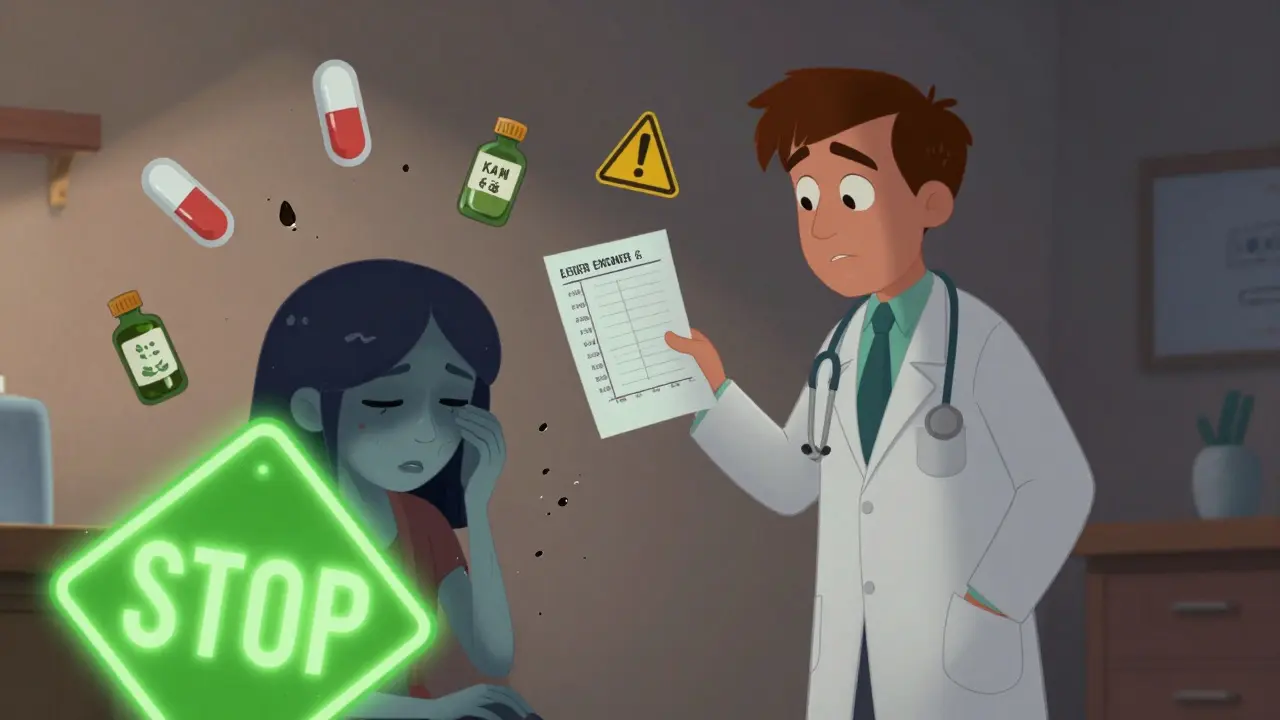
- Stop. Don’t combine them. Period.
- Talk to your doctor or pharmacist. Tell them everything you’re taking-even "natural" supplements.
- Check your liver function. If you’ve been using kava, get a basic blood test (ALT, AST, bilirubin). Even if you feel fine, it’s worth it.
- If you’ve had symptoms like fatigue, nausea, dark urine, or yellow eyes-stop kava immediately and see a doctor.
- Don’t trust online reviews. Just because someone says "it worked for me" doesn’t mean it’s safe for you.
If you’re using kava for anxiety and want to quit, don’t stop cold turkey. Talk to your provider about alternatives like cognitive behavioral therapy, SSRIs, or even low-dose buspirone-none of which carry the same liver risks.
The Bigger Picture
Kava is a $117 million industry in the U.S., mostly sold online. Most buyers never talk to a pharmacist. No label warns about drug interactions. No FDA approval process checks safety before sale. That’s not a supplement-it’s a gamble.
California and New York are starting to push for warning labels. The FDA is now requiring enhanced liver monitoring for kava in clinical trials. But until then, the burden is on you.
The safest version of kava-the traditional water extract-isn’t even available in most stores. What you’re likely buying is a concentrated, alcohol-based product designed to maximize potency, not safety.
If you want natural relief from anxiety, there are safer options: exercise, mindfulness, magnesium, or even chamomile tea. None of those have been linked to liver failure.
Don’t risk your liver for a feeling that might not even be worth it.
What If You’ve Already Combined Them?
If you’ve taken kava with a sedative and feel unusually drowsy, confused, or nauseous, seek medical help immediately. Don’t wait. Sedation can turn into respiratory depression. Liver damage can progress without symptoms.
Even if you feel fine, get your liver checked within 30 days. ALT levels above 3 times the normal range mean you need to stop kava immediately. Most mild cases reverse within two months if caught early.
Can kava cause liver damage even if I don’t take sedatives?
Yes. While the risk is higher when combined with sedatives, kava alone has been linked to over 25 cases of severe liver injury worldwide, including hepatitis, cirrhosis, and liver failure requiring transplant. Most cases occurred with long-term use of high-dose extracts (over 250 mg daily). Traditional water-based preparations appear safer, but no form is risk-free.
Is kava legal in the U.S.?
Yes. Kava is sold as a dietary supplement under the 1994 Dietary Supplement Health and Education Act (DSHEA). The FDA has issued warnings since 2002 about liver risks but has not banned it. This means manufacturers don’t need to prove safety before selling it. That’s why you’ll find kava in gas stations, online stores, and health shops-with no warning labels about drug interactions.
How long does kava stay in your system?
The sedative effects usually peak within 90 minutes and last 2 to 6 hours. But kavalactones can linger in your liver for days, especially with repeated use. This is why even taking kava a few days before a sedative can still increase the risk of interaction. The liver enzymes it inhibits remain suppressed for up to 72 hours after the last dose.
Are there safer alternatives to kava for anxiety?
Yes. Several evidence-based alternatives carry far less risk: cognitive behavioral therapy (CBT), regular exercise, magnesium glycinate, L-theanine, and prescription options like buspirone or low-dose SSRIs. None of these have been linked to liver failure. Chamomile tea and passionflower are milder herbal options, but even these should be used cautiously with sedatives.
Should I stop kava if I’m on antidepressants?
If you’re taking antidepressants like SSRIs (e.g., sertraline, fluoxetine) or tricyclics (e.g., amitriptyline), you should avoid kava. These drugs are metabolized by the same liver enzymes (CYP2D6, CYP2C9) that kava inhibits. This can lead to higher drug levels in your blood, increasing side effects like dizziness, nausea, or serotonin syndrome. Always consult your doctor before combining any supplement with psychiatric meds.
If you’re currently using kava and taking any sedative medication, the safest choice is to stop kava now. Your liver doesn’t have a warning system. By the time you feel symptoms, it might already be too late.


One comment
Let me be crystal clear: if you’re mixing kava with benzodiazepines, you’re not ‘self-medicating’-you’re performing a high-risk biological experiment on yourself with zero oversight. The FDA reports aren’t suggestions. They’re autopsy reports waiting to happen. And no, ‘I’ve been doing it for months’ doesn’t make you immune. Your liver doesn’t care about your discipline. It only cares about CYP3A4 inhibition.
Stop romanticizing ‘natural remedies.’ This isn’t herbal tea. This is pharmacology with a cowboy hat on.
And for the love of all that’s metabolic, stop posting Reddit testimonials like they’re peer-reviewed data. One person’s ‘mild drowsiness’ is another person’s liver transplant queue.
It’s not about fearmongering. It’s about basic biochemistry. And if you don’t get that, you shouldn’t be touching supplements at all.
Get tested. Stop lying to your doctor. And for God’s sake, read the damn label-even if it doesn’t say ‘DANGER’ in red flashing letters, the science is screaming it.
The philosophical dilemma here lies not in the pharmacology of kava, but in the epistemological rupture between traditional wisdom and modern commodification.
For millennia, Pacific Islanders consumed kava in ceremonial contexts-slowly, mindfully, with communal accountability. The kavalactone content was regulated not by chemistry, but by culture. Today, the same plant is reduced to a profit-driven extract, stripped of ritual, dosed by algorithm, and sold to anxious consumers who mistake pharmacological potency for spiritual relief.
It is not the plant that is dangerous. It is the system that has severed it from its context.
The liver damage is not an accident of biochemistry-it is a symptom of cultural dislocation. We have replaced wisdom with convenience, and now we are paying the biological price for our intellectual laziness.
Perhaps the real question is not ‘Is kava safe?’ but ‘Why have we abandoned the wisdom that once kept it safe?’
Per CYP3A4 inhibition kinetics, kava extracts exhibit non-linear pharmacokinetic behavior, particularly with alcohol-based solvents. Plasma concentrations of kavalactones exceed therapeutic thresholds by 3–5x compared to aqueous preparations, leading to enzyme saturation and downstream metabolic interference with benzodiazepines.
Pharmacogenomic variability in CYP2D6 and CYP2C9 polymorphisms further compounds risk, particularly in slow metabolizers. The 27% increase in midazolam AUC is statistically significant (p < 0.01) in controlled trials.
Furthermore, hepatotoxicity correlates with pyrrolizidine alkaloid contamination in non-traditional extracts-likely introduced via improper root processing or adulteration.
Recommendation: Avoid all non-aqueous extracts. If used, monitor ALT/AST weekly. Discontinue if >3x ULN. No exceptions.
Let’s cut through the corporate BS. The FDA didn’t warn about kava because it’s dangerous-they warned because Big Pharma got scared of a $117M natural alternative that doesn’t require prescriptions.
Every single country that banned kava? They also banned CBD, kratom, and psilocybin. Coincidence? No. It’s about control.
And don’t you dare tell me ‘traditional water extract’ is safe. That’s the same crap they told us about tobacco. ‘It’s fine if you don’t smoke 20 a day.’
They’re lying. They’re all lying. The liver damage? Maybe. But the cover-up? 100% real.
Why do you think the FDA lets it be sold in gas stations? So you’ll keep buying it. So they can say ‘we warned you’ when you get sick. Then they sell you the liver transplant.
This isn’t a health issue. It’s a profit war. And you’re the battlefield.
Oh, so now we’re supposed to believe that kava is the villain because it’s sold in a bottle? How quaint. The real tragedy is that people still think ‘natural’ means ‘safe’-as if plants evolved to be pharmaceutical-grade. Did you know that hemlock is natural? Or foxglove? Or deadly nightshade?
And let’s not pretend the pharmaceutical industry is some angelic guardian of public health. They’ve been selling opioids like candy while demonizing anything that doesn’t have a patent.
But still. Kava? In extract form? With sedatives? That’s not just irresponsible-it’s the kind of behavior that makes me question whether humanity is capable of basic self-preservation.
And yes, I’ve seen the liver enzyme reports. I’ve seen the transplant lists. I’ve seen the people who thought they were ‘just trying to be healthy.’
It’s not about fear. It’s about humility. You’re not a biochemist. You’re not a pharmacologist. Stop pretending you are.
Everyone’s panicking about kava, but nobody’s talking about how Valium was prescribed to grandmas for 40 years with zero liver warnings. Funny how the ‘natural’ stuff gets demonized while Big Pharma gets a free pass.
Also, if kava causes liver damage, why haven’t the Pacific Islanders all died by now? Oh right-they drink it in water, not in 300mg alcohol bombs sold by influencers.
So the real problem isn’t kava. It’s capitalism. And the fact that you think a $12 bottle online is equivalent to a ceremonial drink made by a chief in Vanuatu.
Also, I’ve taken kava with Xanax. Felt fine. So your ‘life-threatening’ combo is just a scare tactic for people who don’t know how to read a study.
So basically… don’t take kava if you’re on meds? 😅 I mean, I get it, but like… I’ve been taking it for anxiety since 2020 and I’m still standing. Also, my cat is more alert than me after a kava night. 🐱💤
Also, why is everyone acting like this is new? I’ve seen Reddit threads from 2005 with the same warnings. We’re all just relearning the same lesson every 5 years.
Also, can we talk about how the FDA lets you buy 1000mg melatonin gummies but bans kava? 😭
Anyway, I’ll probably keep taking it. But now I’ll do it while watching Netflix and pretending I didn’t read this post. 🤷♀️
As someone who grew up in a Pacific Islander household, I’ve seen kava prepared the traditional way-ground root, cold water, strained through cloth, served in a bowl with ceremony. It’s not a supplement. It’s a social ritual.
The extracts sold in the U.S. are not kava. They’re kava-shaped products made for profit, not healing.
Most people don’t realize that the Pacific Islanders who drink kava daily have lower rates of anxiety and depression than Western populations. Why? Because they don’t take it alone. They take it with community. With silence. With presence.
It’s not the kavalactones that heal. It’s the intention.
If you’re taking kava to escape your life, you’re missing the point. And yes, the extracts are dangerous. But the real danger is believing that a pill can replace connection.
Bro, I took kava with Xanax last week and I slept for 14 hours straight. Woke up feeling like I was in a dream. No liver damage. No hospital. Just chill.
Why you all so scared? You think your liver is made of glass? 😂
My cousin in Lagos takes kava with gin every weekend. Still alive. Still laughing.
Stop scaremongering. This is just Big Pharma trying to kill the vibes. 🙃
Also, I don’t even know what CYP3A4 means. But I know my body. And my body say: kava good. Docs bad.
How is it that we can have 15 different studies on kava’s hepatotoxicity, yet the same people who scream about ‘pharmaceutical conspiracy’ will happily swallow 500mg of ashwagandha from a brand that doesn’t even list the extraction method?
It’s not about kava being evil. It’s about how we treat ‘natural’ as a free pass to ignore science.
And if you’re using kava for anxiety, you’re using a blunt instrument to fix a scalpel problem.
CBT is free. Exercise is free. Therapy is covered by insurance. But no-you’d rather buy a $20 bottle from Amazon and call it ‘self-care.’
It’s not brave. It’s lazy. And frankly, a little insulting to anyone who’s actually done the work.
I just want to say: if you’re reading this and you’re scared because you’ve been taking kava with your meds… you’re not alone. And you’re not bad. You’re just trying to feel okay.
But you don’t have to keep doing it alone.
Talk to your doctor. Tell them everything. Even if you’re embarrassed. Even if you think they’ll judge you.
Your liver doesn’t care if you’re ‘just trying to relax.’ It just wants you to stop putting toxins in it.
And if you’re ready to quit? There are people who can help. Real people. Not influencers. Not supplements. Real support.
You deserve to feel calm without risking your life. 💛
It is axiomatic that the administration of pharmacologically active botanical extracts in the absence of standardized dosing, quality control, and regulatory oversight constitutes a significant public health hazard.
The DSHEA framework, enacted in 1994, represents a legislative failure to protect consumers from unverified medicinal claims.
Kava, as a CYP3A4 inhibitor, demonstrates a clear pharmacodynamic interaction profile with benzodiazepines, as evidenced by multiple case series and pharmacokinetic studies.
Therefore, the continued sale of non-aqueous kava extracts without mandatory labeling of active constituent concentration, extraction solvent, and contraindications constitutes a violation of the principle of informed consent.
It is not merely irresponsible-it is ethically indefensible.
Okay so I’ve been taking kava for 3 years. Never had a problem. But then I read this and I Googled ‘kava liver failure’ and suddenly I’m crying in the grocery store aisle because I thought I was healing myself but I was just… slowly poisoning myself?
I didn’t know. I swear. I thought ‘natural’ meant ‘safe.’ I thought my yoga teacher knew what she was talking about.
I’m getting bloodwork tomorrow. I’m quitting. And I’m mad. Not at the post. At myself.
But also… thank you. For saying it like it is. I needed to hear it from someone who didn’t sell me a bottle.
Let me ask you something: if kava causes liver damage, why hasn’t the WHO declared it a Class 1 carcinogen? Why isn’t it on the DEA list? Why is it still sold in Walmart?
Because the whole thing is a scam. The liver cases? Maybe 5% are real. The rest are people who were drinking alcohol, taking acetaminophen, or had hepatitis B and just blamed kava.
And the FDA? They’ve been pushing this narrative since 2002 because Big Pharma paid them to.
Also, I’ve taken kava with Ambien. Slept like a baby. Woke up fine. Your ‘life-threatening’ combo is just fear porn.
They want you scared. So you’ll buy their pills. Don’t be their puppet.
I just want to say something gentle: we all want to feel better. We’re all tired. We’re all anxious. We’re all looking for something that helps without a prescription or a therapist’s hourly rate.
Kava, in its purest form, can be part of that. But only if we treat it with respect. Not as a quick fix. Not as a supplement. But as a medicine.
And yes, mixing it with sedatives is dangerous. We know that.
But instead of shaming people who’ve done it, maybe we can help them stop. Gently. Without judgment.
Because the real enemy isn’t kava. It’s the loneliness that made them reach for it in the first place.
If you’re reading this and you’re scared… you’re not broken. You’re human. And you deserve help, not a lecture.
And for the person who said ‘I’ve been doing it for years and I’m fine’-congratulations. You’re one of the lucky ones. But your luck isn’t a medical guideline.
One in 10,000 people get struck by lightning. That doesn’t mean walking outside in a thunderstorm is safe.
Stop using your survival as proof it’s not dangerous. That’s not logic. That’s survivorship bias wrapped in bravado.
And if you think your liver is invincible? Wait until your ALT hits 1200. Then come back and tell me how ‘natural’ it all felt.