
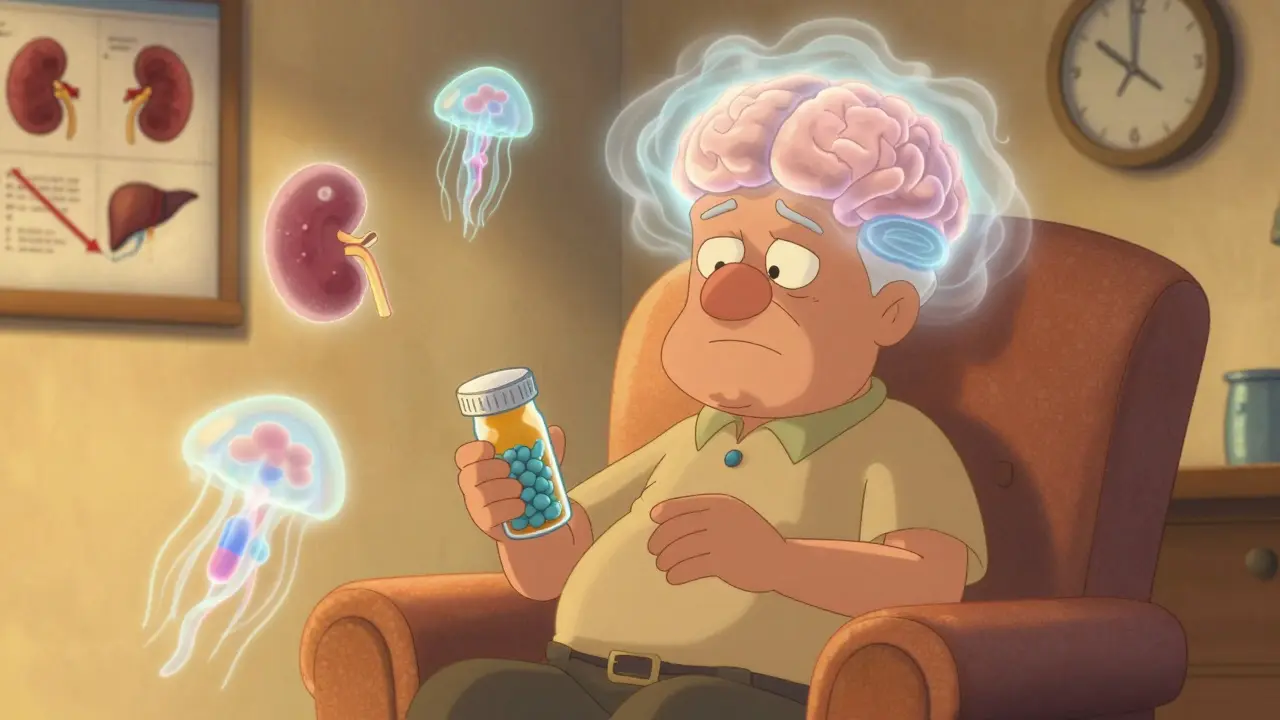
When you’re younger, a pill works the way it’s supposed to - you take it, and within hours, you feel better. But after 65, that same pill might not work the same way. In fact, it could make you sicker. This isn’t just a myth or an old wives’ tale. It’s biology. As your body ages, how it handles medicine changes in ways most people don’t expect - and those changes can be dangerous if you’re not aware of them.
Why Older Bodies Process Drugs Differently
Your body doesn’t just slow down with age - it rewires how drugs move through it. This is called pharmacokinetics: how your body absorbs, distributes, metabolizes, and gets rid of medication. By the time you hit 70, your kidneys are filtering about 30% to 50% less blood than they did at 30. That means drugs like digoxin, warfarin, and many antibiotics stick around longer. They don’t get flushed out. And when they build up, they don’t just sit there - they start causing problems. Your liver, which breaks down most medications, also loses efficiency. Blood flow to the liver drops by 30% to 40% after age 70. That slows down the breakdown of drugs like propranolol and lidocaine. Even if you take the same dose you did at 50, your body is now holding onto more of it. That’s why so many older adults end up in the ER with dizziness, confusion, or falls - not because they took too much, but because their body couldn’t clear it. Then there’s body composition. As you age, you lose muscle and gain fat. That changes where drugs go in your body. Fat-soluble drugs like diazepam (Valium) or lorazepam (Ativan) get stored in fat tissue. They don’t leave quickly. Instead, they slowly leak back into your bloodstream over days, keeping you sedated long after you took the pill. One study found this can double or even triple how long these drugs stay active in your system.What Happens When Drugs Meet Your Brain
It’s not just about how your body moves drugs - it’s about how your brain reacts to them. The blood-brain barrier becomes more porous with age. That means more of a drug gets into your brain than it used to. At the same time, your brain has fewer nerve cells and fewer receptors to respond to signals. This makes you far more sensitive to drugs that affect your central nervous system. Take benzodiazepines - the common sleep or anxiety pills. At 30, you might take 5mg of lorazepam and feel calm. At 80, that same dose can cause severe confusion, memory loss, or even hallucinations. Studies show older adults are 2 to 3 times more likely to have these reactions. And it’s not just sleep aids. Antihistamines like diphenhydramine (Benadryl), often used for allergies or colds, are a major culprit. In people over 75, these drugs cause confusion in 25% of users - compared to just 5% in younger adults. They also cause urinary retention, dry mouth, and dangerous drops in blood pressure when standing up. Even heart medications change their effect. Beta-blockers, which slow your heart rate, don’t work as well in older adults because your heart’s receptors lose sensitivity. Your heart might not respond to the same dose the way it did at 40. But here’s the twist: your blood vessels still respond strongly to alpha-receptor drugs. That’s why some older adults end up with high blood pressure despite taking meds - their heart isn’t reacting, but their arteries are tightening up.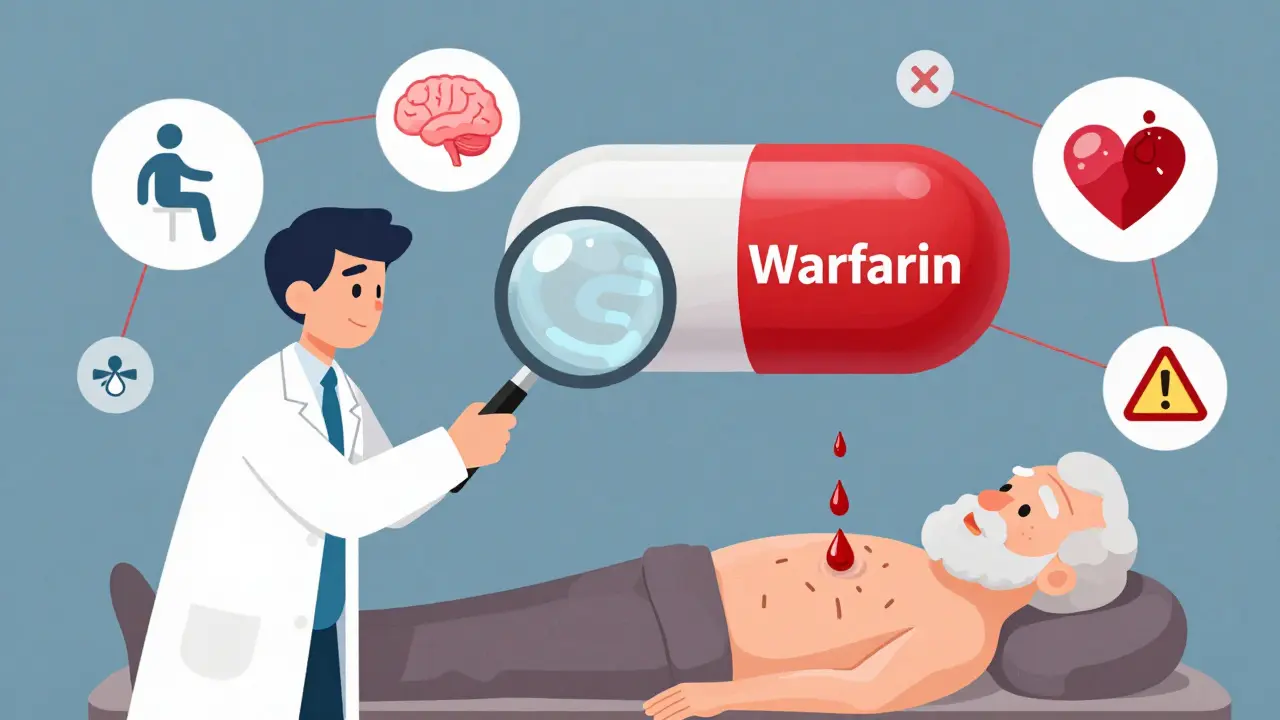
Why Your Dose Might Need to Be Lower - Even If You’re Healthy
Doctors often prescribe the same dose to older patients as they do to younger ones. That’s dangerous. The American Geriatrics Society’s Beers Criteria lists over 30 medications that should be avoided or reduced in older adults - not because they’re bad drugs, but because your body handles them differently. Take warfarin, the blood thinner. At 50, you might need 7-10 mg a day. At 80, you might need only 5-6 mg. Why? Your liver makes fewer clotting factors, and your kidneys clear the drug slower. Too much warfarin means bleeding - in the brain, in the gut, anywhere. In fact, warfarin alone causes over 125,000 emergency room visits each year in the U.S. among seniors. Insulin is another example. Many older adults with diabetes get the same insulin doses as younger patients. But their bodies don’t process sugar the same way. Their liver releases less glucose, and their kidneys clear insulin slower. That means even a “normal” dose can cause dangerous low blood sugar - especially if they skip a meal or drink a little alcohol. In one study, 40% of seniors on insulin had at least one hypoglycemic episode in a year. The rule of thumb? Start low. Go slow. For most medications cleared by the kidneys, doctors should begin with 25% to 50% of the standard adult dose. That’s what 68% of pharmacists recommend for patients over 75. And it works. One survey found that when this approach was used, adverse drug events dropped by nearly 30%.How to Know If Your Medication Is Right for You
You can’t just guess. You need to know your numbers. The most important one? Creatinine clearance - not just your serum creatinine level. Many doctors still rely on creatinine alone, but that’s misleading. Creatinine levels can stay normal even when kidney function is dropping, especially in older adults with less muscle mass. The Cockcroft-Gault formula gives a better picture of how well your kidneys are working. If your creatinine clearance is below 60 mL/min, you’re in the danger zone for at least 40% of commonly prescribed drugs. That includes painkillers like tramadol, antibiotics like ciprofloxacin, and even some antidepressants. Your pharmacist should be checking this every time you get a new script. There are also tools to help. The Anticholinergic Cognitive Burden Scale rates common meds on how much they affect your brain. A score over 3 means you’re at 50% higher risk of dementia over the next 7 years. If you’re taking three or four over-the-counter meds with anticholinergic effects - like allergy pills, sleep aids, and stomach meds - your score could be dangerously high. The STOPP/START criteria are another resource. STOPP tells you what to avoid. START tells you what to add. For example, if you’re on blood pressure meds but not on a statin, you might be missing something important. If you’re on an NSAID for arthritis but not on a stomach protector, you’re at risk for a bleeding ulcer. These aren’t just guidelines - they’re life-saving checklists.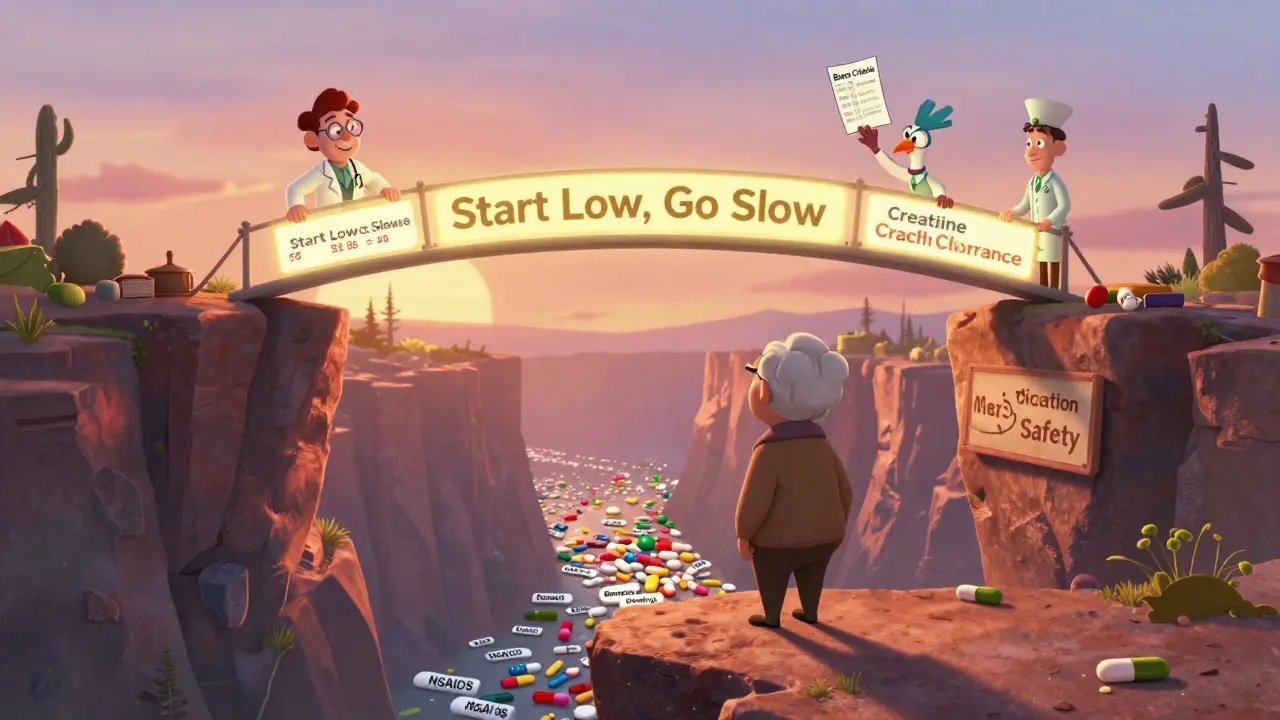
What You Can Do Today
You don’t need to wait for your doctor to bring it up. Take control. Here’s what to do:- Bring a full list of everything you take - including vitamins, supplements, and over-the-counter meds - to every appointment. Don’t assume your doctor knows what’s in your cabinet.
- Ask: “Is this dose right for my age and kidney function?” Don’t be shy. This is your health.
- Request a medication review with your pharmacist. Most pharmacies offer this for free. They’ll spot interactions you didn’t know about.
- Use the Beers Criteria app. It’s free, updated yearly, and used by over 250,000 healthcare providers.
- If you feel dizzy, confused, or unusually tired after starting a new med, don’t wait. Call your doctor. That’s not “just getting older.” That’s a warning sign.
The Bigger Picture: Why This Matters Beyond Your Medicine Cabinet
This isn’t just about one person taking the wrong pill. It’s a public health crisis. In the U.S., over 177,000 hospitalizations each year among people over 85 are caused by preventable drug reactions. Medicare spends $12 billion a year treating these avoidable problems. And it’s not getting better. Only 12% of participants in major drug trials are over 75. That means most of the dosing guidelines we rely on were based on data from people half their age. But things are changing. The FDA now requires new drugs to include testing in older adults. In 2023, they approved the first age-adjusted dosing algorithm for dabigatran (Pradaxa) - a blood thinner that now has different doses for people over 80. That’s progress. There’s also new research into “gero-pharmaceuticals” - drugs designed specifically for aging bodies. Scientists are exploring ways to reverse cellular aging that might restore how drugs work. One study showed that a combination of dasatinib and quercetin reduced a key aging marker by 50% in human tissue. That could mean future meds will work more like they did when you were younger. For now, though, the best tool you have is awareness. Your body isn’t broken - it’s changed. And understanding those changes can mean the difference between staying healthy and ending up in the hospital.Why do older adults need lower doses of medication?
Older adults need lower doses because their bodies process drugs differently. Kidneys filter less blood, the liver breaks down drugs slower, body fat increases, and muscle mass decreases. These changes mean drugs stay in the system longer and build up to higher levels, increasing the risk of side effects even at standard doses.
What medications should seniors avoid?
The American Geriatrics Society Beers Criteria lists over 30 medications to avoid or use with caution in seniors. These include benzodiazepines (like diazepam), anticholinergics (like diphenhydramine), NSAIDs (like ibuprofen), and certain sleep aids. Many of these cause confusion, falls, or kidney damage in older adults.
Can aging affect how well a drug works?
Yes. Aging changes how your body responds to drugs - not just how it moves them. Your brain becomes more sensitive to sedatives, your heart responds less to beta-blockers, and your blood vessels may overreact to certain stimulants. This is called pharmacodynamic change, and it means the same dose can have stronger, weaker, or different effects than it did when you were younger.
How do I know if my kidney function is low enough to affect my meds?
Don’t rely on your serum creatinine alone - it can be normal even when your kidneys are failing. Ask for your creatinine clearance using the Cockcroft-Gault formula. If it’s below 60 mL/min, most medications will need dose adjustments. Your pharmacist can calculate this for you.
Is it safe to take over-the-counter meds as I get older?
Many OTC meds are risky for seniors. Antihistamines (like Benadryl), sleep aids, and stomach remedies often contain anticholinergics, which can cause confusion, urinary problems, and falls. Even common pain relievers like NSAIDs can cause stomach bleeds or kidney damage. Always check with a pharmacist before taking anything new.


One comment
The pharmacokinetic shifts in aging aren't just physiological-they're evolutionary trade-offs. Reduced renal perfusion? That's not degradation, it's metabolic conservation. The body prioritizes core functions, and drug clearance becomes a luxury. What we call 'side effects' are often just the system recalibrating to a new homeostatic set point. We're treating aging like a disease to be fixed, when it's really a different operating system altogether.
Pharmacodynamics is even more fascinating-receptor downregulation, altered G-protein coupling, membrane fluidity changes. These aren't bugs, they're features of a system optimized for longevity, not pharmacological precision. We're applying 30-year-old dosing algorithms to a 75-year-old neurochemistry that evolved under entirely different constraints.
The Beers Criteria are a start, but they're still reactive. We need predictive pharmacogenomic models that account for epigenetic drift, mitochondrial decline, and proteostatic collapse. Until then, we're just guessing with better charts.
And let's not pretend the FDA's new age-adjusted algorithms are revolutionary. They're just the first cracks in a dam built on decades of ageist clinical trial design. The real scandal? We still don't have a single FDA-approved geriatric pharmacokinetic model based on longitudinal data from people over 85.
It's not that we don't know. It's that we refuse to see aging as a biological variable worth studying on its own terms.
I love how this post breaks it all down without making you feel dumb. Seriously, I showed this to my 81-year-old mom last week and she finally stopped arguing with her doctor about her 'too low' blood pressure med. She was convinced she just needed more because she 'felt fine'-until she started getting dizzy every time she stood up. Now she's on a reduced dose and actually sleeping through the night for the first time in years.
Also, I made her print out the Beers Criteria app and keep it in her pill organizer. She calls it her 'Medicine Bible' now. And yes, she's still taking her Benadryl for allergies... but now she knows it's basically a one-way ticket to confusion city. Progress, not perfection, right?
To anyone over 65 reading this: don't be embarrassed to ask your pharmacist, 'Is this really for me?' They'll thank you. I promise.
And if you're a caregiver? Do this for the people you love. It's the quietest act of love you can do.
My grandma took 12 pills a day before her medication review. Twelve. Including two different sleep aids, three antihistamines, and an NSAID she’d been on since 1998. Her doctor never asked what she was taking-just kept adding more.
After the pharmacist sat down with her for 45 minutes and ran her through the STOPP/START checklist? Down to five meds. Two of them were new-vitamin D and a low-dose statin she’d been missing. Her balance improved. Her memory cleared. She started gardening again.
It’s not about cutting meds. It’s about cleaning up the clutter. Your body isn’t broken. It’s just overwhelmed. And sometimes, less really is more.
Also-yes, your pharmacist can and should calculate your creatinine clearance. Don’t wait for your doctor to bring it up. Walk in and say, 'Can we review my meds? I want to make sure I’m not taking anything that’s doing more harm than good.' They’ll be thrilled you asked.
So let me get this straight. After 65, you’re too fragile to handle standard doses, but you’re still expected to take the same meds as everyone else because 'the science says so'? Meanwhile, the same doctors who prescribe you 5mg of warfarin are giving 10mg to a 25-year-old athlete who just had a knee replacement?
This isn't biology. This is negligence wrapped in jargon. The entire medical system is built on data from people under 60. We’re treating the elderly like lab rats who forgot to die on schedule.
And don’t even get me started on the 'Beers Criteria.' It’s a list of drugs that work fine if you’re not a walking corpse. Why aren’t we demanding drug trials that include people over 80? Why are we still using 1970s dosing charts? This isn’t medicine. It’s institutional ageism with a white coat.
Someone’s making money off this. And it’s not you.
The data is clear. Kidney function declines with age. Liver metabolism slows. Body composition shifts. These are measurable physiological changes. Dosing must reflect this. Starting at 25% to 50% of standard dose for renally cleared medications is not experimental. It is evidence based. Pharmacists are trained to calculate creatinine clearance. Use them. Advocate for yourself. Your life depends on it.
This is such an important conversation-and I’m so glad it’s being had. I work with older adults in community health, and the number of people on five or more medications without ever having a full review is staggering.
One of my clients, 84, was on diphenhydramine nightly for 'sleep' and ibuprofen daily for 'aches.' She was falling once a week. Her family thought it was just 'getting older.' After switching to melatonin and acetaminophen with a stomach protector, and cutting the antihistamine entirely? No more falls. Clearer thinking. She started joining the book club again.
It’s not about taking less. It’s about taking smarter. And the tools are out there: Beers Criteria, STOPP/START, Cockcroft-Gault. You just have to ask. And if your provider doesn’t know these? Find someone who does.
Your body isn’t broken. It’s just been misunderstood.
lol why are we pretending this is new? 🤡
Every single thing in this post has been known since the 80s. The FDA? Still pushing 50-year-old guidelines. Pharma? Still testing on 25-year-old college kids. Doctors? Still prescribing Benadryl like it’s candy.
And yet here we are in 2025, acting like this is some groundbreaking revelation. Bro. We’ve had the data. We’ve had the tools. We’ve had the warnings.
It’s not a biological mystery. It’s a corporate and institutional failure. The system is designed to keep prescribing, not to keep people alive. 🤷♂️
As someone who grew up watching my father navigate polypharmacy after 70, I can say this: awareness saves lives. He was on 11 meds. We cut it to 5. His energy returned. He stopped forgetting names. He started walking again.
The biggest mistake? Assuming 'if it’s not broken, don’t fix it.' But your body isn’t broken-it’s adapting. And the meds you’ve been on for 20 years? They might not be adapting with you.
Ask for a med review. Bring your list. Ask about kidney function. Don’t wait for a crisis. The best time to fix this was yesterday. The second best time? Today.
I’m a nurse practitioner who works with geriatric patients. I see this every day. One woman came in after a fall-turns out she was on a full dose of amitriptyline for 'nerve pain' and a nightly dose of diphenhydramine. She was sedated 24/7. We tapered both. Within two weeks, she was cooking again, calling her grandkids, laughing.
It’s not that these drugs are evil. It’s that we use them like they’re one-size-fits-all. They’re not. Aging isn’t a disease. But our approach to treating it? Often, it is.
Ask for a pharmacist consult. It’s free. It’s safe. And it might just give you back your life.
Let’s be real-this whole post is just Big Pharma’s way of making you feel guilty for taking your meds. You think your body 'processes drugs differently'? Nah. It’s the toxins in the water, the GMOs, the 5G towers, the fluoride. Your kidneys aren’t failing-they’re being poisoned by the system.
And why do you think they want you on lower doses? So you’ll need more pills. More appointments. More 'special' supplements. They’re not trying to help you. They’re trying to keep you hooked.
I stopped taking all my meds after reading this. Now I drink apple cider vinegar and take magnesium. I feel better than ever. The doctors are scared. They know they can’t control you anymore.
This is so important. My aunt was on five different meds for sleep, anxiety, and pain-and she was always so tired, she couldn’t even watch TV. We did a full med review with her pharmacist. Cut out two, lowered the others. Now she’s baking cookies again. She says she feels like herself for the first time in years.
Don’t wait for a fall or a hospital stay. Just ask. 'Is this dose right for my age?' It’s not rude. It’s smart. And if your doctor gets annoyed? Find a new one. Your health is worth it.
so you're telling me after 65 you're basically a walking liability? great. so now i have to take 1/4 of a pill and ask a pharmacist for permission to breathe? wow. what a revolution. next they'll tell me my bones are too brittle to sneeze. 🙄
I’ve been caring for my 86-year-old mom since her stroke. She was on 14 medications. Four of them were for side effects of the others. One was for 'anxiety' that was actually caused by the antihistamine she was taking for allergies.
We sat down with her pharmacist. He used the Beers Criteria, the Anticholinergic Burden Scale, and Cockcroft-Gault. We cut six meds. Lowered four. Added two vitamins. Her speech improved. Her balance got better. She stopped hallucinating at night.
It wasn’t magic. It was just someone who actually knew how aging changes drug metabolism.
Don’t assume your doctor knows this stuff. Most don’t. But your pharmacist? They do. And they’re waiting for you to walk in and say, 'Can we talk about what I’m really taking?'
It’s not about being afraid. It’s about being informed. And your future self will thank you.
Just saw someone mention the Beers Criteria app. That’s a great start-but don’t stop there. The 2024 update added new warnings for gabapentin and proton-pump inhibitors in older adults. If you’re still on those long-term? Talk to your provider. There are safer alternatives.
And if your doctor says, 'But it’s been working for years'-ask, 'But is it still safe?' That’s the question nobody wants to hear, but everyone needs to ask.