
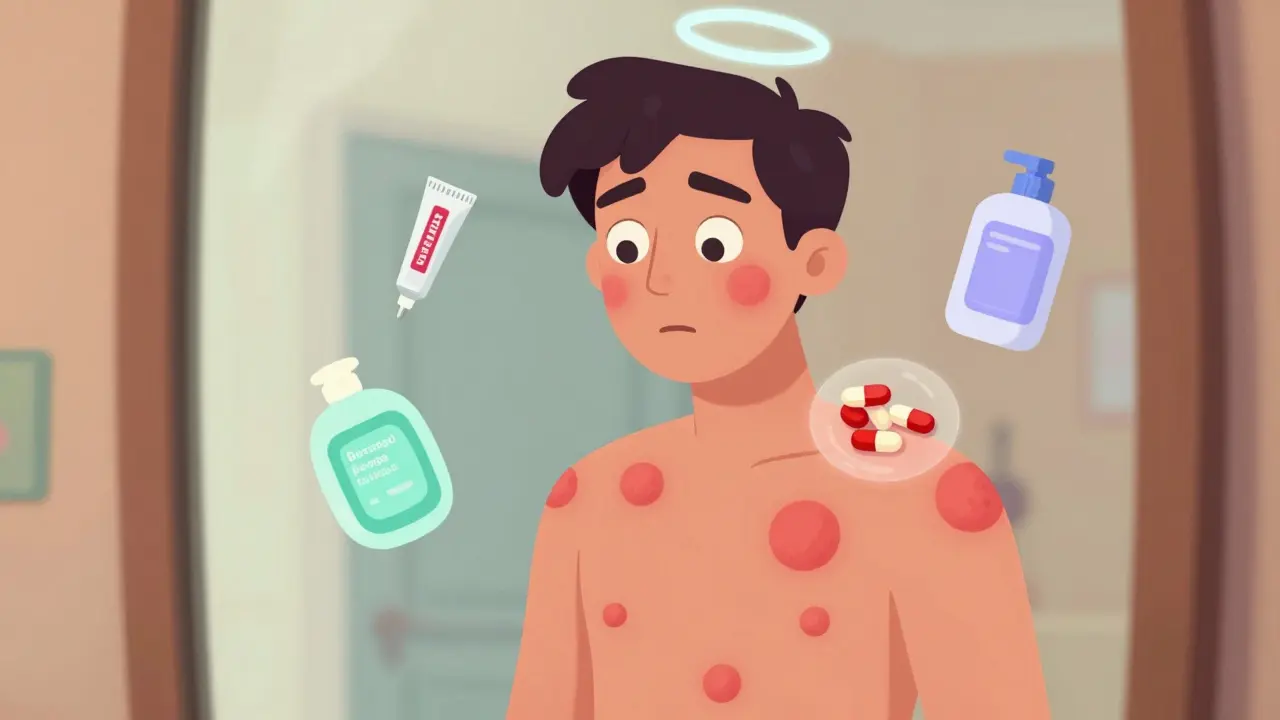
Steroid Acne Treatment Time Estimator
Input Your Treatment Details
When you start taking steroids-whether for asthma, an autoimmune disease, or muscle gain-you might not expect your skin to turn against you. But for many people, acne isn’t just a teenage problem. It can show up weeks after starting steroid treatment, often in places you wouldn’t normally see breakouts: your chest, back, shoulders, even your jawline. This isn’t regular acne. This is steroid acne.
What Makes Steroid Acne Different?
Steroid acne doesn’t look like the kind you got in high school. Regular acne usually has a mix of blackheads, whiteheads, and angry red bumps. Steroid acne? It’s more uniform. Think dozens of small, red, pus-filled bumps that appear all at once, often in clusters. They’re not greasy. They don’t feel like clogged pores. They just show up-sometimes suddenly-and they don’t respond to your usual face wash or spot treatment. The trigger? Corticosteroids like prednisone, dexamethasone, or even topical creams used for eczema. Anabolic steroids used for bodybuilding cause a similar reaction. Both types flood your system with hormones that change how your skin behaves. Research from 1973 first linked these breakouts to steroid use, and since then, we’ve learned more about how they work. One key difference: steroid acne often hits the upper body harder than the face. While facial acne is common in teens, steroid acne tends to spread across the chest and back. In about 30-40% of cases, it’s not acne at all-it’s Malassezia folliculitis, a yeast overgrowth that causes itchy, uniform bumps. It looks like acne, but it needs a completely different treatment.Why Does This Happen?
It’s not just about oil. Steroids mess with your skin’s immune response. They increase the expression of a protein called TLR2, which normally helps your skin fight off bacteria. But when it’s turned up too high, it starts overreacting to Propionibacterium acnes, the bacteria that lives on everyone’s skin. That’s when inflammation kicks in-and those tiny red bumps appear. Anabolic steroids add another layer. They boost testosterone-like hormones, which also increase sebum production. Combine that with the immune disruption from steroids, and you’ve got a perfect storm. That’s why bodybuilders often get severe, deep, painful breakouts that don’t respond to standard acne meds. And timing? It’s not immediate. Most people don’t see breakouts until 4-6 weeks after starting steroids. That’s why many think it’s just a bad skin cycle, not a reaction to their medication.Topical Treatments That Actually Work
If you’re on steroids long-term-say, for a transplant or Crohn’s disease-you can’t just stop. So you need treatments that work while you’re still taking them. Tretinoin 0.05% is the gold standard. Back in 1973, a study of 12 patients showed that applying tretinoin once or twice daily cleared up 85-90% of steroid acne lesions within two to three months-even while they kept taking prednisone. Today, dermatologists still recommend it as a first-line option. Start slow: once every other night to avoid irritation, then build up to nightly use. Don’t expect overnight results. It takes 6-8 weeks to see real change. Benzoyl peroxide 5% is another must-have. It kills bacteria, reduces inflammation, and helps unclog pores. Use it as a wash on your chest and back after showering. Leave it on for a minute before rinsing. It’s gentle enough for daily use and pairs well with tretinoin. For Malassezia folliculitis, you need antifungals. Ketoconazole shampoo (2%) works wonders. Apply it like a body wash-lather it on your chest and back, leave it for 5-10 minutes, then rinse. Do this 2-3 times a week. Some people swear by selenium sulfide shampoo (2.5%) for the same purpose. Both are available over the counter. Avoid harsh scrubs, loofahs, or alcohol-based toners. Steroids already weaken your skin barrier. Adding abrasives will make things worse. Stick to gentle cleansers and fragrance-free moisturizers labeled “non-comedogenic.”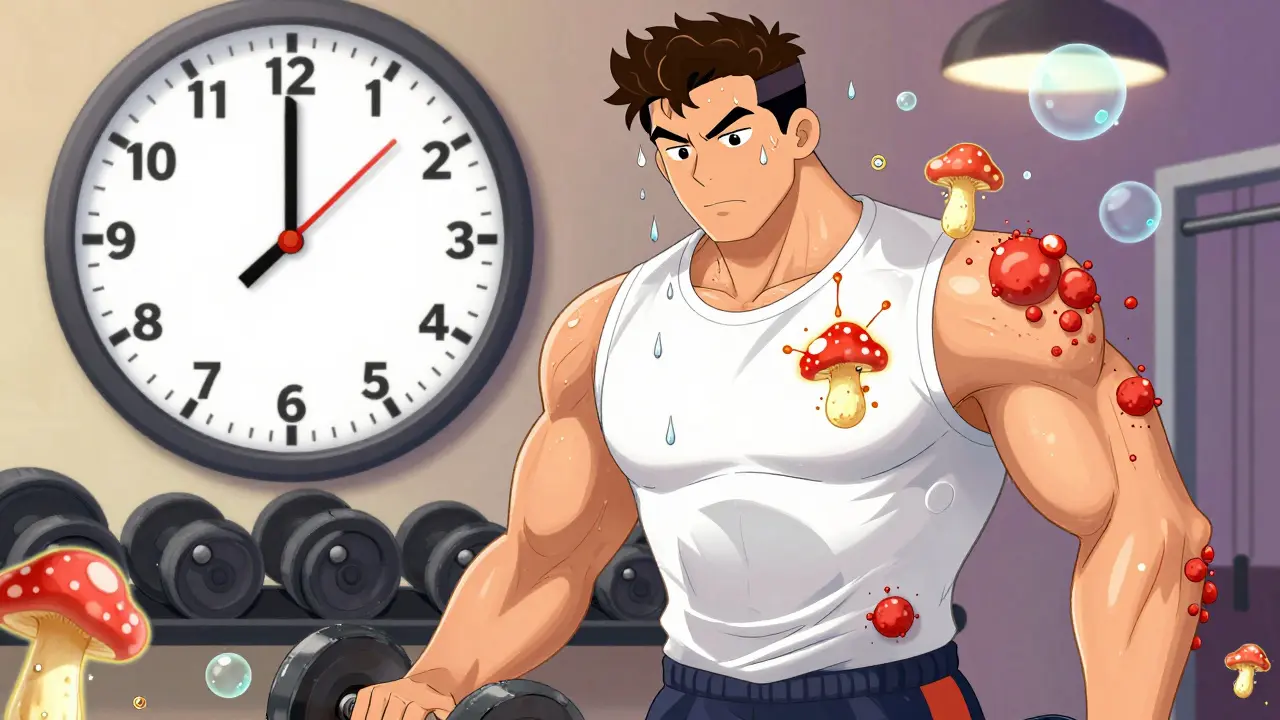
Oral Options When Topicals Aren’t Enough
If your acne is spreading, painful, or not budging after 8 weeks of topical treatment, you’ll need stronger help. Oral antibiotics like doxycycline (100mg twice daily) are common. They reduce inflammation and kill bacteria. But they’re not a forever fix. The Cleveland Clinic recommends limiting them to 3-4 months to avoid antibiotic resistance. Once your skin clears, you should taper off. For women, oral contraceptives with ethinyl estradiol and progestin can help by lowering androgen levels. Spironolactone (25-50mg daily) is another anti-androgen option that’s been shown to reduce acne in women on steroids. Both need a prescription and aren’t suitable for men. Isotretinoin (Accutane) is powerful. It shrinks oil glands, reduces bacteria, and resets skin cell turnover. For steroid acne caused by corticosteroids, it’s often the most effective solution. But here’s the catch: in people using anabolic steroids, isotretinoin can trigger something called acne fulminans-a rare, severe form of acne with painful, ulcerated lesions that can require hospitalization. Two bodybuilders in a 2021 case study ended up in the ER after starting isotretinoin during a cycle. So if you’re using steroids to build muscle, do not take isotretinoin without close supervision from a dermatologist.Lifestyle Adjustments That Help
Medication isn’t the only tool. Your daily habits matter too. Shower right after workouts. Sweat traps bacteria and yeast against your skin. If you’re on steroids, that’s a recipe for breakouts. Rinse off within 30 minutes of exercising. Use a gentle cleanser-no harsh body scrubs. Wear breathable fabrics. Tight synthetic shirts or workout gear trap heat and moisture. Cotton or moisture-wicking materials reduce friction and sweating. Change out of damp clothes immediately. Watch your diet. No, sugar doesn’t cause steroid acne. But high-glycemic foods and dairy can make inflammation worse. If you’re already fighting breakouts, cutting back on milk, chocolate, and processed carbs might help. Focus on whole foods, vegetables, and omega-3s from fish or flaxseed. Sun protection is non-negotiable. Steroids and acne treatments like tretinoin make your skin more sensitive to UV rays. Even a short walk outside can lead to redness or burns. Use a mineral sunscreen with zinc oxide (SPF 30+) every day. Reapply if you’re outside for more than two hours.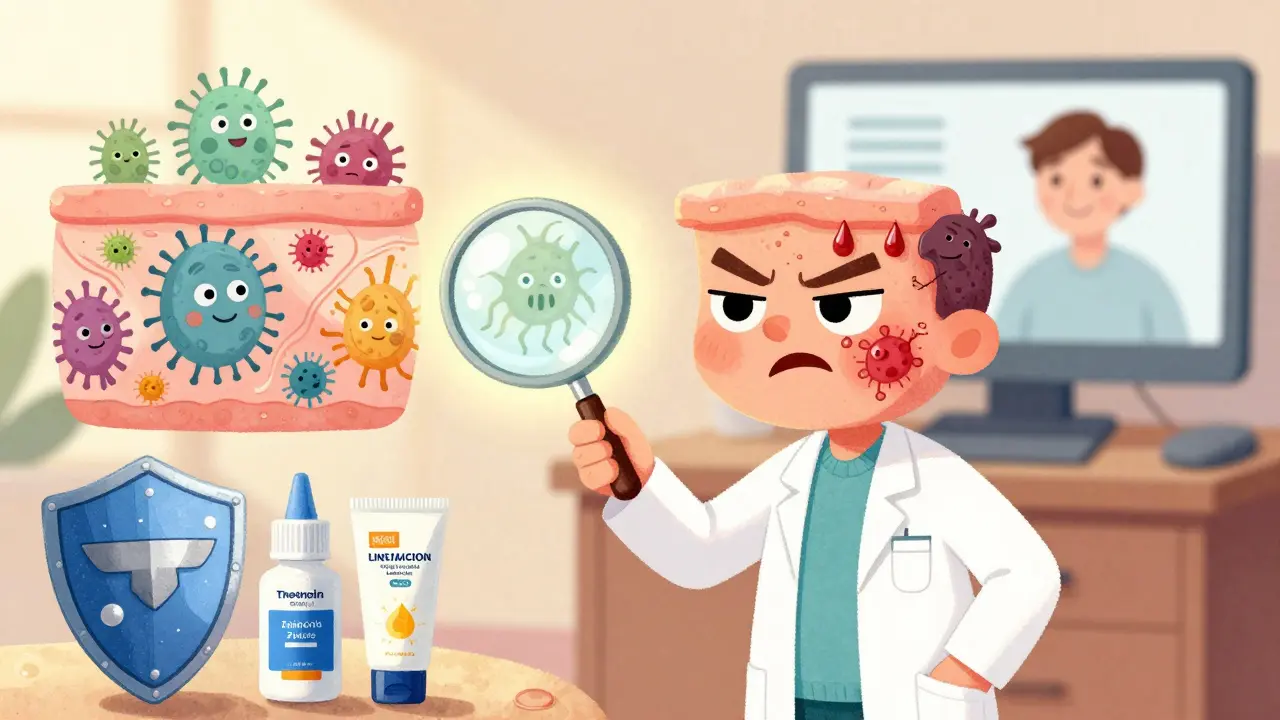
How Long Until It Clears?
If you stop taking steroids, the acne usually fades in 4-8 weeks. But if you’re on them for life-like after a transplant-that’s not an option. That’s why long-term management matters. Most people see improvement with topical tretinoin and benzoyl peroxide in 6-12 weeks. Full clearance can take up to 6 months. Don’t give up if it’s slow. Consistency beats intensity. For Malassezia folliculitis, antifungal treatments often work faster-sometimes within 2-4 weeks. But if you stop the shampoo, the yeast can come back. Some people need to use it once a week long-term to keep it under control.When to See a Dermatologist
You don’t need to suffer in silence. See a dermatologist if:- Your acne doesn’t improve after 8 weeks of over-the-counter treatments
- You develop painful, deep, or bleeding bumps
- You’re using anabolic steroids and notice sudden worsening
- You’re on long-term steroids and acne is affecting your confidence or sleep


One comment
Okay but let’s be real-this whole ‘steroid acne’ thing is just Big Pharma’s way of keeping you hooked. They give you steroids, then sell you $200 creams to fix the damage they caused. Tretinoin? Please. I used apple cider vinegar and a salt scrub and my skin cleared in 10 days. No prescription needed. Also, Malassezia? That’s just a fancy word for ‘you’re dirty.’ Shower more. Stop being a lazy cow.
Thank you SO much for this post!! 🙏 I’ve been on prednisone for 8 months and thought I was going crazy with these bumps on my chest 😭 I tried everything-benzoyl peroxide, tea tree oil, even that weird charcoal soap-and nothing worked. Ketoconazole shampoo changed my life. I use Nizoral like a body wash 3x a week and now I can wear tank tops again. You’re a lifesaver. 💕
While the clinical observations presented are generally accurate, it is imperative to note that the 1973 study referenced employed a sample size of twelve subjects, which is statistically underpowered for generalizable conclusions. Furthermore, the assertion that tretinoin achieves 85–90% lesion clearance requires replication in contemporary, double-blind, placebo-controlled trials before being elevated to a first-line recommendation. The conflation of steroid-induced acne with Malassezia folliculitis, while clinically relevant, lacks diagnostic specificity without potassium hydroxide (KOH) microscopy confirmation.
I’ve been on azathioprine for Crohn’s and got this weird acne last year. Didn’t even connect it until I read this. Tried the tretinoin and benzoyl peroxide combo-slow, but it’s working. Not perfect, but better than crying in the shower every morning. Also, the ketoconazole shampoo thing? Genius. I just use Head & Shoulders now. No fancy stuff. Just keep it simple.
wait so like… is it true that anabolic steroids make your face break out worse than just regular steroids? i thought it was just the face but now im confused. also why do u need a derm if u just use shampoo? i used head & shoulders and it worked??
Stay disciplined. Shower after every session. No excuses. Wear clean clothes. Don’t touch your face. Use the right products. This isn’t rocket science. You want results? Do the work. The science is clear. Your skin isn’t broken-you’re just not consistent.
Let’s deconstruct this paradigm, shall we? The modern dermatological establishment is still operating under a Cartesian model of skin as a passive, inert surface-when in reality, the integument is a sentient, symbiotic ecosystem, a bio-terrain sculpted by hormonal tyranny and microbial rebellion. Steroid acne isn’t a disease-it’s a protest. A silent scream from your microbiome screaming, ‘I AM NOT YOUR LAB RAT!’ Tretinoin? A band-aid on a bullet wound. The real solution? Radical rewilding of the dermal biome. Introduce ammonia-oxidizing bacteria. Let your skin breathe like it did before Big Pharma turned your epidermis into a corporate franchise. We’re not treating acne-we’re negotiating peace with our own biology.
Thank you for providing a comprehensive and clinically grounded overview of steroid-induced cutaneous manifestations. This is an underrecognized phenomenon, particularly in populations on long-term immunosuppressive regimens. The distinction between inflammatory acne and Malassezia folliculitis is critical, as misdiagnosis leads to inappropriate therapy. The inclusion of epidemiological data from telemedicine platforms further validates the growing clinical relevance of this condition. A well-structured and informative contribution to the discourse.
Wow. Just… wow. I’ve been on prednisone for lupus for five years, and I’ve never once heard a doctor mention this. I thought I was just getting old and greasy. I’ve been using the ketoconazole shampoo like a holy ritual-every Tuesday, Thursday, Saturday. It’s not magic, but it’s the only thing that’s kept me from hiding under hoodies. Thank you for writing this. You didn’t just explain acne-you explained my life.
Bro this is the kind of post that saves lives. I’ve been on steroids since I was 12 and thought I was doomed to forever have a chest full of angry red dots. I tried everything-acne patches, laser, even a weird vegan cleanse. Nothing. Then I found the ketoconazole shampoo. I swear to god, it’s like a reset button. I didn’t even know yeast could do this. Now I wear tank tops. I’m not just healed-I’m free. Thank you.
THIS. THIS IS THE POST I NEEDED WHEN I WAS 19 AND ON PREDNISONE. I thought I was ugly. I thought I was failing. I cried every time I looked in the mirror. But you know what? I stuck with the tretinoin and benzoyl peroxide-even when my skin burned and peeled-and now, two years later, I’m finally confident again. It’s slow. It’s messy. But it’s worth it. You’re not broken. You’re just healing. Keep going.