

Clopidogrel-PPI Compatibility Checker
This tool helps determine if your proton pump inhibitor (PPI) is safe to take with clopidogrel. Some PPIs reduce clopidogrel's effectiveness by interfering with its activation in your liver.
Select your PPI to see compatibility status and get guidance from clinical guidelines.
Select a PPI and click "Check Compatibility" to see results.
When you take clopidogrel after a heart attack or stent placement, your body depends on it to stop blood clots from forming. But if you're also taking a common heartburn medication like omeprazole, that protection might be weaker than you think. This isn't just a theory-it’s a real, measurable drop in how well clopidogrel works. And the difference isn’t subtle. For some people, it can mean the difference between staying safe and having another heart event.
How Clopidogrel Actually Works
Clopidogrel isn’t active when you swallow it. It’s a prodrug, meaning your liver has to turn it into something else before it can do its job. That job? Blocking a receptor on platelets called P2Y12. When that receptor is blocked, platelets can’t stick together and form clots. That’s why it’s so important after a heart attack or stent.
The liver uses one specific enzyme to make this happen: CYP2C19. Without this enzyme doing its job, clopidogrel just passes through your system unused. That’s why some people-especially those with genetic variations in CYP2C19-don’t respond well to clopidogrel. But there’s another group that can accidentally block this enzyme: people taking certain proton pump inhibitors (PPIs).
Which PPIs Interfere With Clopidogrel?
Not all heartburn pills are the same. The problem isn’t PPIs as a group-it’s which ones you’re taking. Omeprazole and esomeprazole are the big offenders. They’re strong inhibitors of CYP2C19. Studies show they can cut clopidogrel’s active metabolite by nearly half. One study found that when omeprazole was taken with clopidogrel, platelet inhibition dropped from 35-45% down to under 20%. That’s below the level needed to prevent clots.
On the other hand, pantoprazole, rabeprazole, and lansoprazole barely touch CYP2C19. Their chemical structure doesn’t bind tightly to the enzyme. So even though they do the same job of reducing stomach acid, they don’t interfere with clopidogrel. In fact, the NHS Specialist Pharmacy Service and the European Society of Cardiology both say these three are safe to use with clopidogrel.
The Evidence Is Mixed-But the Pattern Is Clear
You’ll hear conflicting things. Some studies say PPIs increase heart attack risk. Others say there’s no difference. Why? Because the data gets muddy when you mix different PPIs together. If a study includes omeprazole and pantoprazole in the same group, the strong effect of omeprazole gets diluted by the harmless ones.
Here’s what the numbers actually show:
- Omeprazole reduces clopidogrel’s active metabolite by 47% (p<0.001)
- Rabeprazole reduces it by 0% (p=0.37)
- Pantoprazole shows no increase in heart attack risk (HR 0.98, 95% CI 0.87-1.11)
- Omeprazole increases major cardiac events by 50% in some studies (HR 1.50)
The FDA warned about this in 2009. The European Medicines Agency followed with a label change. But here’s the catch: many doctors still prescribe omeprazole with clopidogrel. Why? Because they’re worried about stomach bleeding. And that’s a real concern.
The GI Bleeding Dilemma
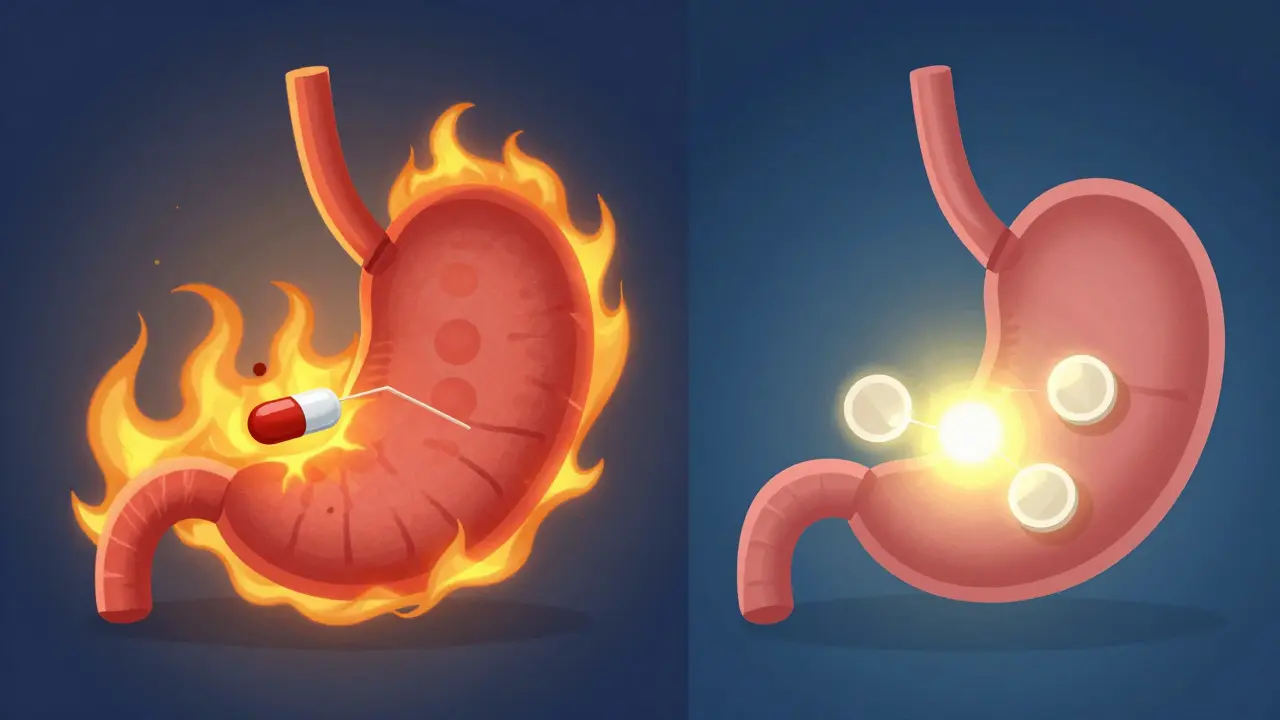
People on clopidogrel, especially those also taking aspirin, have a much higher risk of bleeding in the stomach. Studies show PPIs cut that risk by 69%. That’s huge. For someone over 75, with a history of ulcers, or taking NSAIDs like ibuprofen, skipping a PPI could mean a life-threatening bleed.
So the real question isn’t whether to use a PPI-it’s which one. If you need a PPI, you don’t have to choose between heart protection and stomach safety. You just need the right one.
What Should You Do?
If you’re on clopidogrel and need a PPI, here’s what to ask your doctor:
- Are you currently taking omeprazole or esomeprazole? If yes, ask if you can switch to pantoprazole or rabeprazole.
- Do you actually need a PPI? Not everyone does. If you’re under 65, have no history of ulcers, and aren’t on NSAIDs, you might not need one.
- Could you switch to ticagrelor instead? New guidelines now recommend ticagrelor over clopidogrel for most heart attack patients. It doesn’t rely on CYP2C19, so PPIs don’t interfere with it.
And don’t think splitting doses helps. One study gave clopidogrel in the morning and omeprazole at night-12 hours apart. The interaction still happened. The enzyme gets blocked for the whole day. Timing doesn’t fix it.

What’s Changing in Practice?
Things are shifting. In 2010, over 20% of clopidogrel users were on omeprazole. By 2018, that dropped to under 9%. Why? Because doctors learned. More are now prescribing pantoprazole. In fact, 72% of cardiologists surveyed in 2019 said they’d choose pantoprazole over omeprazole when PPIs were needed.
And there’s new hope on the horizon. Vonoprazan, a newer acid blocker, doesn’t touch CYP2C19 at all. It’s in late-stage trials and could replace PPIs for some patients soon. But for now, the answer is simple: avoid omeprazole. Choose pantoprazole or rabeprazole.
Final Takeaway
This isn’t about fear. It’s about smart choices. Clopidogrel saves lives. But it only works if your body can activate it. Omeprazole stops that. Pantoprazole doesn’t. And if you need a PPI to protect your stomach, you shouldn’t have to choose between heart and gut safety. You just need the right drug.
Don’t stop your meds. Don’t assume your doctor knows this. Ask. Check your prescription. If you’re on omeprazole, ask if switching to pantoprazole is possible. It could be the difference between staying healthy and facing another hospital visit.
Does omeprazole completely stop clopidogrel from working?
No, it doesn’t stop it completely, but it reduces its effectiveness by up to 47% in some people. Studies show platelet inhibition drops from healthy levels (35-45%) to dangerously low levels (under 20%). That means clots can still form, even while taking clopidogrel.
Can I take pantoprazole with clopidogrel?
Yes. Pantoprazole has minimal effect on the CYP2C19 enzyme and does not reduce clopidogrel’s antiplatelet action. Major guidelines from the NHS, ESC, and AHA all recommend pantoprazole as the safest PPI to use with clopidogrel.
What if I’ve been taking omeprazole with clopidogrel for years?
Talk to your doctor before making any changes. If you’re at high risk for stomach bleeding, switching to pantoprazole or rabeprazole is the best next step. If you’re not at high risk, you may not need a PPI at all. Don’t stop either drug without medical advice.
Is esomeprazole just as bad as omeprazole?
Yes. Esomeprazole is the S-isomer of omeprazole and has nearly identical effects on CYP2C19. Both are strong inhibitors and should be avoided with clopidogrel. The NHS and ESC specifically warn against using esomeprazole in this setting.
Should I switch from clopidogrel to ticagrelor?
If you’re eligible, yes. Ticagrelor doesn’t need CYP2C19 to work, so PPIs don’t interfere with it. It’s now the first-choice antiplatelet for most heart attack patients under current guidelines. But it’s not right for everyone-your doctor will consider your bleeding risk, cost, and other factors.




One comment
Just had my cardiologist switch me from omeprazole to pantoprazole last month after reading this. Holy crap, I had no idea. I was on omeprazole for years thinking it was just a 'safe' heartburn pill. Turns out I was gambling with my stent. Now I feel like a dummy, but also way more informed. If you're on clopidogrel and taking any PPI, check your script. Seriously. Don't wait for a crisis.
THIS. This is the kind of post that saves lives. I’m a nurse and I’ve seen patients come in with stent thrombosis because they were on omeprazole and thought it was ‘just acid.’ Please share this. Doctors don’t always know this stuff. Pharmacies don’t flag it. It’s on US.
So glad someone finally broke this down without the medical jargon. I’ve been on clopidogrel since 2020 after my MI, and my PCP kept prescribing omeprazole ‘because it’s the cheapest.’ I had to push back hard. Now I’m on pantoprazole and my stomach’s happier AND my platelets are working. It’s wild how much we’re left to figure out ourselves. This post is a gift.
Let’s be real - this whole thing is Big Pharma gaslighting. They know omeprazole interferes, but they keep selling it because it’s profitable. The FDA warning in 2009? Ignored. The ESC guidelines? Buried under marketing brochures. And now they’re pushing vonoprazan like it’s the holy grail? Same playbook. Wake up. They don’t care if you live or die - only if you keep buying.
As someone from Canada who’s been managing GERD for over a decade, I’m relieved to see clear guidance. My GI specialist actually switched me to rabeprazole last year after I mentioned I was on Plavix. I didn’t even know there was a risk - I thought all PPIs were interchangeable. Thank you for clarifying the science. This is exactly the kind of nuanced, evidence-based info we need more of.
Omeprazole reduces clopidogrel efficacy by 47%? That’s statistically significant. But wait - what’s the absolute risk increase? 0.5%? 2%? Nobody says. And ‘under 20% platelet inhibition’ - under what? Baseline? Control? Vague. Also, ticagrelor’s bleeding risk is higher. Why no mention? This post is cherry-picking data. Don’t be fooled.
i read this and i was like... wait. so i been takin omeprazole for 6 years with my plavix?? and my doc never said nothin?? now im scared. also i think i spelled plavix wrong. its plavix right? not plavix? idk. but i think i need to call my doc. also is pantoprazole like... purple? because i think i saw that on a bottle once. idk. help.
My mom’s on clopidogrel and omeprazole. She’s 78, had a stent in 2021, and her PCP told her ‘it’s fine.’ I found this article and sent it to her doctor. He called me back within an hour. Switched her to pantoprazole. She’s doing great. This isn’t just theory - it’s real. And it’s happening to people you love.
Let’s not pretend this is complicated. If you’re on clopidogrel, avoid omeprazole and esomeprazole. Use pantoprazole or rabeprazole. If you can’t afford it, ask for samples. If your doctor pushes back, ask for the guidelines. The evidence is clear. This isn’t about fear. It’s about using the right tool for the job. Simple. Clean. Done.
I’m from India and we get omeprazole over the counter. No prescription needed. My uncle took it with clopidogrel for 3 years. He had a second heart attack. No one told him. No one knew. This needs to be in public health campaigns. Not just Reddit. Schools. Pharmacies. TV. This is life or death - and people are dying because of ignorance.
Y’all are overthinkin this. I’m from Indiana and I’ve been takin clopidogrel and omeprazole for 8 years. No issues. My heart’s fine. If you got a stent, you probly got a bad diet anyway. Just eat less junk, stop stressin, and quit worryin about pills. My grandpa lived to 92 on aspirin and fried chicken. This post is fearmongerin.
Look. I get it. You’re all excited about pantoprazole. But let’s talk about the elephant in the room: compliance. Most patients can’t tell the difference between pantoprazole and omeprazole. They look the same. The labels are similar. The cost? Omeprazole’s $5. Pantoprazole’s $45. So you’re telling people to pay nine times more for a ‘safer’ option - while the system still doesn’t alert them? This isn’t a medical issue. It’s a socioeconomic failure. And until we fix that, none of this matters.
They’re lying. All of them. The FDA, the ESC, the cardiologists - they’re all in on it. Omeprazole doesn’t interfere. It’s the vaccines. It’s the blood pressure meds. It’s the fluoride in the water. They want you dependent. They want you paying. They want you scared. You think this is science? It’s control. Wake up. Your body doesn’t need clopidogrel. Or PPIs. Just stop taking everything. Go raw. Go alkaline. Go free.