

Living with asthma doesn’t mean you have to guess what to do when symptoms show up. A well-made asthma action plan turns confusion into clear steps - and can keep you out of the emergency room. It’s not a one-size-fits-all handout. It’s your personal roadmap, built with your doctor, based on your daily life, your triggers, and your body’s signals. And if you’re not using one, you’re flying blind when your asthma flares.
What an Asthma Action Plan Really Is
An asthma action plan is a written guide that tells you exactly what to do when your asthma is under control, when it’s getting worse, and when it’s an emergency. It’s built around three simple color zones: green, yellow, and red. These aren’t just labels - they’re your early warning system. The green zone means you’re in control. The yellow zone says, "Pay attention, something’s changing." The red zone says, "This is serious - act now."
The National Heart, Lung, and Blood Institute (NHLBI) has been clear since 2007: every person with asthma should have one. Studies show people who use their action plans have up to 70% fewer emergency visits. That’s not a small difference. That’s life-changing. And yet, only about 30% of asthma patients actually have one in hand. Why? Because too many doctors don’t make it a priority - and too many patients don’t know how to use it.
The Three Zones: Your Asthma GPS
Let’s break down what each zone means - and what you should do.
Green Zone (Go): This is your normal. You wake up feeling fine. You can run, laugh, sleep through the night, and play with your kids without wheezing. Your peak flow meter reads 80-100% of your personal best. You’re not coughing, not tight-chested, not gasping. In this zone, you keep taking your daily controller medication - usually an inhaled corticosteroid like fluticasone (Flovent) - exactly as prescribed. No changes. No panic. Just consistency.
Yellow Zone (Caution): This is where things start to shift. You notice a cough that won’t quit. Your chest feels heavy. You’re waking up at night because you can’t breathe. Your peak flow drops to 50-79% of your best. You might struggle to walk up stairs or talk in full sentences. This isn’t an emergency - yet. But it’s your signal to act. Follow your plan: take your rescue inhaler (like albuterol) - 2 to 4 puffs every 4 to 6 hours. Keep taking your daily controller. Monitor your symptoms every hour. If you don’t improve after two doses, or if you’re getting worse, call your doctor. Don’t wait until you’re gasping.
Red Zone (Danger): This is your body screaming for help. You’re gasping for air. You can’t speak more than a word or two at a time. Your peak flow is below 50%. Your rescue inhaler isn’t helping. Your lips or fingernails are turning blue. This isn’t a "maybe" situation. This is a 999 call. Get help immediately. Don’t drive yourself. Call an ambulance. Have someone take you. Delaying here can cost you your lungs - or worse.
Building Your Plan: What Goes In
A good action plan isn’t just colors and zones. It’s specific. It’s yours. Here’s what every plan needs:
- Your personal best peak flow number. This isn’t a generic number. It’s the highest reading you’ve ever gotten when you’re completely symptom-free. You measure this over 2-4 weeks of good health. If your doctor didn’t help you find this, ask for it. Without it, the yellow and red zones mean nothing.
- Exact medication names and doses. Not "your inhaler." Not "the blue one." Write down: "Albuterol 90 mcg per puff, 2 puffs every 4 hours as needed." Include your daily controller too. If you take two different inhalers, list them separately.
- When to call your doctor. Do you call if symptoms last more than 24 hours? If your peak flow stays in yellow for two days? Be specific.
- When to go to the ER. Same as the red zone - but spell it out. "Go to ER if: Rescue inhaler doesn’t help after 2 doses, or you can’t speak full sentences."
- Contact info. Your doctor’s number. Your pharmacy. A trusted family member. Put it at the top. You won’t think clearly when you’re struggling to breathe.
Some plans include triggers to avoid - pollen, cold air, smoke - and when to check air quality. Others list steps for school or work. If you have kids, share their plan with teachers, coaches, and babysitters. Asthma doesn’t stop at home.

Why Most People Fail (And How to Succeed)
People don’t fail because they don’t care. They fail because the plan isn’t used.
A 2022 survey found that 41% of asthma patients don’t follow their plan because they "forgot where they put it." That’s not laziness. That’s poor design. If your plan is tucked in a drawer, it’s useless. Tape it to your fridge. Save it in your phone. Print it in color. Use the Asthma and Allergy Foundation of America’s free app - it sends reminders, tracks symptoms, and updates your plan based on what you log.
Another big issue? Not knowing your personal best peak flow. One Reddit user said: "My doctor never established my personal best, so I don’t know what 50% looks like." That’s common. Ask for it. Measure your peak flow every morning for two weeks when you’re feeling fine. The highest number you get? That’s your baseline. Write it in big letters on your plan.
And don’t forget to update it. Your asthma changes. Seasons change. Triggers change. You might need a new dose. A new inhaler. A new schedule. Review your plan every time you see your doctor - even if you feel fine.
What If You Can’t See Colors?
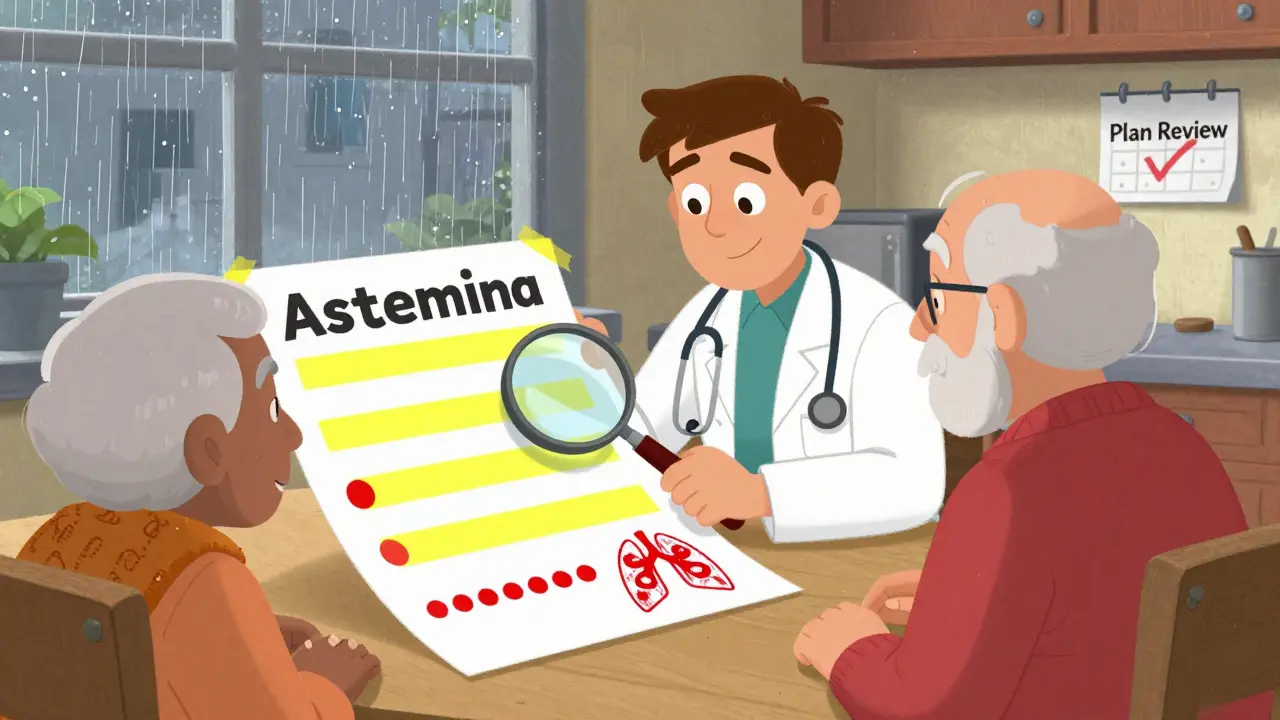
About 8% of men and 0.5% of women have trouble distinguishing red and green. That’s not rare. If you’re one of them, ask your doctor for a version with patterns - stripes for yellow, dots for red - instead of colors. The Allergy Asthma Network offers these alternatives. A good plan works for everyone.
Digital Tools Are Changing the Game
In 2023, the NHLBI released updated digital templates that sync with smart inhalers like Propeller Health. These devices track when you use your inhaler, where you are, and even the air quality around you. If you use your rescue inhaler three times in one day, your app can alert you - and your doctor - before things spiral. A 2022 study showed this boosted adherence by 35%. It’s not magic. It’s data.
The Asthma and Allergy Foundation of America’s online plan generator, launched in January 2023, has already helped 85,000 people create custom plans in minutes. You answer a few questions - triggers, symptoms, meds - and it spits out a printable, shareable plan. No doctor visit needed. Though seeing your doctor is still the best way to make sure it’s accurate.
Who Needs This Most?
Everyone with asthma. But it’s especially critical for:
- Children - their symptoms change fast, and they can’t always explain how they feel.
- Older adults - studies show they need extra time to understand the zones. Don’t assume they get it. Walk them through it.
- People with severe asthma - one flare can mean hospitalization. This plan is their shield.
- Those with seasonal triggers - if pollen knocks you down every spring, your plan needs to change in March.
Adults are often overlooked. Only 52% of adult primary care practices routinely hand out action plans. Pediatric practices? 78%. That gap needs to close. Asthma doesn’t stop at 18.
Final Thought: This Isn’t Optional
You don’t need a fancy app. You don’t need to be a medical expert. You just need a clear, simple plan - and the habit of checking it.
One mom on Reddit said her daughter’s plan stopped an ER trip last winter. Another person realized they’d been living in the yellow zone for months - thinking their wheezing was "normal." They adjusted their meds. Within weeks, they were back in green.
Your asthma doesn’t care if you’re busy, tired, or overwhelmed. But your action plan does. It’s there to carry the load when you can’t. Keep it visible. Keep it updated. Use it.
Because when you know what to do - and when to do it - asthma doesn’t control you. You control it.
Do I really need an asthma action plan if I feel fine?
Yes. Asthma can flare without warning. Feeling fine now doesn’t mean you won’t need help later. An action plan isn’t for emergencies - it’s to prevent them. People who use plans have 3.2 more symptom-free days each week. That’s not luck. That’s preparation.
Can I use someone else’s asthma action plan?
No. Asthma is personal. Your triggers, meds, and response to treatment are unique. Using someone else’s plan could mean taking the wrong dose, ignoring your real symptoms, or missing a red zone warning. A plan only works if it’s built for you.
What if my doctor won’t give me an action plan?
Ask again. Cite the NHLBI guidelines - they recommend a written plan for every asthma patient. If they still refuse, ask for a referral to an allergist. You can also use the Asthma and Allergy Foundation of America’s free online plan generator to create a draft, then bring it to your next appointment. You have the right to a plan.
How often should I update my asthma action plan?
At least once a year - or whenever your asthma changes. If you start a new medication, your triggers shift (like moving cities or starting a new job), or you notice more symptoms, update it. Seasonal changes (like spring pollen) often mean adjusting your plan. Review it at every asthma-related visit.
I use a peak flow meter, but I don’t know my personal best. What do I do?
Measure your peak flow twice a day - morning and night - for two weeks while you’re symptom-free. Write down the highest number you get. That’s your personal best. Use it to set your green, yellow, and red zones. If you’re unsure, ask your doctor to help you calculate it. Without this number, your plan is incomplete.
Can I have an asthma action plan if I don’t have a peak flow meter?
Yes. While peak flow meters help, they’re not required. Many plans rely on symptoms alone: coughing, wheezing, nighttime awakenings, activity limits. If you can’t use a meter, focus on recognizing your personal warning signs. Tell your doctor what your early symptoms are - and build your plan around them. The goal is early action, not perfect numbers.




One comment
It's fascinating how something as simple as a color-coded plan can reduce ER visits by 70%. It makes you wonder why we overcomplicate healthcare so much. The green-yellow-red framework isn't just medical-it's psychological. It gives people a language for their own bodies, which is huge. I've seen this with anxiety disorders too-people need clear thresholds, not vague advice. The real win here is agency. You're not waiting for a crisis-you're monitoring, adapting, staying in control. That's not just asthma management. That's self-mastery.
So… you’re telling me if I just tape a piece of paper to my fridge I’ll stop wheezing? Cool. I’ll get right on that. Meanwhile, my inhaler’s still in the glovebox next to last year’s expired coupons. Honestly? This whole thing feels like a glorified checklist. I’ve got a plan. It’s called ‘pray and hope.’
The data here is solid-70% fewer ER visits is massive. But what’s even more interesting is the behavioral economics angle. People don’t fail because they’re negligent; they fail because the plan isn’t embedded into their routine. It’s not about compliance-it’s about friction. If your plan requires digging through drawers or remembering to open an app, it’s doomed. The real innovation isn’t the zones-it’s the integration. Syncing with smart inhalers? That’s the future. Passive monitoring + real-time feedback = behavioral nudges that actually work. We’re not just managing asthma anymore. We’re designing systems that manage *us*.
I’ve been using my asthma plan for 3 years now. It’s not glamorous. It’s not fancy. But it’s taped to my mirror. Every morning, I check my peak flow. If I’m in yellow, I take my rescue inhaler before coffee. If I’m in red, I call my husband. He knows the drill. I didn’t get it from my doctor-I made it myself using the AAFA generator. Then I brought it to my next visit. He was surprised. Said he’d never thought to ask if I had one. Turns out, most patients don’t. But we’re not broken. We just need a little help remembering. You don’t need to be perfect. You just need to show up. And your plan? It’ll show up for you too.
Yeah right. Like I’m gonna measure my peak flow every day. I’ve got a job, two kids, and a cat that knocks over my coffee. This plan sounds like a full-time job. Also, who has time to update it? My asthma doesn’t care about seasons. It just attacks when I’m in the middle of a Zoom call.
Someone mentioned the app. That’s great. But what if your phone dies? What if you’re in a rural area with no signal? What if you’re 70 and don’t own a smartphone? The whole digital push feels like a luxury for people who already have resources. The real problem isn’t that people don’t use the plan-it’s that the system doesn’t make it easy for them to get one in the first place. My uncle’s been on steroids for 12 years. He doesn’t even know what a peak flow meter is. And his doctor? Never mentioned it. This isn’t about awareness. It’s about access.
This is too much. Just take your puff and shut up. You don’t need colors. You don’t need zones. You don’t need apps. You just need to not smoke and stay away from cats. Simple. Why make it hard? People overthink everything. Asthma is not rocket science. Stop reading. Start breathing.
While I appreciate the intent behind this article, I must point out that the reliance on peak flow meters is scientifically questionable. The 2019 Cochrane Review found no significant difference in outcomes between patients using peak flow monitoring versus symptom-based management alone. Furthermore, the color-coding system assumes uniform perception of symptoms, which ignores neurodivergent experiences and sensory processing differences. A truly inclusive plan should prioritize patient-reported outcomes over arbitrary metrics. And please-no emoticons. This is not a TikTok trend.
Just wanted to say THANK YOU for this. 💯 I’ve been in yellow for months and didn’t even realize it. Thought my cough was just from allergies. Used the AAFA generator, printed it out, and showed my doctor. We adjusted my dose. Two weeks later? I slept through the night for the first time in years. 🙌 It’s not magic. It’s just knowing what to do before it’s too late. Seriously-go make yours today. Your future self will high-five you.
Bro. I made my plan on a napkin during a doctor’s wait. Wrote it in Sharpie. Put it in my wallet. Now I got my whole life on one sticky note: 'If I sound like a seal, take 2 puffs. If I can’t talk, call 911. Don’t be a hero.' It ain’t fancy. But it works. My dog even knows when I’m in red-he barks at my wife. She’s got the backup copy. We’re a team. Asthma don’t care how you do it. Just do it.