
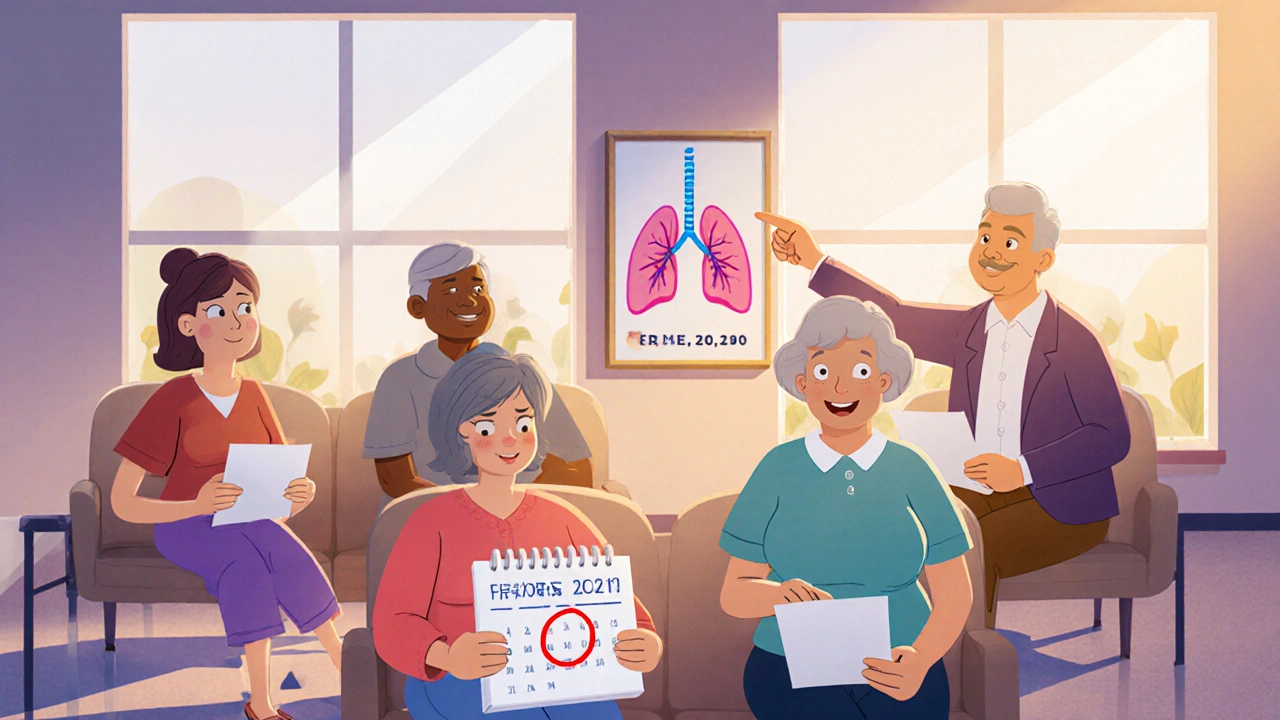
Every year, over 130,000 people in the U.S. die from lung cancer. Most are diagnosed too late-when treatment is harder, less effective, and far more expensive. But there’s a simple test that can catch it early, when it’s still curable: low-dose CT for lung screening. It’s not magic. It’s science. And it’s available to millions of people who don’t even know they qualify.
Who Should Get Screened?
If you’re between 50 and 80 years old and have smoked at least 20 pack-years, you’re likely eligible. A pack-year means smoking one pack a day for a year. So if you smoked a pack a day for 20 years, or two packs a day for 10 years, you hit that threshold. Even if you quit smoking, you still qualify if you stopped within the last 15 years. This isn’t just a guess. It’s based on massive studies like the National Lung Screening Trial (NLST), which tracked over 53,000 people. Those who got annual low-dose CT scans had 20% fewer lung cancer deaths than those who got chest X-rays. That’s not a small win-it’s life-changing. Some guidelines, like those from the American Cancer Society and the National Comprehensive Cancer Network, go even further. They suggest screening for people who quit more than 15 years ago if they have other risk factors-like a family history of lung cancer, exposure to asbestos or radon, or a history of lung disease like emphysema or pulmonary fibrosis. But here’s the catch: only about 23% of eligible people in the U.S. are actually getting screened. Why? Many don’t know they qualify. Others are scared of false alarms. Some can’t get to a clinic-especially in rural areas, where the nearest screening center might be 30 miles away.What Happens During the Scan?
The test itself takes less than 10 seconds. You lie on a table, raise your arms, and hold your breath while the machine spins around you. No needles. No fasting. No prep. You don’t even need to change clothes. The machine uses a fraction of the radiation of a regular CT scan-about 1.2 millisieverts (mSv). That’s roughly the same amount of radiation you’d get from natural sources in four months. For comparison, a standard chest CT is about 7 mSv. The low-dose version is designed to find small nodules without exposing you to unnecessary radiation. The images are analyzed by radiologists trained in lung screening. They look for nodules-small spots in the lungs. If a nodule is 4 millimeters or larger, it’s considered positive and needs follow-up. Most of these aren’t cancer. In fact, 96% of positive scans turn out to be harmless.What Do the Results Mean?
Your result will fall into one of three categories:- Negative: No nodules found, or only tiny, harmless ones. You’ll be asked to return in a year.
- Positive: A nodule 4 mm or larger is seen. This doesn’t mean cancer. It means you need more tests-usually another CT scan in 3 to 6 months to see if the nodule grows.
- Indeterminate: Something unclear shows up. You might need a PET scan, biopsy, or longer follow-up.
What Happens If Cancer Is Found?
If a nodule grows or looks suspicious, you’ll be referred to a lung specialist. Most screen-detected cancers are caught at Stage I-when they’re still small and haven’t spread. At this stage, surgery alone can cure over 80% of patients. Today, most surgeries are done using video-assisted thoracoscopic surgery (VATS), which uses small incisions and a camera. Patients go home in 2-3 days instead of a week. Recovery is faster. Pain is less. And survival rates are dramatically higher than if the cancer had been found later. The NLST found that 71% of cancers caught by LDCT were Stage I. In the group that got chest X-rays, only 49% were caught that early.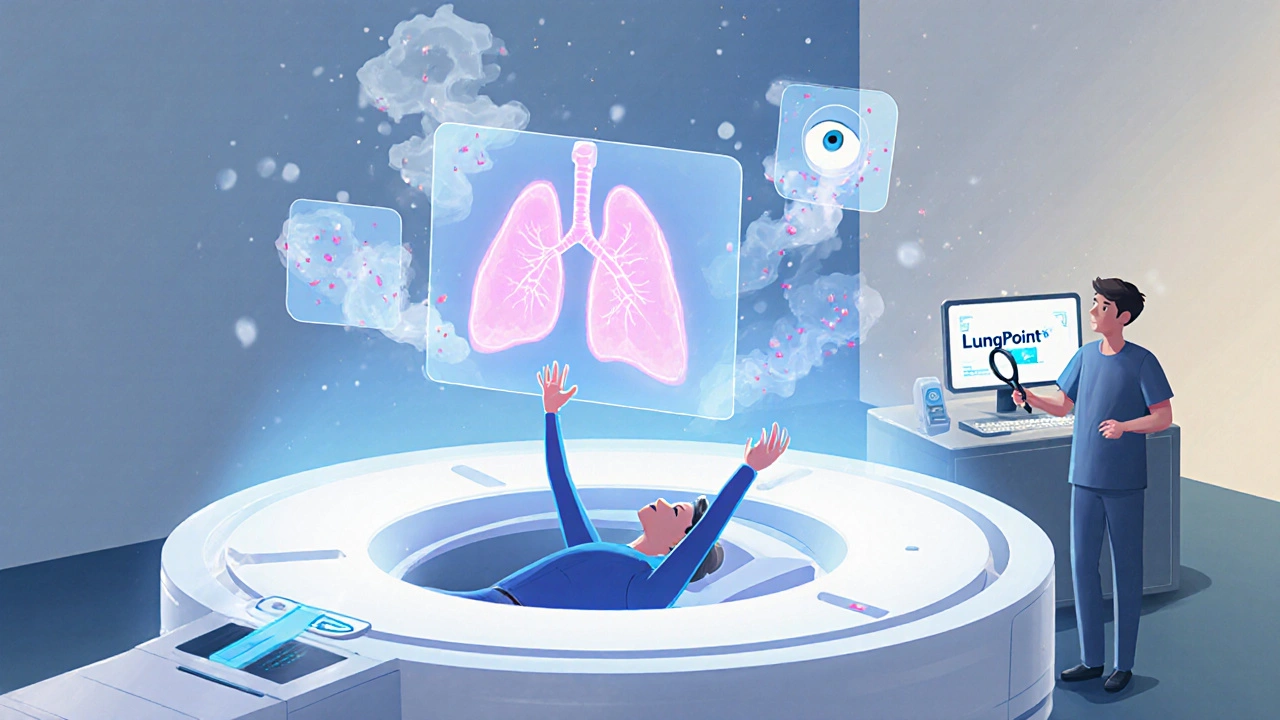
Are There Risks?
Yes. But they’re small compared to the benefits. The biggest risk is radiation-but even that’s minimal. Studies estimate that for every 1,000 people screened annually for 10 years, you might cause one extra cancer death from radiation. But you prevent 15 lung cancer deaths. That’s a net gain of 14 lives. Another risk is overdiagnosis-finding a slow-growing cancer that might never have caused harm. But this is rare in lung cancer. Most screen-detected tumors grow fast enough to be dangerous if left alone. The real challenge? Access. Only 18.5% of eligible people in rural areas get screened. Urban areas are better, but still below 35%. And Black Americans-who have higher lung cancer rates-are screened at 28% lower rates than White Americans.What’s Next?
The U.S. government is considering expanding eligibility even further. Right now, you must have quit smoking within the last 15 years. But research shows lung cancer risk stays high for 25 years or more after quitting. One study found that 34% of lung cancers occur in people who quit over 15 years ago. New tools are helping too. Artificial intelligence can now analyze scans faster and more accurately. One FDA-approved AI tool, LungPoint®, reduces radiologist workload by 30% while keeping detection rates above 97%. Blood tests are also coming. The EarlyCDT-Lung test looks for antibodies that signal early cancer. In 2023 trials, it had a 94% negative predictive value-meaning if it says no cancer, you’re very likely safe.What Should You Do?
If you think you qualify, talk to your doctor. Don’t wait for them to bring it up. Bring it up yourself. Say: “I’m 55, smoked a pack a day for 25 years, and quit five years ago. Should I get screened?” Ask if your provider is part of the ACR Lung Cancer Screening Registry. That means they follow national standards for quality, radiation safety, and follow-up. If you’re on Medicare, the test is free. No copay. No deductible. As long as you meet the criteria and get a referral from your doctor. If you’re uninsured, many community health centers and hospitals offer low-cost or sliding-scale screenings. Call your local American Lung Association office-they can help you find one.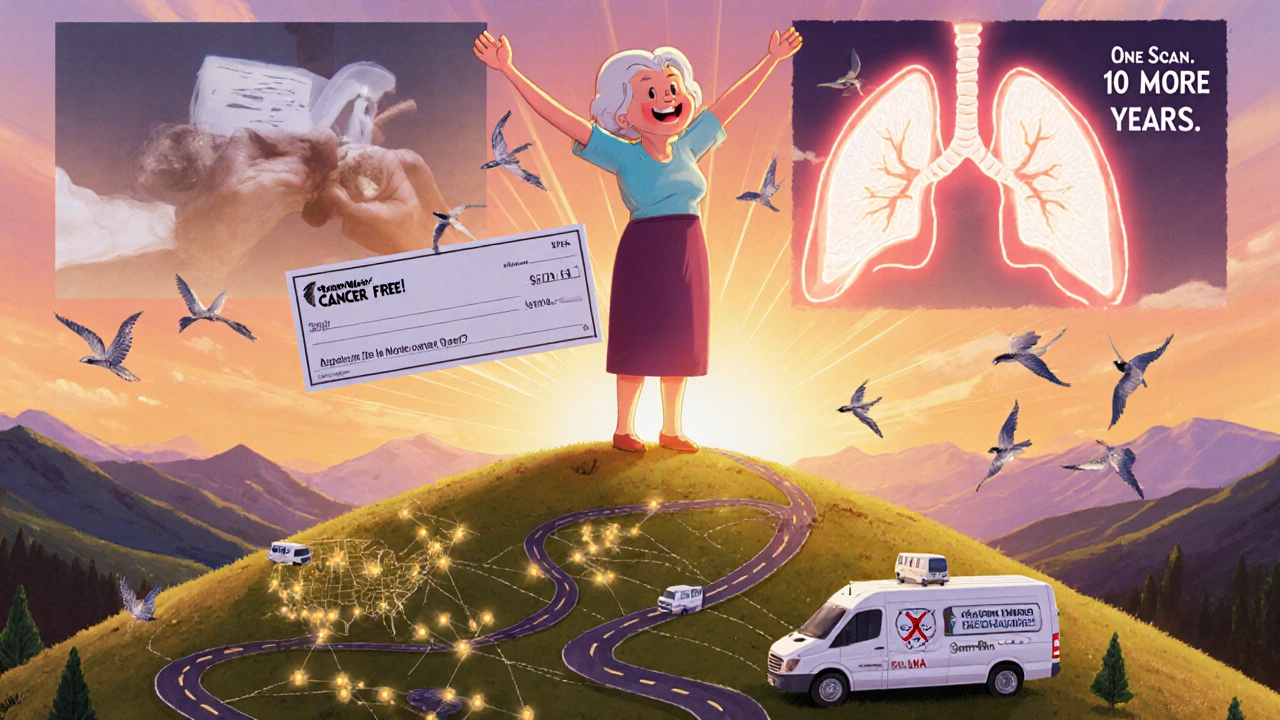
Real Stories, Real Outcomes
Mary Johnson, 58, from Ohio, had her first LDCT scan in 2022. She’d smoked for 30 years, quit 12 years ago. The scan found a 6mm nodule. Follow-up confirmed Stage I adenocarcinoma. She had surgery. No chemo. No radiation. Today, she’s cancer-free. James Wilson, 62, from Texas, also had a positive scan. His nodule turned out to be benign. But he spent three months in anxiety, paid $450 out of pocket for extra tests, and still wakes up wondering if it’s back. These aren’t outliers. They’re common. And they show why screening works-but also why it needs to be done right.Final Thoughts
Low-dose CT screening isn’t perfect. But it’s the best tool we have to stop lung cancer before it kills. It’s not about fear. It’s about control. About knowing. About catching it early enough to beat it. If you’re eligible, don’t wait. Talk to your doctor. Get screened. One scan could give you 10 more years. Or 20. Or more.Who qualifies for low-dose CT lung screening?
You qualify if you’re between 50 and 80 years old, have a smoking history of at least 20 pack-years (like one pack a day for 20 years), and currently smoke or quit within the past 15 years. Some guidelines also include people who quit longer ago if they have other risk factors like family history or exposure to asbestos or radon.
Is low-dose CT screening safe?
Yes. The radiation dose is very low-about 1.2 millisieverts, which is less than half the radiation you get from natural sources in a year. The risk of radiation causing cancer is extremely small. For every 1,000 people screened, you might cause one extra cancer death-but you prevent 15 lung cancer deaths. The benefits far outweigh the risks.
What if my scan comes back positive?
A positive result doesn’t mean you have cancer. It means a nodule was found that needs closer look. Most are benign. You’ll likely need another CT scan in 3 to 6 months to see if it grows. If it does, you may need a biopsy or PET scan. Only about 1.2% of nodules detected in screening turn out to be cancer over two years.
Is low-dose CT covered by insurance?
Yes. Medicare covers it for eligible patients with no copay or deductible. Most private insurers follow Medicare guidelines. You’ll need a referral from your doctor and a shared decision-making visit documented before the scan.
How often should I get screened?
Annually. Studies show annual screening gives the best results. If you stop smoking or turn 81, you can stop screening. But if you’re still in the eligible group and your health is good, keep getting screened every year.
Can I get screened if I’ve never smoked?
Not under current guidelines. Screening is only recommended for people with a significant smoking history. However, researchers are developing risk models that may one day include non-smokers with other risk factors like family history, radon exposure, or lung disease.
What if I live in a rural area?
Access is harder, but not impossible. Many rural hospitals now offer screening. Call your local health department or the American Lung Association. Some programs offer transportation help. Telehealth consultations can also help you start the process, even if you need to travel for the scan.
Do I need a referral to get screened?
Yes. You need a referral from your doctor, and you must have a shared decision-making visit first. This is a 25-30 minute conversation where your doctor explains the benefits, risks, and what to expect. Medicare and most insurers require this before approving the scan.
Can AI help interpret my scan?
Yes. AI tools like LungPoint® are now used in many accredited centers. They help radiologists spot nodules faster and more accurately, reducing reading time by 30% and maintaining over 97% sensitivity for cancer-sized nodules. AI doesn’t replace doctors-it helps them do their job better.
What’s the future of lung cancer screening?
The future is smarter screening. New risk models like LYFS-CT can identify who benefits most, even among non-smokers. Blood tests for early cancer markers are in development. Dual-energy CT and AI are improving accuracy. And by 2027, expanded eligibility could prevent 12,000 more deaths each year. But only if people get screened.

One comment
Just had my first LDCT last month. Turned out clean. Felt like I just won the lottery without buying a ticket. No needles, no waiting, no drama. Just lie down, hold your breath, and boom - you’re done. Why isn’t everyone doing this? It’s literally the easiest life insurance you’ll ever get.
One cannot help but observe the epistemological paradox inherent in population-based screening protocols: the very act of surveillance introduces iatrogenic anxiety, yet the ontological security derived from negation of pathology appears to outweigh the epistemic burden. The NLST data, while statistically robust, fails to account for the phenomenological weight of false positives - a burden disproportionately borne by those without socioeconomic buffers. The algorithmic efficiency of AI-assisted radiology, while laudable, risks commodifying human vulnerability into quantifiable metrics.
U.S. is the only country that makes you beg for your own life. In Canada, we just get it done. No referral drama, no 30-minute ‘shared decision-making’ lecture - just scan. And if you’re a smoker past 50? You’re screened. Period. Why are we still debating this like it’s a political campaign? People are dying while we argue about paperwork. #FixTheSystem
Oh please. You think this is about health? It’s about liability. Hospitals get paid for scans. Insurance companies love the ‘preventive care’ label. But nobody talks about the 24% who get a positive result and then spend six months terrified, paying out-of-pocket for follow-ups, while the system says ‘it’s fine, just watch it.’ This isn’t prevention - it’s a psychological tollbooth disguised as medicine.
My dad got screened last year. Found a nodule. Turned out benign. But he slept with the light on for weeks. I’m so glad he did it though. If it catches one thing early, it’s worth every second of fear. You owe it to your future self to ask. Just say the words. ‘I think I qualify.’ It’s not scary. It’s brave.
Look, I smoked for 22 years, quit 8 years ago. I got screened. Got a positive. Got another scan. Got another. Got another. Turned out it was just an old TB scar from 1997. I spent $1,200 and lost 11 pounds from stress. But hey - I’m alive. And now I nag every ex-smoker I know to get checked. You don’t get to be a hero by doing nothing. Do the scan. Then shut up and live.
I work at a rural clinic. We’ve started doing LDCTs through a mobile van that comes in once a month. People drive 60 miles just to get scanned. One woman cried because she hadn’t seen a doctor in 12 years. She was scared. But she came. And now she’s coming back next year. This isn’t just medicine - it’s dignity.
Why are we screening people who quit 15 years ago? That’s giving up on accountability. If you smoked for 20 years and then quit, you got lucky. Now you want the government to pay for your second chance? I worked 40 years, never smoked, never got a screening. You think that’s fair? This isn’t healthcare - it’s reward for bad choices.
AI? Really? You’re trusting algorithms to read your lungs? In India, we’ve been using AI for cancer detection since 2019 - and guess what? It’s not perfect. It’s a tool. Not a savior. Radiologists are still gods. And if you think your scan is ‘free’ - you’re delusional. The cost is in your anxiety, your insurance premiums, your employer’s premiums. This isn’t a gift - it’s a financial burden dressed in a white coat.
Just got mine. Negative. Went in scared. Came out calm. Talked to my doc. No drama. No guilt. Just a scan. Do it. Now.
Screening is a scam. People die from radiation. People die from stress. People die from overdiagnosis. The system wants you scared so you keep coming back. I never smoked. My lungs are clean. But I don’t need a machine to tell me that. I breathe. I live. I trust my body. You should too. This isn’t science. It’s fear marketing dressed up as care