

When you feel off-balance, it’s easy to call it dizziness. But if you feel like the room is spinning, or you’re tumbling even while lying still, that’s something else entirely - that’s vertigo. Many people use these words interchangeably, but they’re not the same. And confusing them can mean missing the real problem - and delaying the right treatment.
What Exactly Is Dizziness?
Dizziness is the umbrella term. It’s that lightheaded, woozy, faint-like feeling. You might feel like you’re about to pass out, or that your head is floating. It doesn’t involve spinning. Instead, it’s more about your body not feeling grounded. This kind of dizziness often shows up when you stand up too fast, after skipping a meal, or during dehydration. It’s linked to your blood pressure dropping, your blood sugar dipping, or even anxiety. In fact, about 15-20% of adults deal with dizziness every year.
One common cause is orthostatic hypotension - when your blood pressure drops more than 20 mmHg within seconds of standing. That’s why you might see stars when you jump out of bed. Anemia and low blood sugar can trigger it too. Medications, especially for high blood pressure or depression, can make it worse. And yes, stress and panic attacks can mimic physical dizziness. But here’s the thing: if you’re dizzy and your vision blurs, your heart races, or you feel sweaty, it’s likely not your inner ear. It’s your body signaling something else is off.
What Is Vertigo - Really?
Vertigo isn’t just dizziness with extra spice. It’s a specific illusion - the feeling that you or your surroundings are moving, usually spinning. You might feel like you’re on a merry-go-round, even though you’re sitting still. This isn’t in your head. It’s your vestibular system, the part of your inner ear and brain that controls balance, sending wrong signals.
Vertigo comes with telltale signs. Your eyes might jerk involuntarily - that’s called nystagmus, and it happens at 2-6 Hz. You can’t stop it by closing your eyes. The spinning doesn’t go away when you stop moving. And it often gets worse when you turn your head, roll over in bed, or look up. This is why people with vertigo avoid sudden movements. They’ve learned the hard way that even a quick glance at a shelf can trigger a wave of nausea and disorientation.
Vestibular Causes: Your Inner Ear Is the Culprit
Most vertigo - about 80% of cases - comes from your inner ear. That’s the vestibular system: three fluid-filled loops (semicircular canals) and two tiny calcium crystal sacs (otolith organs). They detect head motion and send signals to your brain at 100-200 milliseconds. When something disrupts that, your brain gets mixed messages. You feel like you’re moving, but your eyes and body say you’re not. That mismatch is vertigo.
The top three vestibular causes are:
- Benign Paroxysmal Positional Vertigo (BPPV): This is the most common. Tiny calcium crystals break loose and float into the wrong canal. When you move your head, they jiggle the fluid, tricking your brain into thinking you’re spinning. It’s harmless but terrifying. About 20-30% of all vertigo cases are BPPV. It’s more common after 50, and women are affected more than men.
- Vestibular neuritis or labyrinthitis: Usually from a virus. Your vestibular nerve gets inflamed. Symptoms hit hard - sudden spinning, vomiting, imbalance - and last days to weeks. No hearing loss with neuritis; labyrinthitis includes hearing loss.
- Ménière’s disease: Fluid builds up in the inner ear. You get spinning attacks lasting 20 minutes to hours, plus ringing in the ear, fullness, and hearing loss. It affects about 615,000 Americans. Often misdiagnosed as migraines or ear infections.
These are all peripheral - meaning they start in the inner ear. And they respond well to specific treatments. For BPPV, the Epley maneuver - a series of head movements - fixes it in 1-3 sessions with 80-90% success. Vestibular rehab exercises help neuritis and Ménière’s patients retrain their brains to ignore faulty signals.

Neurological Causes: When the Brain Lies
Not all vertigo comes from the ear. About 5-10% of cases are neurological - meaning the brain itself is the problem. These are more dangerous. They can signal stroke, multiple sclerosis, or tumors.
Central vertigo often comes with other red flags:
- Doubled vision (diplopia)
- Slurred speech (dysarthria)
- Weakness on one side of the body
- Severe headache with no history of migraines
- Loss of coordination (ataxia) - you can’t walk straight
Common neurological causes:
- Vestibular migraine: This is sneaky. You get vertigo attacks - sometimes with no headache - that last minutes to hours. It affects 7-10% of vertigo patients. Often mistaken for Ménière’s. Dr. Sue-Jin Chang found over 30% of these cases were first labeled as sinusitis or anxiety.
- Cerebellar stroke: A stroke in the back of the brain. It’s rare - only 2-3% of vertigo cases - but deadly if missed. The American Academy of Neurology says immediate imaging is needed if vertigo comes with new ataxia or hearing loss on one side.
- Multiple sclerosis: Demyelination in the brainstem can disrupt balance signals. Often presents with chronic dizziness and other neurological symptoms.
Here’s the scary part: emergency doctors miss stroke-related vertigo 88% of the time. Why? Because they’re trained to look for classic stroke signs - facial droop, arm weakness - but vertigo alone doesn’t scream “stroke.” That’s why any new, severe vertigo with neurological symptoms needs a CT or MRI right away.
Why Diagnosis Matters So Much
Getting the diagnosis right changes everything. King Edward VII Hospital’s 2022 data showed that when BPPV is correctly diagnosed, 85% of patients recover fully. But if it’s mistaken for general dizziness and treated with anti-nausea pills alone? Only 45% improve.
Patients often wait months. Reddit’s r/vertigo community found an average delay of 8.2 months before diagnosis. BPPV patients waited 3.1 months - relatively quick. But Ménière’s patients? Over 14 months. One person spent two years on antidepressants for “anxiety dizziness” before a VNG test revealed vestibular migraine. Another spent 18 months told it was “just stress” after a concussion - until a vestibular test showed permanent damage.
Diagnostic tools are precise:
- VNG (videonystagmography): Records eye movements in response to warm and cold air in the ear. 95% sensitive for inner ear issues.
- Head impulse test: A quick head flick. If your eyes can’t stay locked on a target, your vestibular nerve is damaged.
- AI-assisted nystagmus analysis: New software from Johns Hopkins can tell peripheral vs. central vertigo with 85% accuracy - faster than most doctors.
But not every clinic has these tools. Only 12% of primary care doctors feel confident diagnosing vertigo. That’s why so many patients bounce between specialists - ENT, neurologist, psychiatrist - before getting the right answer.
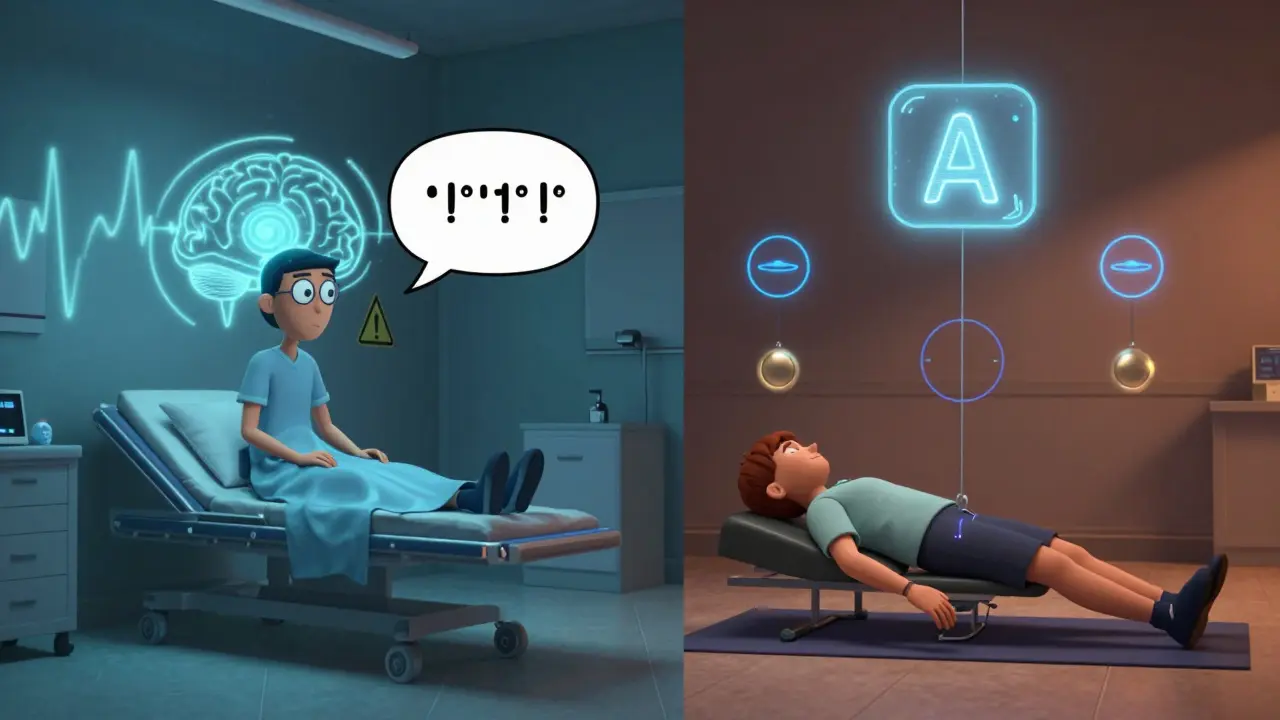
Treatment: What Actually Works
There’s no one-size-fits-all fix. Treatment depends entirely on the cause.
For BPPV: The Epley maneuver. Done by a trained therapist, it takes 15 minutes. Most feel better after one session. You can even do it at home with a video guide - but only if you’re sure it’s BPPV. Doing it for the wrong type of vertigo can make things worse.
For vestibular neuritis: Rest for a few days, then start vestibular rehab. These are balance exercises - standing on one foot, walking while turning your head, focusing on a target while moving. It takes 6-8 weeks. 89% of patients who stick with it see major improvement.
For vestibular migraine: Avoid triggers - caffeine, stress, bright lights, certain foods. Preventive meds like beta-blockers or anticonvulsants help. New FDA-approved protocols for transtympanic gentamicin (injected into the ear) show promise for severe cases.
For neurological causes: This is urgent. Stroke needs clot-busting drugs within hours. MS needs immunotherapy. Tumors need surgery. There’s no home remedy here.
What You Should Do Next
If you’re dizzy:
- Does it feel like you’re going to faint? Check your blood pressure, hydration, and meals. Try standing up slower.
- Is it spinning? Did it start after a head movement? Could be BPPV. Try the Epley maneuver (find a reliable video online).
- Are you nauseous, hearing loss, or ringing in the ear? See an ENT. It could be Ménière’s.
- Did vertigo come with slurred speech, weakness, or double vision? Go to the ER. Don’t wait.
- Has it lasted over 3 months with no clear cause? Ask for a VNG test. It’s not expensive - Medicare now covers it at $235 per session.
Most people don’t realize their dizziness is treatable. The global vertigo treatment market is growing fast - $2.8 billion in 2022 - because more clinics are offering specialized vestibular rehab. And more doctors are learning how to spot the difference.
It’s not just about feeling better. It’s about avoiding falls, especially as you age. Over a third of adults over 65 have dizziness. That’s a fall risk. Getting the right diagnosis isn’t a luxury - it’s a safety net.
Is vertigo the same as dizziness?
No. Dizziness is a general feeling of lightheadedness or unsteadiness. Vertigo is a specific type of dizziness where you feel like you or your surroundings are spinning. Vertigo involves the vestibular system, while dizziness can stem from many other causes like low blood pressure or anxiety.
Can vertigo be caused by stress?
Stress doesn’t directly cause vertigo, but it can trigger or worsen it - especially in vestibular migraine. Stress can also make you more sensitive to dizziness, leading to chronic symptoms like persistent postural-perceptual dizziness (PPPD). However, if you’re truly spinning, it’s likely a physical issue in your inner ear or brain.
How do I know if my vertigo is from my ear or my brain?
Inner ear (peripheral) vertigo usually comes with nausea, vomiting, and is triggered by head movement. It rarely causes weakness, slurred speech, or double vision. Brain (central) vertigo often comes with neurological symptoms like those - or sudden imbalance, trouble walking, or loss of coordination. If you have any of those, seek emergency care.
Is vertigo dangerous?
Most vertigo - like BPPV or vestibular neuritis - is not dangerous, though it’s extremely disruptive. But vertigo caused by stroke, tumor, or MS can be life-threatening. The key is recognizing red flags: sudden severe vertigo with weakness, double vision, trouble speaking, or loss of coordination. If those are present, treat it like a medical emergency.
What tests diagnose vertigo?
The most common is videonystagmography (VNG), which records eye movements in response to air and water stimuli in the ear. The head impulse test checks vestibular nerve function. For suspected brain causes, MRI or CT scans are used. AI tools are now helping distinguish between inner ear and brain causes with over 85% accuracy.




One comment
I had BPPV last year and the Epley maneuver was a game-changer 🙌 My therapist showed me how to do it at home-first try, boom, no more spinning. So many people suffer for months thinking it's anxiety. It's not. It's just crystals in the wrong place. 😊
Holy hell, this post is a masterclass. I didn't know vertigo could be a neurological emergency. I thought it was just 'bad inner ear luck.' The part about stroke being missed 88% of the time? Chilling. I'm printing this and taping it to my fridge. Also, AI nystagmus analysis? That's wild. We're living in the future, folks.
I must correct several inaccuracies in this otherwise well-intentioned piece. First, the claim that '80% of vertigo cases are peripheral' is misleading without specifying population demographics. In elderly populations with comorbidities, central etiologies rise significantly. Second, the assertion that VNG is '95% sensitive' is drawn from idealized clinical trials-not real-world primary care settings where equipment is often outdated. Third, the Epley maneuver success rate of 80-90% applies only to posterior canal BPPV; lateral canal variants require different protocols. Finally, the suggestion that 'anyone can do it at home' is dangerously irresponsible without confirming canal involvement via Dix-Hallpike. This is medical misinformation dressed as public education.
I'm a neurologist in Lagos, and I see this every week. People come in saying 'I'm dizzy,' and it's vestibular migraine-no headache, just vertigo. They've been on antidepressants for a year. Then we do VNG, and it's clear. The problem? No access to specialized tests. We use the head impulse test with a flashlight and a pen. It works. Also, stress doesn't cause vertigo, but it amplifies it. And yes, Ménière's is misdiagnosed as sinusitis all the time. We need more training. Not more pills.
Vertigo isn't just a symptom. It's a message. Your body's screaming, 'Something's off!' And most of us just take a pill and hope it goes away. I used to think my dizziness was stress. Turns out? BPPV. One maneuver. Gone. No meds. No panic. Just a little head movement. Why aren't we teaching this in schools?
This post is pure propaganda. You're glorifying Western medicine while ignoring traditional healing. In my culture, vertigo is treated with herbal teas, breathwork, and ancestral grounding. No Epley maneuver. No VNG. Just wisdom passed down. Why do we trust machines over grandmothers? Also, 'neurological causes' are just the system's way of pathologizing natural body responses. You're scared of the unknown. That's why you need an MRI.
I’ve been living with vestibular migraine for 5 years. No one believed me until I got a VNG. The worst part? People say 'just relax' or 'it's all in your head.' But when you’re spinning in bed with nausea and light sensitivity? It’s not anxiety. It’s biology. I’m so glad this article exists. It’s like someone finally spoke my language.
yo i had this for like 6 months and thought it was just stress or me being tired. then i found a video on youtube called 'how to do the epley at home' and did it before bed. next morning? no spinning. like, poof. gone. i wish i knew this sooner. also, dont trust your dr if they just give you meclizine. that's a bandaid.
Let’s be real-this whole 'vestibular rehab' thing is just a scam to get people to pay for physical therapy. I did the exercises for two weeks. Nothing. Then I stopped taking my blood pressure meds and my vertigo vanished. Coincidence? I think not. The system wants you dependent. The truth? Your body heals itself if you stop poisoning it with pills and tests.
To everyone who’s been told it’s 'just anxiety'-I see you. I was there. I cried in three different ERs before someone finally listened. You’re not crazy. You’re not weak. You’re not broken. You just have a misfiring system. And guess what? It’s fixable. You don’t need a miracle. You need a VNG test. And someone who believes you. You’re not alone.
i think this is all overhyped. i had vertigo once after drinking too much coffee. i slept it off. problem solved. why do we need all this fancy science? just chill out. stop overthinking. your body knows what to do. also, why is everyone so obsessed with tests? just breathe. lol.
I’m so tired of people saying 'it's just BPPV' like it's no big deal. I had 3 episodes in 6 months. I fell. Broke my wrist. My kid had to call 911. This isn't 'oh I did a head tilt and now I'm fine.' This is terrifying. And yeah, I'm done with doctors who don't take it seriously. I'm getting my MRI. No excuses.
So… we spent 2000 words explaining that spinning = vertigo and woozy = dizziness? I’m impressed. Truly. The next article: 'Water is wet. Fire burns. And gravity? It’s still a thing.'