Biosimilar & Interchangeability Checker
Check Substitution Eligibility
Select the product status listed in the Purple Book and your location's regulations.
Ready to Check
Enter details on the left to see if your pharmacist can substitute your medication.
Have you ever looked at a prescription for a biologic drug and wondered if there’s a cheaper, equally effective alternative? Or maybe you’ve heard the terms "biosimilar" and "interchangeable" thrown around in your pharmacy but weren’t sure what they actually mean for your health or your wallet. The answer often lies in a specific, government-maintained resource known as The Purple Book, which is an official online searchable database maintained by the U.S. Food and Drug Administration (FDA) that lists all approved biological products, including biosimilars and interchangeable counterparts. It might sound like just another bureaucratic document, but this tool is critical for patients, pharmacists, and doctors navigating the complex world of modern medicine.
Unlike small-molecule drugs (like aspirin or ibuprofen), which are simple chemical compounds that can be easily copied once a patent expires, biological products are large, complex molecules made from living organisms. Think of them more like intricate puzzles than simple Lego bricks. Because of this complexity, you can’t just make an exact copy; you have to create something that is highly similar. This is where the concepts of biosimilarity and interchangeability come in, and the Purple Book is the definitive source for checking the status of these products.
What Exactly Is the Purple Book?
The Purple Book isn't a physical book you find on a shelf. It is a digital database hosted on the FDA’s website. Its primary job is transparency. It provides healthcare professionals and patients with clear information about which biological products are licensed, which ones are biosimilars, and crucially, which ones are designated as "interchangeable."
This resource was born out of the Biologics Price Competition and Innovation Act (BPCIA), which is a federal law enacted in 2010 that created a streamlined approval pathway for biosimilar and interchangeable biological products. Before the BPCIA, there was no legal framework for approving follow-on biological products. The act allowed manufacturers to submit applications for products that were highly similar to already-approved reference products. Initially, the FDA maintained two separate lists-one for products regulated by the Center for Drug Evaluation and Research (CDER) and one for the Center for Biologics Evaluation and Research (CBER). In 2020, these were merged into the single, integrated Purple Book we use today, making it much easier to search and understand.
When you open the database, you aren't just looking at a list of names. You’re looking at a structured hierarchy. Each product card shows key details: the date the product was licensed under section 351(a) of the Public Health Service (PHS) Act, whether it has reference product exclusivity, and its relationship to other products. The FDA uses a color-coding system here: matching product card colors indicate that a biological product is biosimilar to or interchangeable with a reference product sharing that same color. This visual cue helps users quickly identify relationships between the original drug and its alternatives.
Biosimilar vs. Interchangeable: Knowing the Difference
This is the part that confuses most people. You might assume that if a drug is a "biosimilar," it can automatically be swapped for the brand-name version. That is not always true. Understanding the distinction is vital because it determines whether your pharmacist can substitute the drug without calling your doctor.
A biosimilar is a biological product that is highly similar to an approved reference product, with no clinically meaningful differences in safety, purity, or potency. To earn this designation, the manufacturer must conduct extensive analytical and clinical studies to prove that their product behaves almost identically to the reference product. However, being a biosimilar doesn't guarantee that it can be substituted at the pharmacy counter.
An interchangeable biological product is a biosimilar that meets additional requirements, specifically demonstrating that it can be switched back and forth with the reference product without increasing safety risks or reducing effectiveness. All interchangeable products are biosimilars, but not all biosimilars are interchangeable. To get that extra "interchangeable" label, a company must provide evidence from switching studies. These studies show that if a patient alternates between the biosimilar and the reference product, the outcome remains safe and effective. This is a higher bar to clear.
Why does this matter? Because substitution laws depend on it. If a product is only a biosimilar, a pharmacist generally cannot substitute it for the prescribed reference product unless the prescriber explicitly allows it. But if it is designated as interchangeable, state laws may allow the pharmacist to substitute it automatically, potentially saving the patient money. The FDA emphasizes that the interchangeable designation does not mean the product is safer or more effective than a non-interchangeable biosimilar; it simply means the switching risk has been thoroughly vetted.

How to Use the Purple Book Database
Navigating the Purple Book is straightforward once you know what to look for. Here is how you can check the status of a specific biological product:
- Visit the FDA Website: Go to the official FDA Purple Book page. Ensure you are on the fda.gov domain to avoid outdated third-party mirrors.
- Search by Name: Use the search bar to type in the brand name (proprietary name) or the generic name of the biological product. For example, you might search for "Humira" or "adalimumab-bwwd".
- Review Product Cards: When results appear, look at the product cards. Pay attention to the colors. If you see multiple cards with the same color background, those products are related. One will be the reference product (usually labeled 351(a)), and others will be biosimilars (351(k)) or interchangeable products.
- Check Designations: Look for the specific labels. A product might be listed as "Biosimilar" or "Interchangeable." The database also indicates if a product has reference product exclusivity, which affects when competitors can enter the market.
- Note Presentations: Icons on the cards show available forms, such as pre-filled syringes or autoinjectors. This is helpful for patients who need to self-administer medication.
The database is updated regularly. As new products receive approval, they are added immediately. This real-time access ensures that healthcare providers are working with the most current regulatory information. If you are a patient, you can use this tool to ask informed questions. For instance, you could say to your doctor, "I see that Product X is listed as interchangeable in the Purple Book. Can my pharmacist substitute it for my current medication?"
The Role of State Laws in Substitution
Here is where things get tricky. The FDA grants the interchangeability designation at the federal level, but the actual act of substituting the drug happens at the pharmacy, which is governed by state law. Just because the FDA says a product is interchangeable doesn't mean every pharmacy in the country can swap it.
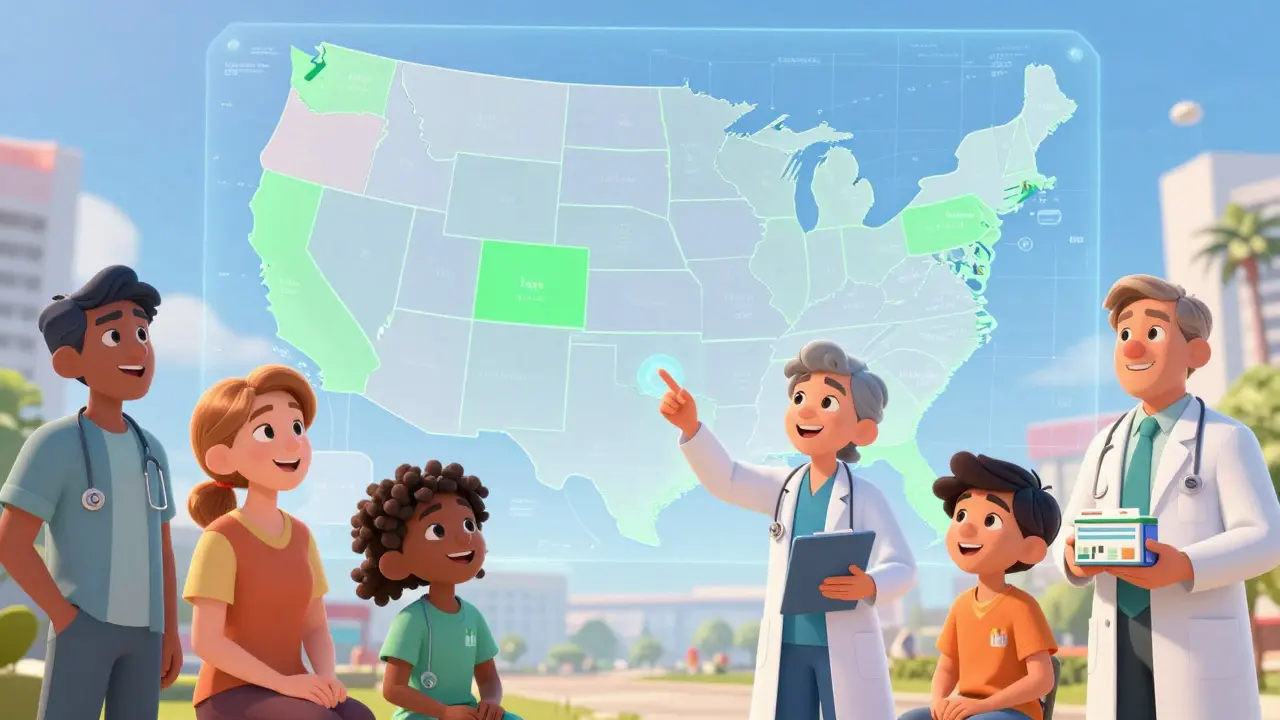
As of late 2023, 47 states and Puerto Rico allowed pharmacists to substitute an interchangeable biosimilar for a prescribed reference medicine without needing prior permission from the prescriber. However, many of these states have specific rules. Some require the pharmacist to notify the prescriber, while others mandate notifying the patient. Some states keep logs of substitutions, while others do not.
This patchwork of regulations means that even with a clear "interchangeable" stamp in the Purple Book, the experience can vary depending on where you live. Pharmacists must stay up-to-date with their specific state board of pharmacy rules. For patients, this means you should always confirm with your pharmacist whether substitution is permitted in your state and whether your insurance plan covers the biosimilar equivalent. Sometimes, even if substitution is legal, insurance formularies might prefer one product over another, influencing what gets dispensed.
Current Landscape of Interchangeable Products
While hundreds of biosimilars have entered the U.S. market since the BPCIA was passed, the number of products with the full "interchangeable" designation remains smaller. As of late 2023, only seven biosimilars had received this top-tier designation. These include treatments for serious conditions such as inflammatory diseases (like rheumatoid arthritis), certain eye conditions affecting the retina, and insulin products for diabetes management.
The slow uptake of interchangeable designations is partly due to the rigorous data requirements. Switching studies are expensive and time-consuming. Additionally, some manufacturers choose not to pursue interchangeability because they believe their biosimilar is already trusted enough by prescribers to be used voluntarily, or because they focus on markets where substitution laws are less relevant. However, industry experts anticipate growth in this area. As patents for major blockbuster biologics expire, more companies are investing in the data needed to secure that interchangeable label, driven by the potential for broader market access through pharmacy substitution.
| Product Type | Regulatory Pathway | Similarity to Reference | Switching Studies Required? | Pharmacy Substitution Allowed? |
|---|---|---|---|---|
| Reference Product | BLA (Section 351(a)) | N/A (The Original) | No | N/A |
| Biosimilar | BLA (Section 351(k)) | Highly Similar | No | Only if prescriber allows or state law permits specific cases |
| Interchangeable | BLA (Section 351(k)) + Extra Data | Highly Similar + Predictable Outcome upon Switching | Yes | Yes, in most states (subject to local laws) |
Why Transparency Matters for Patients
The existence of the Purple Book serves a deeper purpose beyond regulatory compliance: it empowers patients. Biological therapies can cost tens of thousands of dollars per year. The introduction of biosimilars and interchangeable products is one of the few levers available to reduce these costs. By providing a clear, accessible record of which products are approved and how they relate to each other, the FDA helps ensure that patients have access to affordable options without compromising safety.
For healthcare providers, the Purple Book reduces uncertainty. Doctors can confidently prescribe biosimilars knowing the regulatory status. Pharmacists can verify substitution eligibility instantly. This clarity streamlines the entire care process. Without a centralized resource like the Purple Book, verifying the status of a complex biologic would require digging through individual labeling documents or contacting manufacturers directly-a inefficient and error-prone process.
As the biopharmaceutical landscape continues to evolve, with new cell and gene therapies entering the mix, the Purple Book will likely expand to cover these advanced modalities as well. For now, it remains the gold standard for understanding the ecosystem of biological products in the United States. Whether you are a patient trying to save money on your monthly meds or a pharmacist ensuring you follow state law, bookmarking this resource is a smart move.
Is the Purple Book free to access?
Yes, the Purple Book is a public resource maintained by the FDA. It is completely free to access and search on the FDA's official website. There are no fees or subscriptions required to view product statuses, approval dates, or interchangeability designations.
Can my pharmacist substitute any biosimilar for my prescribed biologic?
Not necessarily. Pharmacists can typically only substitute a biosimilar if it has been designated as "interchangeable" by the FDA AND if your state's laws permit automatic substitution. Even then, some states require notification to the prescriber or the patient. If the biosimilar is not designated as interchangeable, the pharmacist usually needs explicit permission from your doctor to dispense it instead of the reference product.
Are interchangeable biosimilars safer than non-interchangeable ones?
No. The FDA states clearly that the interchangeable designation does not mean the product is safer or more effective than a biosimilar that is not approved as interchangeable. Both types must meet high standards for safety, purity, and potency. The "interchangeable" label simply adds evidence that switching back and forth between the products does not increase risk, which facilitates pharmacy substitution.
How often is the Purple Book updated?
The Purple Book is updated regularly as the FDA approves new biological products or makes changes to existing product listings. While there isn't a fixed daily schedule, updates occur promptly following licensing decisions. Users should check the database frequently for the most current information, especially when new approvals are anticipated.
What is the difference between a generic drug and a biosimilar?
Generic drugs are identical copies of small-molecule chemical drugs (like pills). They must contain the exact same active ingredient and work the same way in the body. Biosimilars are highly similar to biological products (large, complex molecules made from living cells). Because biologicals are too complex to be copied exactly, biosimilars are allowed minor differences in inactive components as long as there are no clinically meaningful differences in safety or effectiveness.
Does the Purple Book list vaccines and blood products?
Yes. The Purple Book includes information on FDA-licensed allergenic, cellular and gene therapy, hematologic, and vaccine products regulated by the Center for Biologics Evaluation and Research (CBER), in addition to therapeutic biologics regulated by CDER. This makes it a comprehensive resource for all types of biological products.