
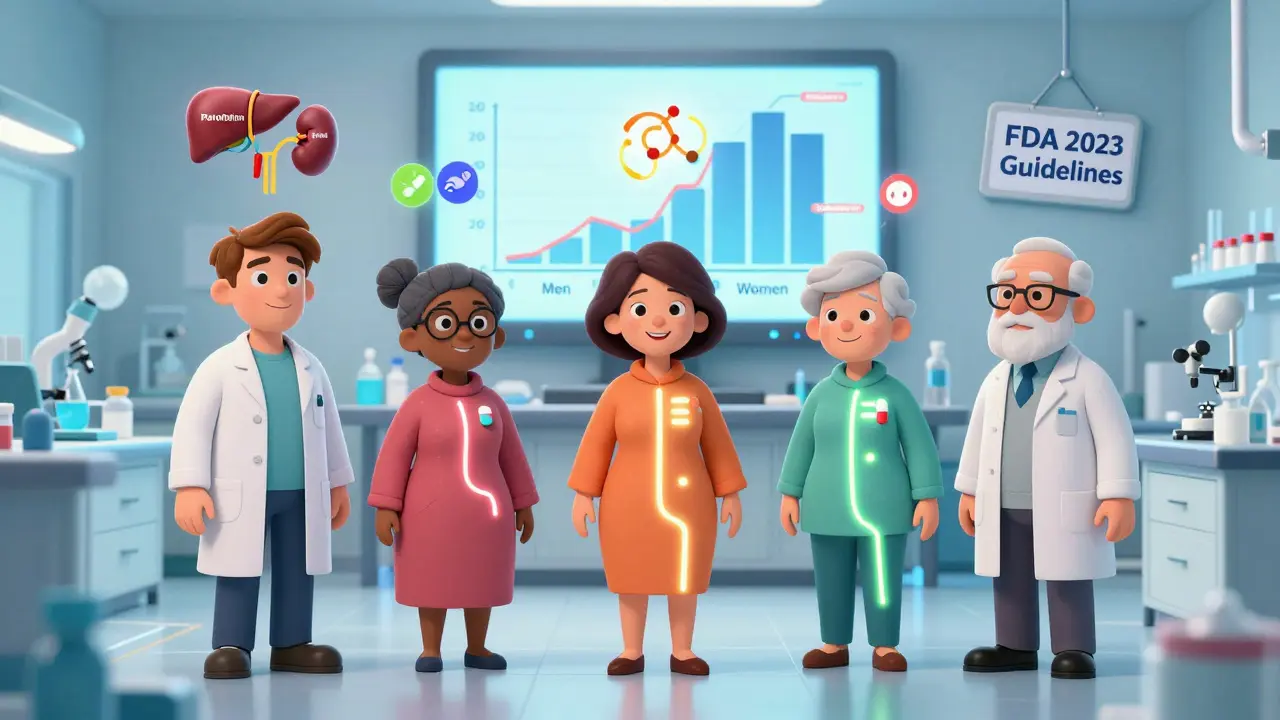
When a generic drug hits the market, we assume it works just like the brand-name version. But what if the people taking it aren’t the same as the ones who tested it? That’s the real issue behind bioequivalence and why age and sex matter more than most people realize.
Bioequivalence studies are the backbone of generic drug approval. They compare how fast and how much of a drug enters the bloodstream between a generic and the original. The goal? To prove they’re the same. But for decades, these studies were done almost entirely on young, healthy men. Why? Because it was easier. Men were seen as less variable, less complicated. But that assumption is outdated-and dangerous.
Why Age and Sex Aren’t Just Demographics
Drugs don’t treat bodies the same way. Your age changes how your liver processes medicine. Your sex affects how your stomach empties, how much fat you carry, and even how your kidneys filter drugs. These aren’t minor differences. They can mean the difference between a drug working perfectly or causing side effects.
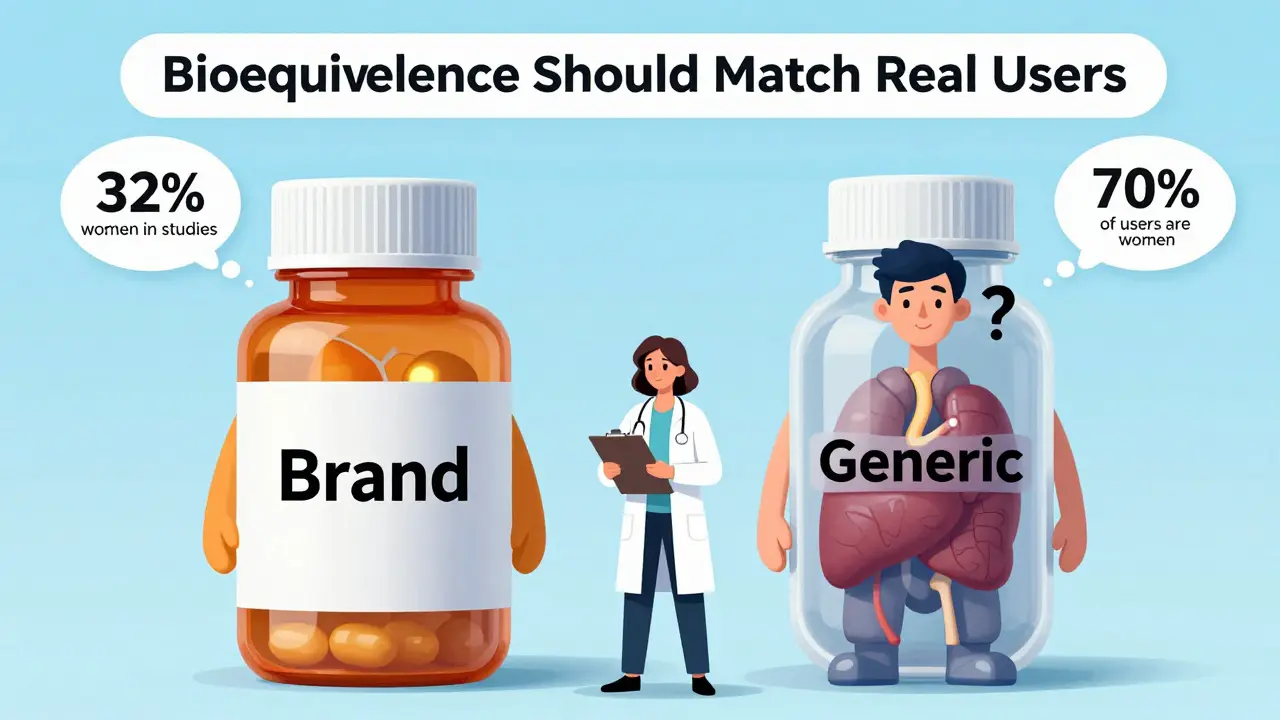
Take levothyroxine, a common thyroid medication. Over 60% of users are women. Yet, bioequivalence studies for this drug often include fewer than 25% women. That’s not just a gap-it’s a blind spot. Women metabolize this drug differently. Their hormone cycles, body composition, and enzyme activity all shift how the drug behaves. If the study population doesn’t reflect the real users, how can we be sure the generic works for them?
Age adds another layer. Older adults often have slower metabolism, reduced kidney function, and take multiple medications. A drug that works fine in a 25-year-old might build up to toxic levels in a 70-year-old. But many bioequivalence studies still exclude people over 60 unless there’s a specific reason to include them. That’s a problem when the drug is meant for seniors.
How Regulators Are Changing the Rules
The U.S. Food and Drug Administration (FDA) used to say sex and age weren’t critical-unless the drug was only for one group. But in May 2023, they updated their guidance. Now, if a drug is used by both men and women, the study must include similar numbers of each. No more 80% male studies for drugs taken mostly by women.
The European Medicines Agency (EMA) takes a slightly different approach. They don’t require exact 50/50 splits. Instead, they say subjects “could belong to either sex.” But even they’ve moved beyond ignoring the issue. Their 2010 guidelines already warned that excluding women or older adults without justification could hide real differences between products.
Brazil’s ANVISA is even stricter. Their rules demand equal male-female distribution, non-smokers, and participants aged 18 to 50. They also require BMI within strict limits. It’s not just about health-it’s about consistency. If everyone in the study is nearly identical, you’re more likely to spot real differences between the two drug versions.
But here’s the catch: not all regulators agree. The FDA wants representation. The EMA wants sensitivity. And that creates tension for drug makers trying to get approvals in multiple countries.
The Hidden Cost of Unbalanced Studies
Recruiting women and older adults isn’t just ethical-it’s practical. Smaller, unbalanced studies can give false results. A 2018 study showed that with only 12 participants, one or two extreme data points could make it look like a drug was bioinequivalent in men but not women. Turn the sample size up to 36, and those outliers even out. The drug was fine all along.
That’s why statisticians now recommend at least 24 to 36 participants in bioequivalence trials. And if you’re studying a drug used by both sexes, you need enough people in each group to detect differences. Stratified randomization-splitting participants by sex before assigning them to treatment-helps ensure fair comparison.
But there’s a financial downside. Recruiting women, especially those of childbearing age, adds complexity. They need pregnancy tests, contraception plans, and often more monitoring. Sites report recruitment for gender-balanced studies takes 40% longer. That means higher costs-and many sponsors still try to avoid it.
Between 2015 and 2020, only 38% of generic drug applications met the 40-60% female participation threshold. The median? Just 32%. That’s not just outdated-it’s risky. Women are more likely to report side effects. They’re also more likely to be on multiple medications. If we don’t test in their bodies, we’re guessing.
What Happens When We Get It Wrong
There’s real harm in ignoring these factors. A 2017 study found a generic antidepressant appeared to have lower absorption in men than the brand-name version-95% vs. 79%. But when they repeated the study with more women, the gap disappeared. The initial result wasn’t a formulation problem. It was a statistical fluke caused by too few participants and no sex-based analysis.
Another example: blood thinners like warfarin. Women often need lower doses. But if bioequivalence studies only used men, the generic might be dosed too high for women. That increases bleeding risk. That’s not theoretical. That’s documented.
And it’s not just about side effects. Sometimes, a drug just doesn’t work as well. A 2023 University of Toronto study found that 37% of commonly tested drugs are cleared from the body 15-22% faster in men than in women. If the generic was tested only in men, women might get less of the drug. Less effect. More trips to the doctor.

What Should Sponsors Do Now?
If you’re developing a generic drug, here’s what you need to do:
- Match the population. If 70% of users are women, your study should be close to that.
- Include older adults. If the drug is for hypertension or diabetes in seniors, include people over 60. Don’t just say “healthy volunteers” and call it done.
- Plan for analysis. Don’t just collect sex and age data-analyze it. Look for interactions between sex and formulation. If you see a difference, don’t ignore it.
- Document everything. Regulators now require clear justifications if you exclude certain groups. If you don’t have data to back it up, you’ll get flagged.
Some companies are already adapting. A 2022 survey found 68% of contract research organizations now actively recruit women. They use targeted outreach, flexible scheduling, and even childcare support. It’s not perfect-but it’s progress.
The Future Is Inclusive
The FDA’s 2023-2027 plan calls for “enhancing representation of diverse populations in generic drug development.” That’s not just a buzzword. It’s a mandate. The EMA is reviewing its 2010 guidelines right now. Changes are coming.
Future standards may even include sex-specific bioequivalence thresholds for narrow therapeutic index drugs-medications where small differences can be dangerous. Think blood thinners, epilepsy drugs, or thyroid meds. These aren’t just “similar enough.” They need to be exact.
And as research grows, we’ll see more data on how hormones, body fat, and enzyme activity vary across age and sex. That’s not noise. It’s signal. Ignoring it doesn’t save money. It risks lives.
Generic drugs save billions. But they only work if they work for everyone. That means designing studies that reflect the people who will actually take them-not the ones who are easiest to recruit.
Why were bioequivalence studies historically done mostly on young men?
Early bioequivalence studies focused on young, healthy men because they were seen as more consistent and easier to recruit. Their hormone levels were stable, they had fewer comorbidities, and regulatory agencies assumed results from men could be generalized to women. This approach was practical but scientifically flawed, especially as evidence mounted that sex and age significantly affect how drugs are absorbed and metabolized.
What are the current FDA requirements for sex representation in bioequivalence studies?
As of the May 2023 draft guidance, the FDA requires that if a drug is intended for use in both sexes, the study must include similar proportions of males and females. This means aiming for roughly a 50:50 split unless there’s a strong scientific reason to do otherwise. For drugs used only by one sex, only participants of that sex should be included. Female participants must also use contraception or abstain from sex during the study.
Do age restrictions vary between regulatory agencies?
Yes. The FDA allows adults 18 and older, with special consideration for including those over 60 if the drug targets seniors. The EMA requires participants to be 18+, while ANVISA in Brazil limits enrollment to 18-50 years. Health Canada accepts 18-55. These differences reflect varying priorities: some focus on generalizability, others on minimizing variability. But all now recognize that excluding older adults without justification can lead to unsafe or ineffective generics.
Can a bioequivalence study done in young adults be used for elderly patients?
Not without justification. While a study in healthy young adults can support approval for broader use, regulators now require clear evidence that the drug behaves similarly in older populations. Pharmacokinetic changes due to aging-like reduced liver metabolism or kidney clearance-can make a drug less safe or effective in seniors. The FDA explicitly states that extrapolating results to older adults requires scientific support, not just assumption.
What happens if a bioequivalence study doesn’t include enough women?
The application may be rejected or delayed. The FDA now requires sponsors to justify any imbalance in sex representation. If a drug is widely used by women but the study had only 20% female participants, regulators may ask for additional data or even a new study. This has already happened with several generic drugs, especially those for thyroid conditions, depression, and osteoporosis-conditions where women are the majority of users.
Real progress means changing how we think about bioequivalence. It’s not just about matching numbers in a lab. It’s about matching real people. The science is clear. The regulations are catching up. Now, it’s up to the industry to do the right thing-not because it’s easy, but because it’s necessary.


One comment
Finally someone’s talking about this. I’ve been on levothyroxine for 12 years and always wondered why the generic felt off some months. Turns out, my body’s not a male lab rat. It’s wild how long we’ve just accepted this. Thanks for laying it out.
Of course the FDA only cares now that women are voting. Real progress? Nah. They just got scared of lawsuits.
This is the kind of stuff that should be on TikTok. Imagine a 60-second explainer: ‘Why your generic antidepressant might be failing you because the study had 10 guys and 2 women.’ We need memes for science. This isn’t just regulatory-it’s personal. My mom took a generic for her BP and ended up in the ER. Turned out her kidneys were slowing down and the dose was built for a 30-year-old dude who lifts weights. We’re not just talking numbers. We’re talking lives.
you know what's funny? the same people who scream about diversity in clinical trials are the ones who refuse to get their blood drawn for a study. they want representation but won't show up. also, why is it always men's fault? women have more hormonal swings, pregnancy, menopause. it's not that we ignored them-it's that we tried to control variables. now we're just throwing darts.
The epistemological foundations of bioequivalence have long been predicated upon a reductionist paradigm that privileges homogeneity over heterogeneity. The historical reliance upon young, male, healthy subjects was not an oversight-it was a methodological necessity, grounded in the principle of minimizing confounding variance. To conflate social equity with pharmacokinetic validity is to commit a category error of significant magnitude. The regulatory shift you describe, while politically expedient, risks introducing systematic noise into an otherwise deterministic model of drug absorption. One must ask: is the pursuit of demographic parity commensurate with the pursuit of therapeutic precision?
I work in clinical trials and can confirm: recruitment for women over 40 is brutal. They’ve got jobs, kids, aging parents. You can’t just say ‘come in for a 10-hour fast’ and expect them to drop everything. Some sites now offer Uber credits and on-site childcare. It’s not perfect, but it’s working. Also-yes, older adults need to be included. My grandma’s on five meds. If we don’t test how generics interact with that? We’re playing Russian roulette with her kidneys.
So now we need 50/50 splits and BMI limits? Cool. Next they’ll require participants to be vegan, own a yoga mat, and have read the original paper. Australia’s still doing 80% male studies. No one’s complaining. Why? Because we’re not obsessed with performative science. Just test it. If it works, it works.
In India, we see this daily. Generic metformin is used by 70% women with PCOS. But trials? 90% men. We get side effects-nausea, dizziness-and no one knows why. Pharma doesn't even bother to stratify. It's cheaper to sell and hope. But the cost? Women suffering silently. We need localized trials. Not just global averages. Real data from real bodies, not lab clones.
LET ME TELL YOU SOMETHING-WHEN MY SISTER GOT A GENERIC FOR HER ANTI-EPILEPTIC AND HAD A SEIZURE BECAUSE THE DOSE WAS BUILT FOR A 25-YEAR-OLD MAN? THAT WASN'T AN ACCIDENT. THAT WAS NEGLIGENCE. WE’RE TALKING ABOUT PEOPLE’S LIVES HERE. NOT STATS. NOT BALANCE SHEETS. LIVES. AND YET WE STILL LET CORPORATIONS CUT CORNERS BECAUSE ‘IT’S EASIER.’ NO. IT’S NOT. IT’S CRIMINAL.
ugh i just cried reading this. my mom died because a generic blood thinner didn't work right for her body. they tested it on 18 guys. she was 72. no one even asked if it was safe for women over 60. now i'm just mad. like, really mad. 💔
Look, I get it. But let’s not pretend this is about fairness. It’s about liability. If a woman has a bad reaction and you didn’t test enough women, you get sued. So now you have to include them-not because it’s right, but because you’re scared. That’s not science. That’s risk management. And it’s going to make generics more expensive. Which means people won’t take them. Which means more people die from untreated conditions. You want inclusion? Fine. But don’t pretend you’re saving lives when you’re just covering your ass.
That 2018 study with the 12 participants? Yeah, I’ve seen that happen. We had a generic muscle relaxant that looked like it failed in men-turns out, the two women in the study had way higher absorption. We didn’t analyze by sex. We just tossed the whole trial. Cost $2M. Now we run stratified analyses by default. It’s annoying? Yes. Necessary? Absolutely. Also-shoutout to the CROs that actually hire women as recruiters. They get 3x the enrollment. Funny how that works.
Why are we even doing this? If a drug works in men, why not just assume it works in women? Evolution didn’t design two different systems. We’re overcomplicating it. Women are just more sensitive. So give them a lower dose. Done. Stop making everything a political football. This isn’t a social justice issue. It’s a dosing issue. Fix the dose. Don’t fix the study.
Let’s be real-this whole thing is just woke science. They want diversity because it looks good on a slide deck. But you know what’s more diverse? The real world. Real people don’t care if a study had 40% women. They care if their pill works. If it lowers blood pressure, stops seizures, or helps their thyroid-then it’s good. Stop trying to engineer perfection. Just make sure it’s safe. And if it works? Let people use it. No need for 36 people with 18 men and 18 women. That’s not science. That’s theater.