
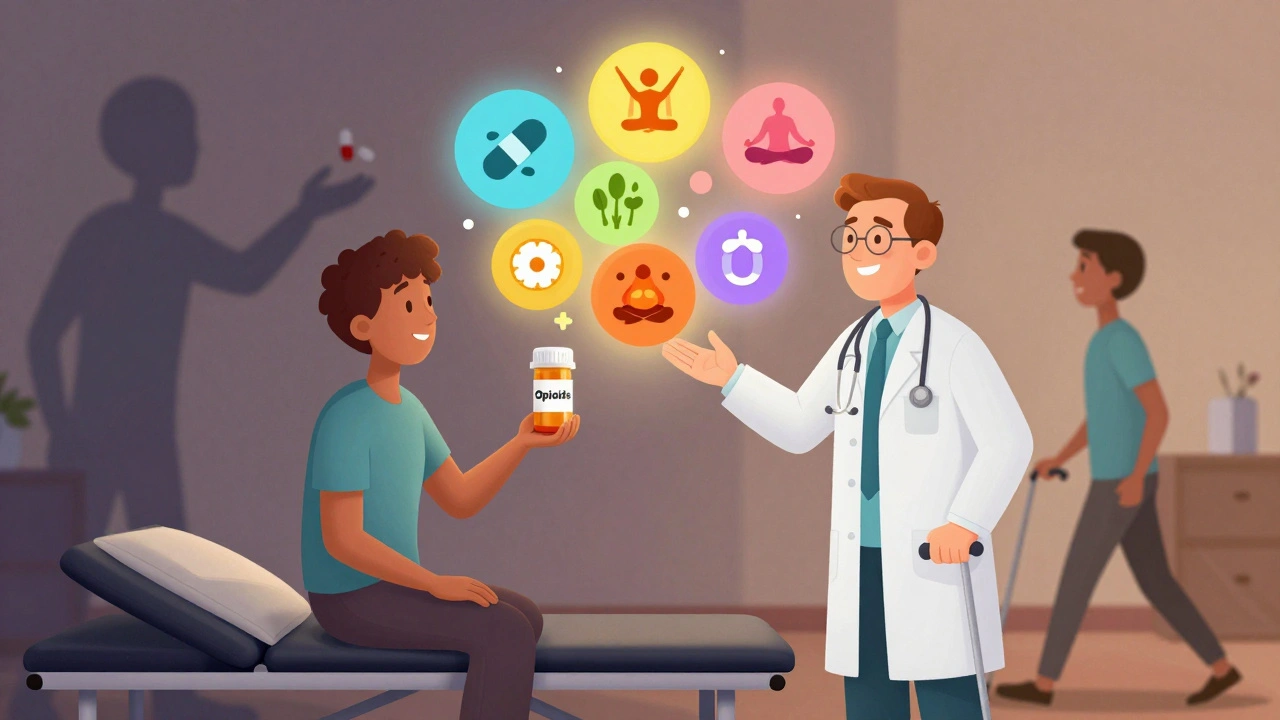
When you’re in severe pain-after surgery, a broken bone, or a flare-up of chronic back pain-it’s tempting to reach for opioids. They work fast. They take the edge off. But for many people, what starts as short-term relief turns into something far more dangerous. The question isn’t just whether opioids help with pain. It’s: when do they help enough to justify the risk?
They’re Not First-Line Treatment for Chronic Pain
The truth is, opioids shouldn’t be the first thing doctors reach for when someone has ongoing pain. The CDC’s 2022 guidelines make this clear: non-opioid treatments like physical therapy, cognitive behavioral therapy, acetaminophen, or NSAIDs come first. Why? Because the evidence shows opioids don’t work better over time-and they come with serious side effects. A 2019 study from Massachusetts General Hospital found that for most patients with chronic pain, opioids only reduce pain by about 1 point on a 10-point scale. That’s barely noticeable. Meanwhile, the risk of dependence climbs with every pill. The American Pain Society called initial opioid use a therapeutic trial-not a lifelong solution. If you’re not feeling significantly better after 6 to 12 weeks, continuing opioids doesn’t make sense.When Opioids Might Still Make Sense
There are times when opioids are the right tool. For acute pain-like after a major surgery, a serious injury, or cancer treatment-they can be lifesaving. The VA/DoD guidelines say opioids should be reserved for severe acute pain when other options fail. That’s key: severe. A sprained ankle? No. A broken hip? Maybe. The same goes for end-of-life care or palliative treatment. If someone is dying and in constant pain, opioids help them die with dignity. These situations are explicitly excluded from most restrictions because the goal isn’t long-term function-it’s comfort. For chronic non-cancer pain, opioids are only considered after non-opioid treatments have been tried and failed. Even then, they’re not a cure. They’re a tool to help someone function better-walk, sleep, work. If your pain score doesn’t drop and your ability to live doesn’t improve, staying on opioids is doing more harm than good.The Risk of Dependence Isn’t Theoretical
Dependence doesn’t mean you’re addicted. It means your body adapts. You need more to get the same effect. Withdrawal kicks in if you stop. That’s physical dependence-and it happens even when you take opioids exactly as prescribed. But addiction? That’s different. It’s compulsive use despite harm. About 8-12% of patients on long-term opioid therapy develop opioid use disorder (OUD). That number jumps to 26% if you’re taking 100 morphine milligram equivalents (MME) or more per day. That’s the equivalent of 100 mg of morphine daily-roughly 10 oxycodone 10mg pills. The risk doesn’t just come from dose. It comes from combinations. Taking opioids with benzodiazepines-like Xanax or Valium-multiplies your overdose risk by nearly 4 times. People do this because both drugs calm the nervous system. But together, they can shut down breathing. In 2021, nearly 70% of opioid overdose deaths involved another drug, most often benzodiazepines or alcohol.
Dosage Matters More Than You Think
There’s no magic number where opioids suddenly become dangerous. But there are clear thresholds where the risk spikes. - Below 20 MME/day: Low risk. Most guidelines don’t require extra monitoring. - 20-50 MME/day: Risk increases 8% for every additional 10 MME. - 50-90 MME/day: Risk increases 11% for every additional 10 MME. - Above 90 MME/day: Strongly discouraged. Requires documented justification and extra safeguards. Kaiser Permanente recommends staying under 50 MME/day whenever possible. Anything over 90 should trigger a full risk review: urine tests, mental health screening, naloxone prescription, and a plan to taper if things aren’t improving. And here’s the kicker: many patients are prescribed way more than they need. A Kaiser study found 43% of people given opioids for acute pain got more pills than they actually used. Those extra pills? Often end up in medicine cabinets, where teens or relatives grab them. That’s how the opioid crisis spread-from legitimate prescriptions to illicit use.Monitoring Isn’t Optional
If you’re on opioids long-term, your doctor should be checking in-not just prescribing. The VA/DoD guidelines say stable patients need at least quarterly check-ins. High-risk patients? Monthly. What do they look for?- Pain level (on a 0-10 scale)
- Function: Can you walk? Sleep? Work?
- Urine drug tests: Are you taking what you’re prescribed?
- Behavior: Are you losing pills? Asking for early refills? Seeing multiple doctors?
Tapering Off Is Hard-But Necessary
Stopping opioids suddenly can be dangerous. Withdrawal isn’t fun-it’s flu-like symptoms, anxiety, insomnia, muscle aches. Worse, it can push people back to street drugs like heroin or fentanyl. That’s why tapering has to be slow, personalized, and patient-led. The Kaiser Permanente guidelines recommend:- Slow taper: 2-5% every 4-8 weeks (for stable patients)
- Moderate taper: 5-10% every 4-8 weeks (if no improvement or tolerance)
- Rapid taper: 10% per week (only if risks outweigh benefits)

What’s Changing Now?
The tide is turning. Between 2012 and 2020, opioid prescriptions in the U.S. dropped by over 40%. More doctors are using Prescription Drug Monitoring Programs (PDMPs)-real-time databases that show if a patient is getting pills from multiple sources. Forty-nine states now use them, and 87% of opioid prescriptions are checked before being written. Naloxone, the overdose-reversal drug, is now available in 51% of U.S. hospitals-up from 18% in 2016. Many pharmacies give it out for free. It’s not just for addicts. It’s for anyone on opioids, especially if they live alone or take benzodiazepines. Research is also shifting. The NIH’s HEAL Initiative has poured $1.5 billion into finding non-addictive pain treatments. Right now, 37 new drugs are in late-stage trials-some targeting nerve pain, others inflammation, others brain pathways that don’t involve opioids at all.What You Should Ask Your Doctor
If you’re on opioids-or thinking about starting-ask these questions:- Is this the best option for my type of pain?
- What’s the goal? To reduce pain? To help me move better?
- How long will I be on this? Is there a plan to taper?
- Am I at high risk for dependence? (Ask about my history of anxiety, depression, or substance use)
- Will you prescribe naloxone?
- Can I try physical therapy or other non-drug options first?
It’s Not About Saying No to Pain Relief
This isn’t about denying people relief. It’s about giving people better, safer relief. Opioids have a place-but only when the benefits clearly outweigh the risks. For most chronic pain, that place is small. For acute pain, it’s real. For end-of-life care, it’s essential. The goal isn’t to eliminate opioids. It’s to use them wisely. To monitor closely. To taper when needed. To protect people from the very drugs meant to help them. The numbers don’t lie: 80,000 people died from opioid overdoses in 2021. Most of those deaths weren’t from street drugs alone. They were from prescriptions that never should’ve been written-or kept too long. You deserve to be free from pain. But you also deserve to be safe. That’s the balance we’re learning how to strike.Are opioids ever safe for long-term chronic pain?
Opioids can be used for long-term chronic pain only if non-opioid treatments have failed and the patient shows clear improvement in pain and function. Even then, they’re not a cure. Doses should stay below 50 MME/day, and patients need regular monitoring. Most guidelines say long-term use should be rare and carefully justified.
Can I get addicted if I take opioids exactly as prescribed?
Yes. Addiction and physical dependence are different. Dependence-where your body adapts to the drug-can happen even with perfect use. Addiction involves compulsive use despite harm, which is less common but still possible. About 8-12% of patients on long-term opioid therapy develop opioid use disorder, even without misuse.
Why is naloxone prescribed with opioids?
Naloxone reverses opioid overdoses by blocking opioid receptors in the brain. It’s recommended for anyone on doses over 50 MME/day, taking benzodiazepines, with a history of substance use, or over 65. It’s not for addicts-it’s for safety. Even people taking opioids as directed can accidentally overdose, especially if they mix them with alcohol or sleep aids.
What are the signs I’m developing opioid dependence?
Signs include needing higher doses for the same pain relief, experiencing withdrawal symptoms (sweating, nausea, anxiety) when you miss a dose, or feeling unable to stop even if you want to. You might also notice your pain isn’t improving, but you’re still taking the pills because stopping feels worse.
Is it safe to stop opioids suddenly if I’ve been on them for months?
No. Stopping abruptly can cause severe withdrawal, including muscle pain, vomiting, diarrhea, and intense anxiety. It can also trigger relapse to illicit opioids. Always work with your doctor on a slow, individualized taper plan. Most people reduce by 5-10% every 4-8 weeks.
What are safer alternatives to opioids for chronic pain?
Physical therapy, exercise, cognitive behavioral therapy, acupuncture, and certain non-opioid medications like gabapentin, duloxetine, or topical capsaicin are often more effective and safer long-term. New non-addictive pain drugs are also in clinical trials. The key is finding what works for your specific condition-not defaulting to pills.

One comment
Opioids are a godsend for people who actually need them-why are we treating every chronic pain patient like a potential addict? I’ve seen my uncle go from wheelchair to walking after a low-dose regimen. The real crisis isn’t opioids-it’s the overcorrection by doctors scared of liability. You want to save lives? Stop punishing the patients.
Let’s be clear: if you’re still on opioids after six months for back pain, you’re not managing pain-you’re enabling weakness. Physical therapy isn’t optional, it’s moral. People who rely on pills instead of discipline are part of the problem. I’ve seen too many young men in India with herniated discs who healed with yoga and willpower. No pills needed.
They say ‘non-opioid treatments first’-but what if those don’t work? What if your spine is collapsing and your doctor says ‘try acupuncture’? That’s not care-that’s negligence! I’ve been on 40 MME for seven years and I’m still working, still raising kids, still breathing! You want to take my dignity? Go ahead-try stopping me. I dare you. I’ve got naloxone. I’ve got grit. And I’ve got a damn right to function.
It’s fascinating how the biomedical model still clings to pharmacological reductionism when we have robust evidence for biopsychosocial frameworks. The MME thresholds are statistically significant, yes-but the real failure lies in the absence of integrated pain neuroscience education in primary care curricula. We’re treating symptoms, not the dysregulated central sensitization. Naloxone access is necessary but insufficient. We need neuroplasticity-targeted interventions-CBT, mindfulness-based stress reduction, even neurofeedback. The paradigm shift is here. Are we ready to evolve?
For anyone struggling with chronic pain: you are not alone. Progress is slow, but it is possible. Many have found relief through gentle movement, sleep hygiene, and professional counseling. It’s not about giving up opioids overnight-it’s about building a life where you don’t need them to feel human. One small step at a time. You’ve got this.
Let’s not romanticize ‘function.’ Someone can ‘walk’ and ‘work’ while being chemically enslaved. The CDC data shows functional improvement is often illusory-patients report ‘better’ because they’re sedated, not healed. And let’s talk about the 43% of acute prescriptions that go unused-those aren’t just sitting in cabinets. They’re being sold on Instagram. This isn’t about patient rights. It’s about systemic negligence disguised as compassion.
Who funded this article? Big Pharma? The CDC? The WHO? They’ve been lying about opioids since the 90s. Now they’re flipping the script-same playbook, new villain. They want you scared of your own medicine. They want you dependent on their ‘alternatives’-which are just more pills with fancier names. Wake up. This is control.
Dependence isn’t addiction. But doctors don’t care. They cut you off cold. No taper. No help. Just ‘you’re addicted.’ Then you go to the streets. That’s not policy. That’s cruelty.
It is deeply concerning that this article frames opioid use as a legitimate medical tool under any circumstances. The entire paradigm is morally bankrupt. Pain is a signal-not a problem to be silenced. The normalization of chemical sedation as a solution to human suffering represents the collapse of medical ethics. We have become a society that prefers numbness over truth.
we’re all just trying to get through the day. some of us have broken backs, some have broken spirits. opioids don’t fix either. but they let you breathe. and sometimes that’s enough.
Oh honey… you think this is about pain? 😔 This is about control. The system wants you docile. Opioids? They’re the velvet leash. Naloxone? The safety net so they don’t get sued. And all the while, your soul gets quieter… and quieter… and quieter… 💔
USA has the highest opioid prescriptions in the world. Guess who’s pushing this? China. Russia. Iran. They flood us with pills so we can’t fight back. This isn’t medicine. It’s chemical warfare. And you’re all too busy crying about ‘tapering’ to see the real enemy.