
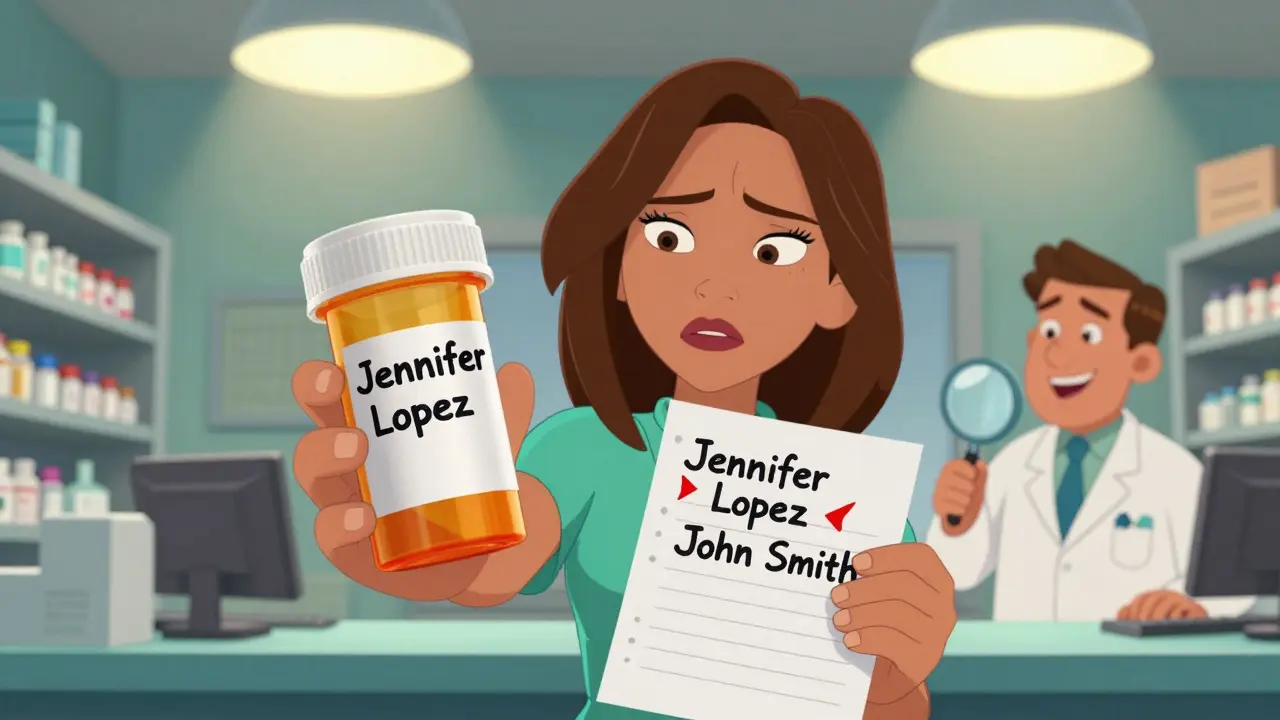
Getting your prescription filled seems simple: walk in, hand over the paper, pick up the bottle, and go. But what if the label says your name is John Smith when you're Jennifer Lopez? Or what if the pill inside is supposed to lower your blood pressure but the label says it's for diabetes? These aren’t rare mistakes-they happen more often than you think. In fact, nearly 1 in 4 preventable medication errors in the U.S. come from mislabeled prescriptions. The good news? You can stop most of them before they hurt you-just by checking five things on the label before you leave the pharmacy.
What’s on a Prescription Label?
Every legal prescription label in the U.S. must include six key pieces of information, as required by the FDA. If any of these are missing or wrong, the pharmacy is in violation. Here’s what you should see:- Your full legal name (first and last, sometimes middle initial)
- The medication name (both brand and generic, like "Lisinopril" and "Zestril")
- The strength (e.g., "5 mg", "10 mg"-not "50 mg")
- The dosage instructions (e.g., "Take one tablet by mouth twice daily")
- The prescriber’s name and pharmacy contact info
- The prescription number and date filled
Some labels also include warnings like "May cause drowsiness" or refill counts. The National Drug Code (NDC)-a long number on the bottle-is used by pharmacies and insurers to track the exact product, but you don’t need to memorize it. Focus on the five things above.
Step-by-Step: How to Verify Your Label
You don’t need to be a pharmacist to catch an error. Just take 30 seconds and follow this simple routine every time you pick up a new prescription:- Hold the bottle at eye level. Good lighting matters. If the label is hard to read, ask for a magnifying glass-most pharmacies keep them behind the counter.
- Check your name. Is it spelled exactly how you gave it to them? No nicknames, no typos. If your name is "Robert James," but the label says "Rob James," ask them to fix it. Names get mixed up when multiple patients have similar names.
- Match the medication name. Did your doctor say "metformin"? Does the label say "Glucophage"? That’s the same thing-metformin is the generic name, Glucophage is the brand. But if it says "insulin" when you were told it was "levothyroxine," that’s a red flag. Write down what your doctor told you before you go to the pharmacy.
- Confirm the strength. This is one of the most common errors. A 5 mg pill and a 50 mg pill look almost identical. If your doctor said "take 5 mg once a day," and the label says "50 mg," stop. Don’t take it. Call the pharmacy immediately.
- Read the directions. "Take one tablet daily" is very different from "take two tablets three times a day." If the instructions don’t match what your doctor told you, ask for clarification. Sometimes, the pharmacy uses abbreviations like "QD" or "BID"-ask them to explain it in plain English.
Do this every time-even if it’s the same medication you’ve taken before. Pharmacies refill prescriptions automatically, and mistakes happen during refills too.
Why This Matters: Real Stories
In 2023, a Reddit user named "NurseInTX" shared how she caught a deadly mistake: her mother’s blood thinner was labeled as 10 mg instead of 5 mg. A double dose could have caused internal bleeding. She called the pharmacy, and they confirmed it was a labeling error-someone had accidentally pulled the wrong bottle. Another case from Drugs.com involved a man who almost took his roommate’s blood pressure pill because the label had his name on it. The pills looked different, but he trusted the label. He noticed the color was off and called the pharmacy. It turned out the pharmacy had accidentally printed his name on the wrong bottle. According to a 2023 survey by the National Patient Safety Foundation, 18% of people who checked their labels found at least one error in the past year. The most common mistakes? Wrong strength (42%), wrong medication (28%), and wrong name (15%).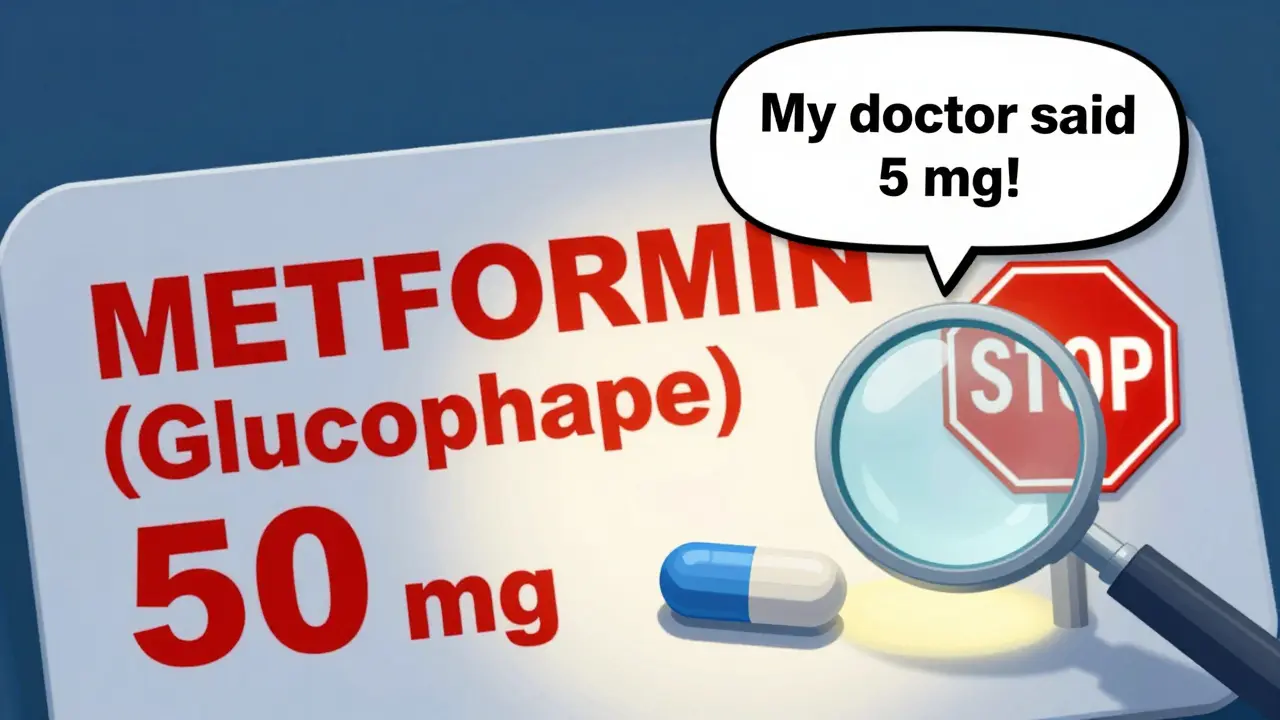
What to Do If Something’s Wrong
If you spot an error, don’t assume it’s just a typo. Don’t take the medication. Don’t leave without fixing it.- Ask to speak with the pharmacist directly. Tell them exactly what you noticed: "The strength says 50 mg, but my doctor prescribed 5 mg."
- Ask them to double-check the original prescription from your doctor. Pharmacies keep electronic copies.
- If they say it’s correct but you’re still unsure, call your doctor’s office. They can confirm what was prescribed.
- Take a photo of the label and the pill inside. This helps if you need to report it later.
Pharmacists are trained to catch errors-but they’re human too. You’re the final safety check. You have every right to ask questions. No pharmacist will mind. In fact, they’ll appreciate it.
Special Considerations: Aging, Vision, and Language
If you’re over 65, have trouble seeing, or aren’t fluent in English, verifying your label can be harder. But help is available.- Small print? Ask for a large-print label. Many pharmacies now offer this. CVS and Walgreens have in-store magnifiers at 78% and 65% of locations, respectively.
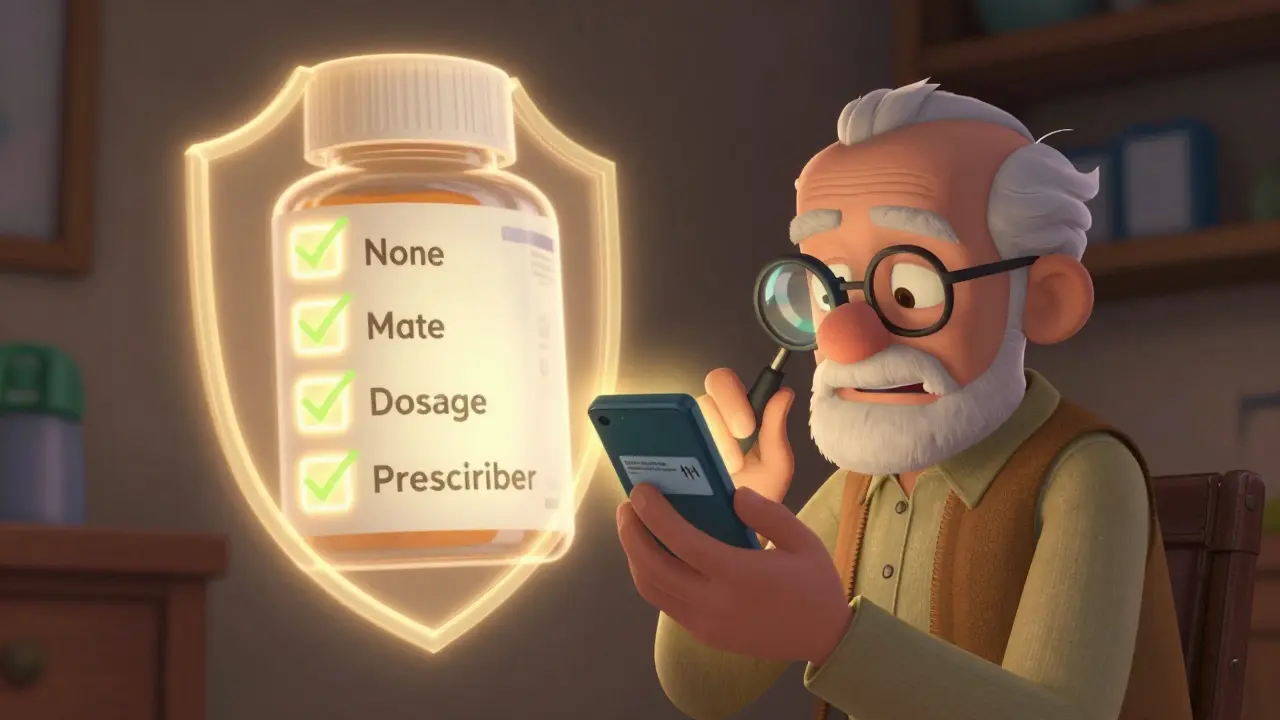
- Low vision? Use your phone’s magnifier app. Turn on the camera and zoom in on the label. It’s free and works on almost every smartphone made after 2018.
- Language barrier? California and New York now require bilingual labels for major languages. Ask for a translator. Most pharmacies have access to phone interpretation services.
- Multiple medications? If you take more than five prescriptions, use a pill organizer and label each compartment with the medication name and time of day. This helps you spot mismatches faster.
AARP found that 71% of adults over 50 feel more confident when pharmacies include large-print verification instructions on the prescription bag. Don’t hesitate to ask for it.
Technology Can Help-but It’s Not a Replacement
Apps like Medisafe and GoodRx let you scan your prescription label and store medication info. They’re great for reminders and refill alerts. But they can’t replace manual verification.Why? Because:
- You need to see the physical label before you take the pill.
- Scanning apps can misread blurry or faded labels.
- Many older adults don’t use smartphones for health tasks-only 28% do, according to Pew Research.
Think of apps as helpers, not substitutes. Always check the bottle first.
What’s Changing in 2025 and Beyond
The FDA is pushing for standardized prescription labels by the end of 2025. That means:- Your name will be printed in 24-point font at the top of every label.
- Medication names will be bolded and easier to read.
- Strength will be shown with larger numbers.
- QR codes may appear on labels, linking to video instructions in multiple languages.
By 2026, 60% of prescriptions for seniors will likely include these QR codes. But even with these upgrades, you still need to verify. Technology improves safety-but it doesn’t eliminate the need for you to double-check.
Final Reminder: Your Safety Is Your Responsibility
No system is perfect. Pharmacies make mistakes. Doctors write unclear notes. Pills look alike. But you are the last line of defense.Take a breath. Look at the label. Compare it to what your doctor told you. Ask questions. It takes less than a minute. And it could save your life.
According to Johns Hopkins Medicine, patient verification alone could prevent 150,000 adverse drug events every year. That’s not just a statistic-it’s people you know. Your mom. Your neighbor. Maybe even you.
What if my name is spelled wrong on the prescription label?
Never take medication with a wrong name. Even a small typo like "Jen" instead of "Jennifer" can lead to someone else getting your pills-or you getting someone else’s. Ask the pharmacist to correct it. If they refuse, call your doctor’s office. Pharmacies are legally required to have your correct name on file.
Can I trust the generic name on the label?
Yes, as long as you know what your doctor prescribed. Generic medications have the same active ingredients as brand names but cost less. For example, "ibuprofen" is the generic for "Advil." If your doctor said "Advil," and the label says "ibuprofen," that’s correct. But if it says "acetaminophen," that’s a different drug. Always check the generic name against what your doctor told you.
Why do some labels have two names for the same medicine?
Pharmacies are required to list both the brand name and generic name on the label. This helps avoid confusion. For example, "Lisinopril (Zestril)" tells you the generic is lisinopril and the brand is Zestril. If your doctor only mentioned one name, ask which one they meant. Both are correct, but you need to know which one you’re supposed to take.
What should I do if the pill looks different than last time?
Pill appearance changes often-different manufacturers use different colors, shapes, or markings. But if it looks completely unfamiliar, don’t take it. Check the label for the medication name and strength. If they match what you were prescribed, it’s likely a different batch. Still, call the pharmacy to confirm. It’s better to be safe than sorry.
Are pharmacies required to help me verify my label?
Yes. Since 2021, the Joint Commission requires all accredited pharmacies to offer counseling on medication safety. This includes helping patients understand their labels. If the pharmacist seems rushed, ask for a moment. You have the right to a clear explanation. If they refuse, report it to the state board of pharmacy.


One comment
Bro, I literally caught a pharmacy giving my grandma the wrong meds last year. She was on warfarin, label said 10mg instead of 5mg. I almost lost her. 🤬 Don’t just take it. STOP. Ask. Demand a pharmacist. This isn’t optional. You’re not paranoid-you’re alive. 🙌
so like... i read this whole thing and like... why are we even doing this? shouldn't the pharmacy just get it right? i mean, come on. i had a prescription once that said 'acetaminophen' but the bottle had 'ibuprofen' written on the cap. i just took it anyway. it was fine. 🤷♂️
Kinda wild how much we rely on people we don’t know to not kill us. Pharmacist’s gotta juggle 20 scripts, 3 angry customers, and a printer that jams every 3 minutes. But yeah, still-check the label. I’ve seen people walk out with someone else’s insulin like it’s a coffee order. Just... take a second. Seriously. 🤝
It is a profound ontological paradox that the very institutions designed to preserve life-pharmacies, medical systems, regulatory bodies-are simultaneously the conduits through which inadvertent death is most frequently facilitated. One must, therefore, exercise vigilant epistemic responsibility in the face of systemic fragility. The label is not merely paper-it is the last epistemological bulwark between the self and annihilation.
Let’s be real. The entire system is a house of cards built on underpaid workers, outdated technology, and corporate greed. The FDA mandates six things? Sure. But in practice? You’ve got a 22-year-old kid in a lab coat who’s never seen a patient before, trying to match a scribble from a doctor who typed it at 2 a.m. after three shifts. And you think the label is going to be perfect? No. It’s going to be wrong. And you? You’re the only one who cares enough to check. So yeah, check it. Every time. Even if you’ve taken the same pill for ten years. Because last year’s batch isn’t this year’s batch. And this year’s batch? Might be someone else’s. And that someone else? Might be you.
My mom’s 72 and has trouble reading small print. She started using her phone’s magnifier app after this post went viral in our family group. Now she takes a pic of every label and texts it to me. We’ve caught two errors already-wrong strength, wrong name. I’m so proud of her for speaking up. You don’t need to be a doctor. You just need to care enough to look.
So let me get this straight. You’re telling me I have to check my meds like I’m inspecting a used car? Cool. Cool cool cool. Next you’ll tell me to taste the milk before I drink it. I mean, I’m not dumb. But also... why does this feel like a productivity hack for anxiety?
My sister once got a script for Zoloft but the label said Zyrtec. She took it. Didn’t feel different. Thought it was just slow to kick in. Took it for three days. Then her eyes swelled shut. Called the pharmacy. They were like, 'Oh, we mixed up two patients.' She had to go to the ER. Now she takes a photo of every label before she leaves. Smart. I do too. Even if I’m just picking up aspirin. You never know. 😎
I used to think this was overkill. Then my dad had a stroke. He was on blood thinners. The label said 20mg. He was supposed to take 5. I didn’t catch it. He almost died. Now I check every label with him. Even if he’s confused. Even if he says, 'It’s fine.' I say, 'No. Let’s look.' We’ve caught three mistakes since. One was a refill with the wrong drug entirely. He’s alive because we didn’t trust the label. We trusted each other.
Just check your name and the pill. If it says 'metformin' and your doc said 'glucophage'-same thing. If it says 'insulin' and you’re diabetic but not on insulin? Stop. Call them. Done. No need to overthink it. Simple. Save your life.