Getting the all-clear to move again after a heart event is a huge milestone. But standing up from your hospital bed and stepping back into daily life are two very different things. You might feel eager to get back in shape, but you also likely carry a heavy dose of anxiety. Will this walk trigger another episode? Is that slight shortness of breath normal? These fears are completely valid, but they don’t have to stop you. In fact, staying sedentary is far more dangerous than moving carefully.
The good news is that cardiac rehabilitation is a medically supervised program designed to improve cardiovascular health following heart events such as myocardial infarction, coronary artery bypass surgery, or other cardiac procedures. It isn't just about walking on a treadmill; it’s a structured, evidence-based pathway that reduces mortality risk by 20-30% when done right. This guide breaks down exactly how to train safely, what to expect in each phase of recovery, and how to navigate the psychological hurdles that often keep people on the couch.
Why Supervised Training Beats Going It Alone
You might be tempted to skip formal programs and just start walking around the block. It feels simpler, doesn't it? But the data tells a starkly different story. Patients who participate in formal cardiac rehab programs show 25% faster functional recovery and 30% lower five-year mortality rates compared to those exercising independently. Why the gap?
The main issue with self-directed exercise is intensity control. Without supervision, 27% of patients exceed safe heart rate thresholds because they misjudge their limits. They either push too hard, risking strain, or stay too cautious, failing to build the strength needed for long-term health. A supervised environment provides real-time monitoring using ECG patches and heart rate monitors, ensuring you stay in the "safe zone" where your heart strengthens without being stressed. Plus, having medical staff nearby means immediate response if something goes wrong, which drastically lowers anxiety.
| Feature | Supervised Program | Self-Directed Approach |
|---|---|---|
| Mortality Risk Reduction | 30% lower (5-year) | Baseline |
| Functional Recovery Speed | 25% faster | Slower |
| Safety Monitoring | Real-time ECG & HR tracking | None or wearable-only |
| Anxiety Management | 82% report reduced fear | High initial anxiety |
| Long-term Adherence | 92% at 12 months | 45% at 12 months |
The Three Phases of Cardiac Rehabilitation
Recovery isn't a switch you flip; it's a ramp you climb. Modern protocols divide this journey into three distinct phases, each with specific goals and safety parameters. Understanding these stages helps you set realistic expectations and avoid the temptation to rush.
Phase 1: The Acute Phase (In-Hospital)
This happens while you're still in the hospital or immediately after discharge. The goal here isn't fitness; it's mobility. You’re working to prevent blood clots and stiffness without stressing the heart. Activities are limited to 1-2 metabolic equivalents (METs), which is roughly the energy cost of sitting quietly.
- Seated Marching: Lift one knee at a time while sitting. Aim for 10-15 repetitions per leg.
- Ankle Pumps: Flex and point your feet while lying down or sitting to boost circulation.
- Gentle Breathing Exercises: Prevent lung complications like pneumonia.
Recent guidelines from the American Heart Association now recommend starting these gentle movements within 24 hours for low-risk patients, rather than waiting 48 hours. This early mobilization has been shown to speed up functional recovery by 19%.
Phase 2: Early Outpatient Phase (Weeks 1-6)
Once you’re home, the focus shifts to building foundational strength and endurance. This is usually where you join a formal outpatient program. You’ll start small-perhaps 5-10 minutes of walking daily-and gradually increase to 30 minutes over four to six weeks.
Intensity is key here. You should aim for a Rating of Perceived Exertion (RPE) of 11-14 on the 6-20 Borg Scale. In plain English, this means you should feel "somewhat hard" effort but still be able to hold a conversation. If you can’t speak in full sentences, you’re pushing too hard. Your target heart rate is generally your resting heart rate plus 20-30 beats per minute. However, if you’re on beta-blockers, this number will be lower, so rely more on how you feel than just the watch on your wrist.
Phase 3: Maintenance Phase (Long-Term)
This is life after rehab. The goal is to make movement a permanent habit. The standard recommendation is at least 150 minutes of moderate-intensity aerobic activity per week, or 75 minutes of vigorous activity. Add muscle-strengthening exercises on two or more days a week. At this stage, many patients find they can safely incorporate High-Intensity Interval Training (HIIT). Recent studies show that HIIT at 85-95% of heart rate reserve is safe for stable post-heart attack patients and yields 37% greater functional improvements than steady-state cardio. But only attempt this after clearing it with your cardiologist.
Listening to Your Body: Warning Signs and Safety
No amount of technology can replace your own awareness. While wearing a heart rate monitor is helpful, you must know the seven warning signs that demand an immediate stop to any activity. If you experience any of these, pause, rest, and seek medical advice if they persist.
- Chest pain, pressure, or tightness
- Pain radiating to your arm, jaw, neck, or back
- Dizziness or lightheadedness
- Palpitations (feeling like your heart is skipping or racing uncontrollably)
- Unusual shortness of breath
- Slurred speech
- Sudden weakness in limbs
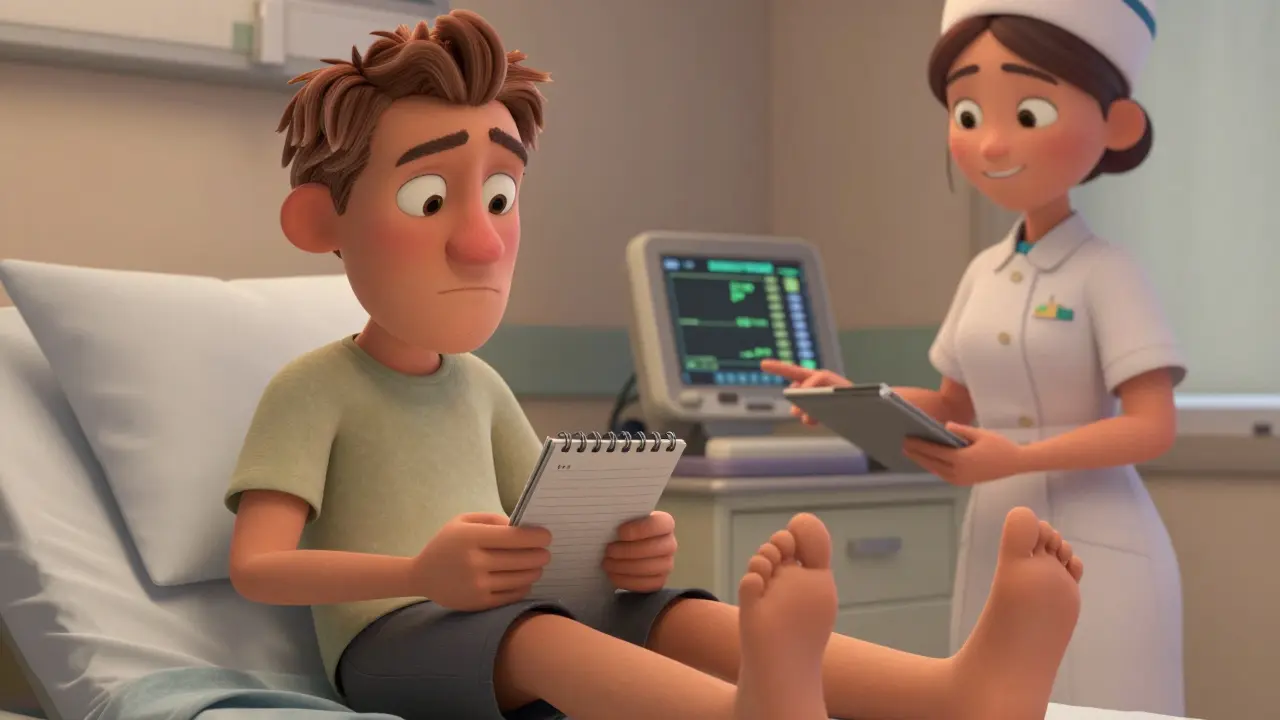
A useful trick is the "talk test." During moderate exercise, you should be able to speak comfortably. If you’re gasping for air between words, dial it back. Also, keep a symptom journal. Note what you did, how you felt, and any minor symptoms. Over time, you’ll learn your personal baseline and spot deviations before they become emergencies.
Overcoming the Fear Factor
Let’s address the elephant in the room: fear. About 68% of cardiac patients report significant anxiety about exercising. You’re worried that every thump in your chest is a precursor to disaster. This is normal, but it’s also counterproductive. Stress hormones raise your heart rate and blood pressure, making exercise harder and less effective.
One of the biggest benefits of group cardiac rehab is the psychological support. Seeing others recover gives you proof that movement is safe. Within four weeks of joining a supervised program, 82% of participants report a significant drop in activity-related anxiety. Try these tips to manage your own nerves:
- Start Small: Don’t aim for a mile on day one. Aim for five minutes. Success builds confidence.
- Use Distraction: Listen to music or a podcast. It takes your mind off the physical sensations.
- Track Progress: Seeing your walking time increase or your resting heart rate drop provides tangible proof of healing.
- Accept Variability: Some days you’ll feel great; others, you’ll feel tired. That’s okay. Adjust duration, not intensity, on bad days.

Navigating Barriers and Accessing Care
Despite its proven benefits, only 20-30% of eligible patients actually enroll in cardiac rehab. Why? Transportation issues, work conflicts, and insurance limitations are common hurdles. If you live in a rural area, you might be even further from care. But options are expanding.
Telehealth has changed the game. Hybrid models, combining a few in-person sessions with remote monitoring via Bluetooth heart rate monitors and ECG patches, are showing 89% adherence rates. Medicare Part B covers up to 36 sessions of cardiac rehab after a qualifying event, so check with your provider about coverage. If traditional centers aren’t accessible, ask your doctor about virtual cardiac rehab programs. Many hospitals now offer FDA-cleared wearable sensors that allow you to train at home under remote supervision.
Practical Tips for Daily Life
Integrating exercise into your routine requires some strategy, especially when dealing with medications and weather. Beta-blockers, commonly prescribed after heart events, can blunt your heart rate response, making it harder to gauge intensity. In this case, focus on perceived exertion (how hard it feels) rather than numbers on a screen. If it’s freezing outside, don’t force a walk. Cold constricts blood vessels and strains the heart. Instead, try mall walking or indoor stationary cycling. Consistency matters more than perfection.
How soon can I start exercising after a heart attack?
For low-risk patients, gentle mobility exercises can begin within 24 hours of the event, often while still in the hospital. More structured outpatient exercise typically starts 1-2 weeks after discharge, depending on your doctor’s clearance and the severity of the event. Always follow your specific physician's timeline.
Is high-intensity interval training (HIIT) safe after a heart event?
Recent research suggests HIIT can be safe and highly effective for stable post-heart attack patients, offering greater functional improvements than moderate cardio. However, this should only be attempted after completing initial cardiac rehabilitation phases and with explicit approval from your cardiologist. Never start HIIT without professional guidance.
What if I take beta-blockers? How do I monitor my heart rate?
Beta-blockers lower your maximum heart rate, making traditional heart rate zones inaccurate. Instead, rely on the Rating of Perceived Exertion (RPE) scale and the "talk test." Aim for an RPE of 11-14 (somewhat hard) where you can still speak in full sentences. Consult your rehab team to establish a personalized target range.
Does insurance cover cardiac rehabilitation?
In the US, Medicare Part B covers up to 36 sessions of cardiac rehab after a qualifying event like a heart attack or bypass surgery. Many private insurers also provide coverage. Check with your provider and the rehab center to understand copays and authorization requirements. Telehealth options may also be covered under recent policy updates.
What are the signs that I am exercising too hard?
Stop immediately if you experience chest pain, pressure, dizziness, palpitations, unusual shortness of breath, slurred speech, or sudden weakness. Other subtle signs include extreme fatigue lasting more than an hour after exercise or sleep disturbances. If these occur, rest and consult your healthcare provider before resuming activity.