
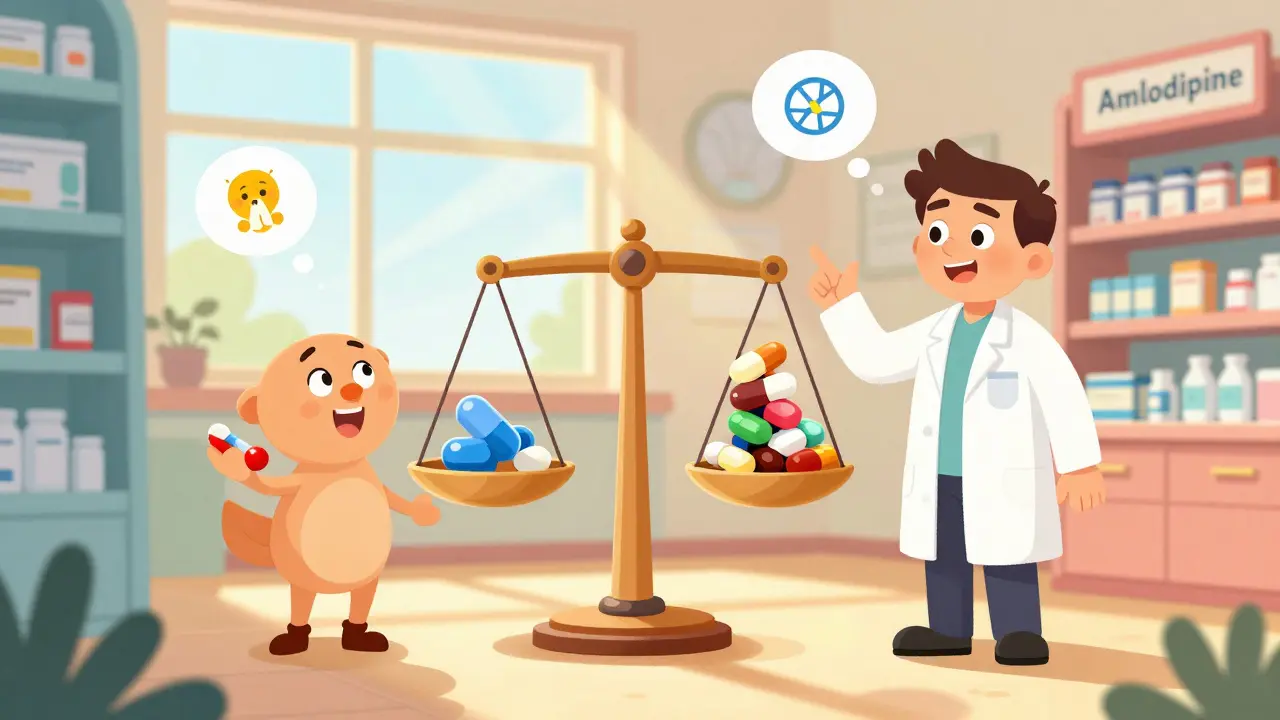
What Are De Facto Combinations?
De facto combinations happen when a patient takes two or more separate generic pills instead of one fixed-dose combination (FDC) tablet that contains the same drugs. For example, instead of swallowing a single pill with amlodipine and valsartan for high blood pressure, the patient takes two pills: one with just amlodipine and another with just valsartan. This isn’t a mistake-it’s a deliberate choice made by doctors, often because the FDC doesn’t match the patient’s exact needs.
The term “de facto” means “in practice,” not officially approved. These combinations aren’t tested together like FDCs are. The FDA and EMA require FDCs to prove that the combination is safe, effective, and stable. But when you mix generics yourself, none of that testing applies. You’re relying on each drug working fine on its own, not as a team.
Why Do Doctors Choose Separate Generics?
It’s not about cutting corners-it’s about precision. Many patients need exact doses that FDCs can’t offer. Take hypertension: a common FDC might contain 10 mg of amlodipine and 160 mg of valsartan. But what if your body needs 5 mg of amlodipine and 120 mg of valsartan? There’s no FDC for that. So your doctor prescribes two separate generics to hit the right numbers.
Diabetes is another big one. Metformin and sitagliptin are often combined in FDCs, but if you have kidney problems, your doctor might lower the metformin dose without touching the sitagliptin. FDCs lock you into fixed ratios. Separate generics give you room to adjust.
Cost also plays a role. In some places, buying two generic pills separately can be cheaper than the branded FDC. In India, a 2012 parliamentary report found that many FDCs offered no real benefit over individual drugs-and sometimes the generics cost less. Even in the U.S., where FDCs are often priced higher, some patients save money by sticking to generics.
The Hidden Risks of Mixing Pills
Here’s the catch: taking separate generics isn’t risk-free. FDCs go through rigorous testing to make sure the drugs don’t interfere with each other’s absorption, stability, or effectiveness. When you mix your own combo, you’re flying blind.
For example, one generic metformin might release slowly, while another releases fast. If you take them at the same time, you could get uneven blood sugar control. A 2020 FDA analysis found that 12.7% of generic drugs showed clinically meaningful differences in how they were absorbed compared to the brand. That’s not a small number-it’s enough to affect outcomes.
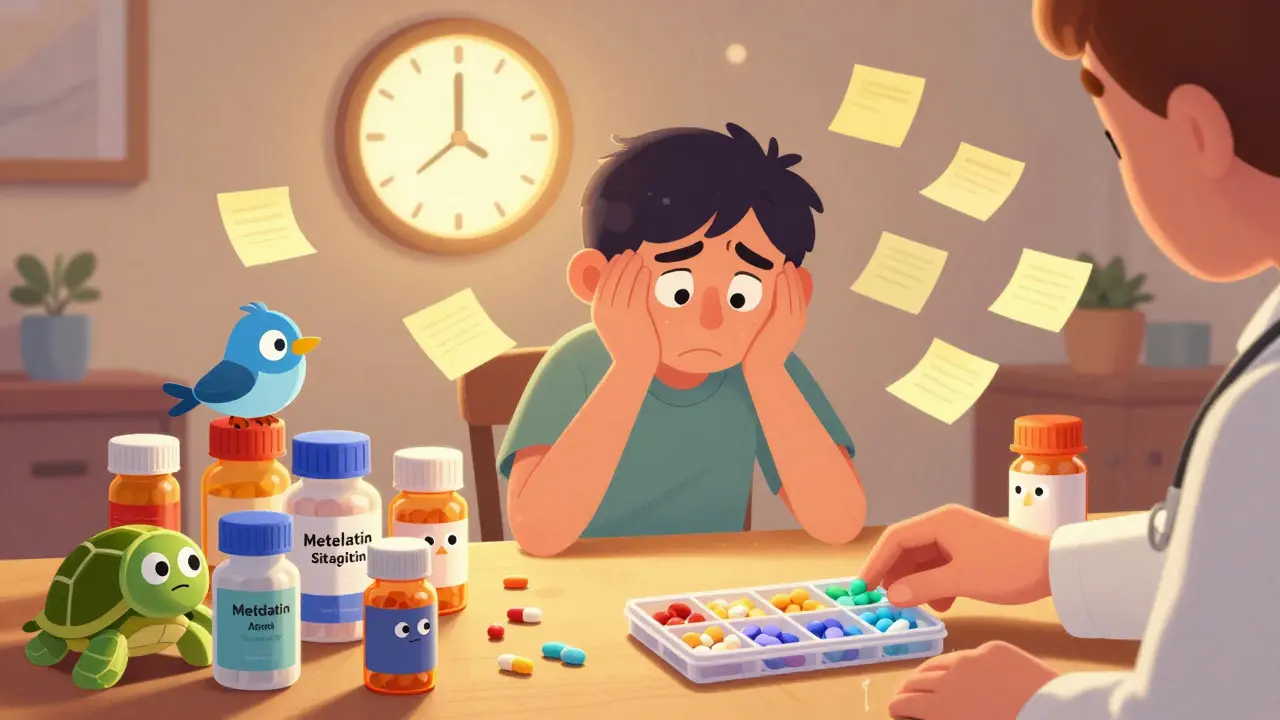
Then there’s adherence. Every extra pill you have to take lowers your chance of sticking to the regimen. A study in PubMed found that each additional pill reduces adherence by about 16%. FDCs improve adherence by 22% compared to separate pills. On PatientsLikeMe, 63% of people on separate generics said they struggled to remember which pill was which. One Reddit user wrote: “I switched from a single FDC to separate pills to save $15 a month. I missed doses twice because I forgot which blue pill was which.”
When De Facto Combinations Work
They’re not always a bad idea. For some patients, they’re the only way to get the right treatment. A 5-star Drugs.com review from a diabetic with kidney disease said: “I’m on separate Metformin and Sitagliptin because the FDC dose was too high for my kidneys. My A1c has been 6.2% for 18 months.” That’s a success story.
Doctors who use de facto combinations wisely know their patients’ needs. In HIV care, where adherence is life-or-death, 89% of patients use FDCs. But in oncology or complex chronic conditions, where dosing changes often, separate generics are essential. A physician on Student Doctor Network said: “I prescribe separate generics for HIV patients who need dose tweaks-but I give them a color-coded schedule. It adds work, but it prevents errors.”
What Healthcare Systems Are Doing About It
Pharmacists and clinics are stepping in to fill the gaps. The Institute for Safe Medication Practices recommends color-coding pills, syncing refill dates, and giving patients clear written instructions. PillPack by Amazon launched a Combination Therapy Support Program in 2021 that pre-sorts pills by time of day and includes counseling. They reported a 41% drop in adherence errors among users.
Electronic health records are also catching up. A 2022 CMS report found that regimens using separate generics generated 28% more documentation errors than FDCs. Now, some EHR systems flag when a patient is on an unapproved combination and prompt the doctor to justify it.
Training matters too. A 2021 study showed that doctors who got special training on combination therapy were 37% less likely to prescribe inappropriate de facto combinations.

The Bigger Picture: Regulation and the Future
The FDA and EMA are watching closely. In January 2023, the FDA issued a safety alert after 147 adverse events were linked to untested drug combinations. The EMA has launched a 2023-2025 project to study off-label combinations and will release findings by late 2024.
Meanwhile, drugmakers are innovating. AstraZeneca patented a modular FDC system in 2022 that lets you swap doses without changing the pill format. Think of it like LEGO-same base, different inserts. This could make FDCs more flexible without losing the adherence benefits.
Industry analysts predict a split: FDCs will dominate in areas like HIV and hypertension where consistency matters most. De facto combinations will stick around in oncology, geriatrics, and renal care-where customization is non-negotiable. But they’ll come with more oversight. A 2022 Health Affairs analysis predicted that within 10 years, unmonitored de facto combinations will drop by 60% as prescribing systems automatically flag risky combos.
What Patients Should Know
If you’re on separate generics instead of an FDC, ask your doctor:
- Why was this choice made for me?
- Is there an FDC that could work with my current doses?
- How do I make sure I don’t mix up my pills?
- Are my generics from the same manufacturer? (Different brands can behave differently.)
Don’t assume separate pills are safer or cheaper without checking. Use pill organizers. Set phone reminders. Talk to your pharmacist about color-coding. Your adherence is the biggest factor in whether this approach works.
Final Thoughts
De facto combinations aren’t inherently good or bad. They’re a tool. Used right, they give patients the precision they need. Used carelessly, they increase risk, confusion, and cost. The goal isn’t to ban them-it’s to make sure they’re intentional, documented, and supported. As FDC technology improves and electronic systems get smarter, the line between “off-label” and “optimized” will blur. For now, the best approach is simple: if you’re taking multiple pills, make sure you know why-and how to take them right.


One comment
I swear, if I have to take one more pill, I’m just gonna start swallowing my vitamins like candy. I’m on three separate generics for blood pressure and diabetes, and I forget which one is which half the time. My pharmacist gave me a color-coded pill organizer, but I still accidentally took two blue pills yesterday. I didn’t even feel anything. Maybe that’s the point? Maybe my body’s just done with this nonsense.
And don’t get me started on the cost. I saved $12 a month by splitting the combo, but now I’m spending $40 a year on extra pill organizers, phone alarms, and stupid sticky notes on my fridge. It’s like I’m running a pharmaceutical circus and I’m the only clown.
My doctor says it’s ‘personalized medicine.’ I call it ‘personalized chaos.’
Let’s be brutally honest: de facto combinations are the medical equivalent of duct-taping your engine together because you can’t afford the replacement part. The FDA doesn’t approve them because they’re not *science*-they’re *convenience*. And convenience is the opiate of the modern healthcare system.
When you mix generics from three different manufacturers, you’re not ‘customizing’ your treatment-you’re playing Russian roulette with pharmacokinetics. That 12.7% absorption variance? That’s not a footnote-it’s a death sentence waiting to happen.
And let’s not pretend this is about patient autonomy. It’s about insurance companies refusing to cover FDCs and doctors too lazy to push back. We’ve turned medicine into a budget spreadsheet, and patients are the line items we’re cutting.
Back home in Indonesia, we do this ALL THE TIME. My uncle takes three separate pills for his BP-each from a different pharmacy because the prices change weekly. He doesn’t even have a pill organizer. He just remembers by the shape: round for one, oval for another, capsule for the last.
He’s 72 and still rides his motorbike to the market every morning. No fancy apps, no color-coding. Just memory, routine, and a little bit of luck.
Maybe the real problem isn’t the pills-it’s that we’ve forgotten how to trust the human body to adapt. We over-engineer everything. Sometimes, the simplest system works best.
Hey, if you’re taking separate generics, you’re not broken-you’re resourceful. You’re adapting. You’re making it work with what you’ve got. That’s strength.
Yes, adherence is harder. Yes, there’s risk. But guess what? So is climbing a mountain. So is learning a new language. So is parenting. Nothing worth doing is easy.
Here’s your game plan: get a pillbox with AM/PM labels. Set three alarms on your phone. Talk to your pharmacist. Use the color-coding trick. You got this. One pill at a time. You’re not just managing meds-you’re mastering your health. And that’s badass.
So we’ve turned medicine into a choose-your-own-adventure book where the plot twist is ‘you might die if you pick the wrong blue pill.’ Brilliant.
Meanwhile, the pharmaceutical industry is patenting LEGO-style FDCs while the rest of us are still trying to remember if we took our metformin before or after the coffee. It’s like we’re in a dystopian sitcom written by a bureaucrat with a thesaurus and a grudge.
At what point do we stop pretending this is ‘personalized care’ and admit it’s just ‘cost-shifting with extra steps’?
I used to take separate generics for my BP. Then I had a panic attack because I thought I missed a pill. Turns out I took the wrong one. My heart was racing, my hands were shaking-I thought I was dying.
Turns out I just took a 10mg instead of a 5mg. I was fine. But the fear? That stuck with me.
Now I’m on the FDC. Cost went up. Adherence went up. My anxiety went down. Sometimes the ‘right’ choice isn’t the cheapest. It’s the one that lets you sleep at night.
Just wanted to say I’ve been on separate generics for 4 years. I use a simple pillbox and set reminders. No big deal. My numbers are great. I think it’s more about how you manage it than the pills themselves.
Also, my pharmacist switched me to generics from the same batch last year. No issues. Maybe it’s not as risky as people think?
ALERT 🚨 THE PHARMA COMPANIES ARE LYING 🚨
They don’t want you on FDCs because they can’t charge $200 a month for it 😈
They’re pushing separate generics so you’ll keep buying them FOREVER 💸
Also, your EHR is spying on you. They know you take pills at 3am. They’re selling your data. I’m not paranoid. I’ve seen the documents. 🤫
Let’s deconstruct this ‘de facto’ nonsense with a quick dose of healthcare economics 101. FDCs are bundled products with regulatory moats-patent extensions disguised as clinical innovation. Separate generics? That’s the free market screaming through the cracks.
But here’s the kicker: the ‘adherence benefit’ of FDCs is statistically significant but clinically marginal. 22%? That’s a lab number. Real people? They forget pills because they’re tired, overwhelmed, or don’t trust the system. Not because of pill count.
So we’re optimizing for a metric that doesn’t reflect human behavior. That’s not medicine. That’s spreadsheet therapy.
I’ve been on separate generics for my thyroid and BP. I never thought about the absorption differences until now. I guess I just assumed all generics are the same.
Is there a way to check if mine are from the same manufacturer? Should I ask my doctor or just call the pharmacy?
YOU ARE NOT ALONE 💪
I was taking 5 pills a day. Now I’m down to 2 FDCs. Life changed. I sleep better. I laugh more. I don’t cry in the bathroom anymore.
Don’t let anyone tell you it’s ‘not personalized.’ Personalized is what WORKS for YOU. And if FDCs help you feel human again? That’s the real win. 🙌❤️
In India we have 1000 types of generics and no one cares about FDCs because doctors dont even know what is in the pill they prescribe. I take 3 pills and it works. End of story.
Why are Americans so obsessed with single pills? In Nigeria we take what we can get. If the medicine works then why complicate it with fancy FDA rules? Your system is broken not our pills
Wait, I just read what @6471 said about same manufacturer generics. That’s actually a good point. I never thought to check that. I just assumed the pharmacy picked the cheapest.
Maybe I should ask if they can source all my generics from the same batch. Would that help with consistency?