
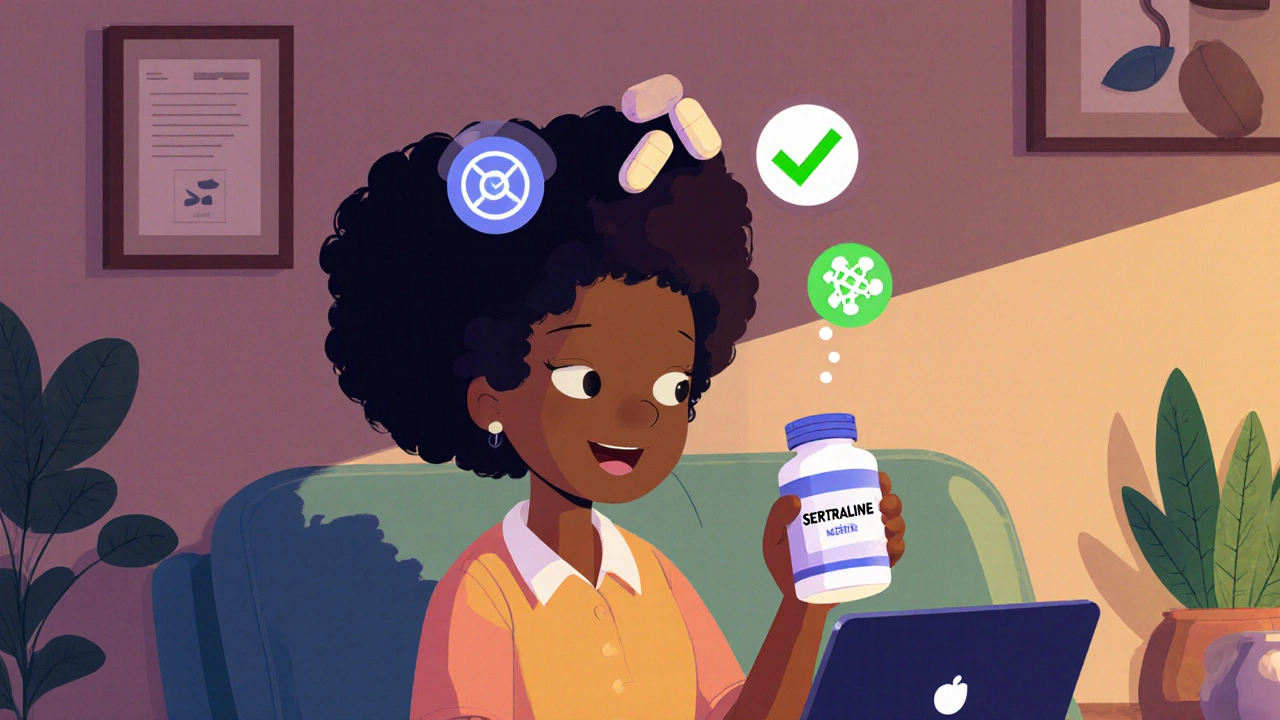
When you need a refill for your generic sertraline or buprenorphine, you might not think twice about ordering it online after a video visit. But behind that simple click is a complex web of rules, tech requirements, and legal traps that could block your prescription-or even get your doctor in trouble. In 2025, telemedicine prescriptions aren’t just convenient. They’re regulated, tracked, and tightly controlled. And if you don’t understand the difference between a non-controlled generic and a Schedule III drug, you could be caught off guard.
Not All Generics Are Treated the Same
Let’s clear this up right away: not every generic medication has the same rules when prescribed online. A generic version of Zoloft (sertraline) is a non-controlled substance. That means your doctor can prescribe it via telemedicine, send it to any pharmacy that accepts e-scripts, and you can refill it monthly without restrictions. No in-person visit needed. No state database checks. No special registration.
But generic buprenorphine? That’s a different story. Even though it’s a low-cost, FDA-approved medication used to treat opioid use disorder, it’s classified as a Schedule III controlled substance. That triggers a whole other layer of federal rules under the DEA’s 2025 telemedicine framework. You can get it prescribed online-but only under strict conditions. Your provider must have a special DEA registration, check your state’s prescription monitoring program (PDMP), verify your ID with a government photo ID, and use electronic prescribing for controlled substances (EPCS). And here’s the kicker: they can only give you a six-month supply in total via telemedicine. After that? You need an in-person visit.
This creates a real gap in care. Many patients with opioid use disorder live in rural areas where driving to a clinic is a three-hour round trip. But under current rules, that trip becomes mandatory after six months-even if they’ve been stable on treatment for years. Clinical evidence shows 12 months of consistent medication-assisted treatment leads to better outcomes. Yet the system forces a disruption.
The DEA’s Three Registration Types (And Who Gets Left Out)
The DEA introduced three new registration categories in early 2025 to replace the emergency pandemic rules. Each one has a narrow scope:
- Telemedicine Prescribing Registration: Only for treating opioid use disorder with Schedule III-V drugs (like buprenorphine). Requires PDMP checks, EPCS, ID verification. Six-month limit on initial prescriptions.
- Advanced Telemedicine Prescribing Registration: Only for specific specialists-psychiatrists, neurologists, hospice doctors, pediatricians, and long-term care physicians. Allows Schedule II-V prescriptions (like Adderall or oxycodone). Primary care doctors are explicitly excluded unless they can prove a "compelling use case."
- Telemedicine Platform Registration: Required for companies like Teladoc or Amwell if they’re offering controlled substance prescriptions. Must build identity verification and audit trails.
What does this mean for you? If you’re a patient with ADHD and need a refill on generic methylphenidate, you’re stuck unless your doctor is a psychiatrist. If you’re a family physician treating 20 patients a day with chronic pain or addiction, you’re locked out unless you reapply under a different category. And if you’re a patient in Arkansas? You can’t get any controlled substance prescribed via telemedicine at all-state law overrides federal rules.
Why Your Prescription Keeps Getting Rejected
Many patients report their telemedicine prescriptions being denied at the pharmacy. Why? It’s rarely about the doctor. More often, it’s about mismatched systems.
Pharmacists aren’t trained on the new DEA rules. If you’re in California and your doctor is in Texas prescribing a Schedule III drug, the pharmacy’s system might flag it as "out-of-state" and refuse to fill it-even though the DEA allows it. Or the PDMP integration failed. The DEA says providers must log the exact date and time of their PDMP check. If that timestamp is missing from the e-script, the pharmacy’s system auto-rejects it.
Dr. Michael Reynolds, a rural family doctor in Montana, told the American Telemedicine Association: "I serve 12 counties across three states. For every patient, I have to check three different PDMPs. That’s 15 to 20 extra minutes per visit. I can’t see that many people and stay sane."
And here’s the worst part: 37% of telehealth platforms still haven’t integrated PDMP systems at all, according to the DEA’s March 2025 report. If your provider is using an old platform, your script might just disappear into a black hole.
What’s Required to Prescribe Legally
If you’re a provider thinking about offering telemedicine prescriptions, here’s what you need to do right now:
- Get DEA registration: Apply for the correct category (Telemedicine Prescribing or Advanced). Applications were rejected 42% of the time in Q1 2025 due to missing PDMP documentation.
- Enable EPCS: You can’t fax or email prescriptions for controlled substances. You need certified electronic prescribing software. Surescripts says it takes 8-12 weeks to implement properly.
- Integrate PDMP: Your EHR or prescribing platform must connect to state PDMP databases using HL7 FHIR APIs. Only 17 states have fully functional systems with API access.
- Verify identity: Use a government-issued photo ID scan. No selfies. No screenshots. The DEA requires verification against official databases.
- Document everything: Timestamp every PDMP check. Note the patient’s ID verification method. Keep digital records for seven years.
And don’t forget state licensing. If you’re prescribing to someone in a different state, you might need a medical license there too. It costs $500-$1,200 per state. Most small practices can’t afford it.
Why Non-Controlled Generics Are the Real Winner
Here’s the silver lining: non-controlled generics are thriving. Medications like generic lisinopril, metformin, levothyroxine, and sertraline face zero federal restrictions for telemedicine. No PDMP checks. No ID scans. No time limits. No special registrations. Just a video visit, a digital prescription, and a delivery to your door.
That’s why 89% of addiction treatment providers use telemedicine for buprenorphine (a controlled substance), but 95% of primary care providers use it for high blood pressure or diabetes meds (non-controlled). The difference isn’t clinical-it’s regulatory.
And the market is responding. In 2025, the telemedicine prescribing market hit $14.3 billion. But 70% of that growth comes from non-controlled generics. Platforms like GoodRx, CVS MinuteClinic, and K Health are investing heavily in chronic disease management because it’s simple, scalable, and legal.
The Big Deadline: December 31, 2025
The current emergency rules allowing telemedicine prescribing without an in-person visit are set to expire on December 31, 2025. After that, the new DEA rules become mandatory. There’s a 30% chance the DEA will extend them again-but most analysts think they won’t. The rulemaking process is done. The system is built. The clock is ticking.
Patients who rely on telemedicine for controlled substances need to prepare. If you’re on buprenorphine and your provider doesn’t have the new registration, you’ll need to schedule an in-person visit before January 1, 2026. If you’re on generic Adderall and your psychiatrist doesn’t have Advanced Registration, your script might stop working.
For non-controlled generics? Nothing changes. You’ll still get your meds fast, cheap, and without a trip to the clinic.
What’s Next for Digital Health?
The DEA is spending $127 million to build a national PDMP system-but experts say it won’t be fully functional until late 2027. Until then, patients and providers will keep dealing with patchy systems, rejections, and confusion.
Meanwhile, Medicare is making things harder. Starting October 1, 2025, Medicare will require patients to have had an in-person mental health visit before they can get reimbursed for telehealth services. That could cut reimbursement for telemedicine prescriptions by nearly half.
But the trend is clear: digital health isn’t going away. It’s just getting more regulated. The future belongs to providers who can navigate the paperwork, use compliant tech, and focus on non-controlled generics where the system actually works. For patients, the lesson is simple: know what kind of medication you’re getting. If it’s a controlled substance, ask your provider: "Do you have the DEA registration for telemedicine prescribing?" If they don’t know what you’re talking about, it’s time to find someone who does.


One comment
Okay but like… why are we still pretending telemedicine is ‘convenient’ when it’s just a bureaucratic obstacle course designed to make poor people suffer? I got my sertraline refill last week and my script got rejected because the pharmacy’s system didn’t like that my doctor’s EHR used ‘HTTP’ instead of ‘HTTPS’ in the audit log. No joke. I’m not even kidding. This isn’t healthcare-it’s tech theater with a side of soul-crushing red tape.
Really appreciate this breakdown. A lot of folks don’t realize how wildly different the rules are between non-controlled and controlled substances. I’m a pharmacist in Ohio and I see rejections daily-not because patients are lying, but because the systems just don’t talk to each other. PDMP timestamps missing? EPCS not configured? It’s not the provider’s fault-it’s the infrastructure failing. We need federal standardization, not more paperwork.
Wait… so you’re telling me the DEA is tracking your buprenorphine script but not your Adderall? And Medicare’s gonna cut reimbursement if you haven’t been to a clinic since 2020? This isn’t regulation-it’s a psyop. The government doesn’t care if you live or die. They just want you to prove you’re ‘worthy’ of medicine. I’ve seen people die waiting for a 3-hour drive to a clinic. This is eugenics with a white coat.
I’ve been on generic metformin via telehealth for 3 years… no issues. Zero. But when I tried to get buprenorphine for my cousin? 4 rejections, 3 calls to the pharmacy, 2 calls to the doctor, and a 45-minute video call where they made me hold up my driver’s license to the camera while reading the serial number out loud. It’s absurd. Why is one pill easy and another a nightmare? It’s not medical-it’s politics. 😔
One must question the epistemological foundations of this regulatory architecture. The bifurcation between controlled and non-controlled substances in telemedicine is not merely administrative-it is ontological. It presupposes a hierarchy of human suffering wherein diabetes and hypertension are deemed worthy of digital access, while opioid use disorder is treated as a moral failing requiring physical presence. This is not policy. It is sacramental exclusion.
It is utterly unacceptable that patients in rural areas are being denied life-saving treatment because of outdated state laws and underfunded systems. This is not a technical issue-it is a human rights violation. The DEA’s timeline is cruel. The 30% chance of an extension is a joke. People are suffering now. If you are a provider reading this: get registered. If you are a patient: demand better. No more delays. No more excuses.
Let’s analyze the data: 37% of platforms lack PDMP integration. 42% of DEA applications rejected due to documentation errors. 17 states have functional FHIR APIs. The probability of a patient receiving a compliant script on the first attempt is 0.21. The system is not broken-it is functioning exactly as designed: to exclude, delay, and frustrate. This is a feature, not a bug.
Y’all are right to be frustrated but don’t give up! 💪 I’m a nurse in rural Maine and we just got our EPCS set up last month after 6 months of headaches. Took a ton of calls, but now we’re approved for buprenorphine. It’s a pain, but it’s possible. If your doc doesn’t know how to do it, help them. Print this post. Bring it to your next visit. We can fix this one script at a time. 🤝❤️
For patients in India, this is a foreign concept. Here, telemedicine for generics is seamless. No ID scans. No PDMP. No DEA. We use WhatsApp for prescriptions. The system works because it’s simple. Perhaps the U.S. needs less regulation and more trust.
LMAO so now the government wants you to drive 3 hours to get your meds but it’s cool to order fentanyl off the dark web? This is why America’s f*cked. You wanna fix telemedicine? Legalize everything. Let people get whatever they need online. No more paperwork. No more state lines. Just let folks live. The DEA is just scared of tech. They’re dinosaurs with clipboards.