
Why Kids Need to Understand Generic Drugs
Every week, millions of children in the U.S. and U.K. take medicine - from cough syrup to antibiotics to asthma inhalers. Many of these medicines are generic drugs, but most kids don’t know what that means. They see a different color, shape, or name on the bottle and think it’s not the same medicine. That confusion can lead to fear, refusal to take medicine, or even dangerous mistakes. Teaching children about generic drugs isn’t about pharmacy jargon. It’s about helping them feel safe, understand their own bodies, and trust the treatment they need.
What Are Generic Drugs? (Explained Simply)
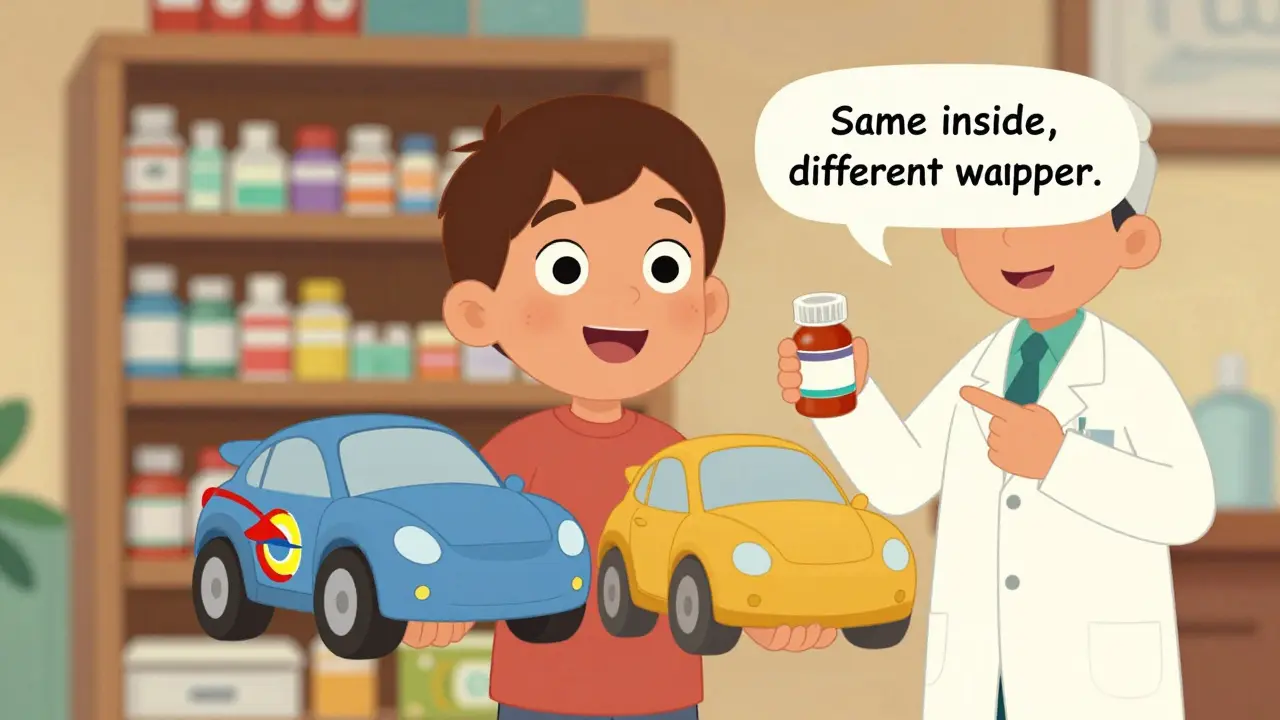
Imagine two identical toy cars. One is branded with a flashy logo and costs £10. The other has no logo and costs £3. They look different, but they both work the same way - same wheels, same engine, same speed. That’s what generic drugs are.
A generic drug has the same active ingredient, strength, and effect as the brand-name version. It just costs less because the company didn’t spend money on ads or fancy packaging. The U.S. Food and Drug Administration (FDA) and the U.K.’s Medicines and Healthcare products Regulatory Agency (MHRA) require generics to meet the same strict safety and quality standards. In fact, 9 out of 10 prescriptions filled in the U.S. are for generics. The same is true in the U.K.
How to Talk to Kids About Generic Drugs
Age matters. A 5-year-old doesn’t need to know about bioequivalence studies. But they do need to know that medicine isn’t broken if it looks different.
- For ages 3-6: Use play. Say, "This is your medicine. It’s like your favorite toy - same power, different color." Show them the medicine bottle and say, "This one has the same stuff inside as last time. It just looks different."
- For ages 7-10: Use simple comparisons. "Your heart medicine is made by two different companies. One is called "Lipitor," the other is called "Atorvastatin." They both fix the same thing. The second one costs less so your family saves money."
- For ages 11-14: Add a bit of science. "Generic drugs have to pass the same tests as brand-name ones. The government checks them. They work just as well. The only difference is the name and price."
Always avoid phrases like "It’s cheaper so it’s not as good." That plants doubt. Instead, say: "It’s the same medicine, just a different wrapper."
Common Myths Kids (and Parents) Believe
- Myth: "Generic drugs are weaker." Truth: They contain the exact same amount of active ingredient. A study from the FDA found no difference in effectiveness between 97% of generic and brand-name drugs.
- Myth: "The pharmacy gave me the wrong medicine." Truth: Pharmacists switch to generics to save money - it’s legal and common. Always check the name on the label. If it says "atorvastatin," that’s the generic for Lipitor.
- Myth: "If it’s not the same color, it won’t work." Truth: Color and shape are just for branding. The medicine inside is identical.
Real-Life Examples That Help Kids Remember
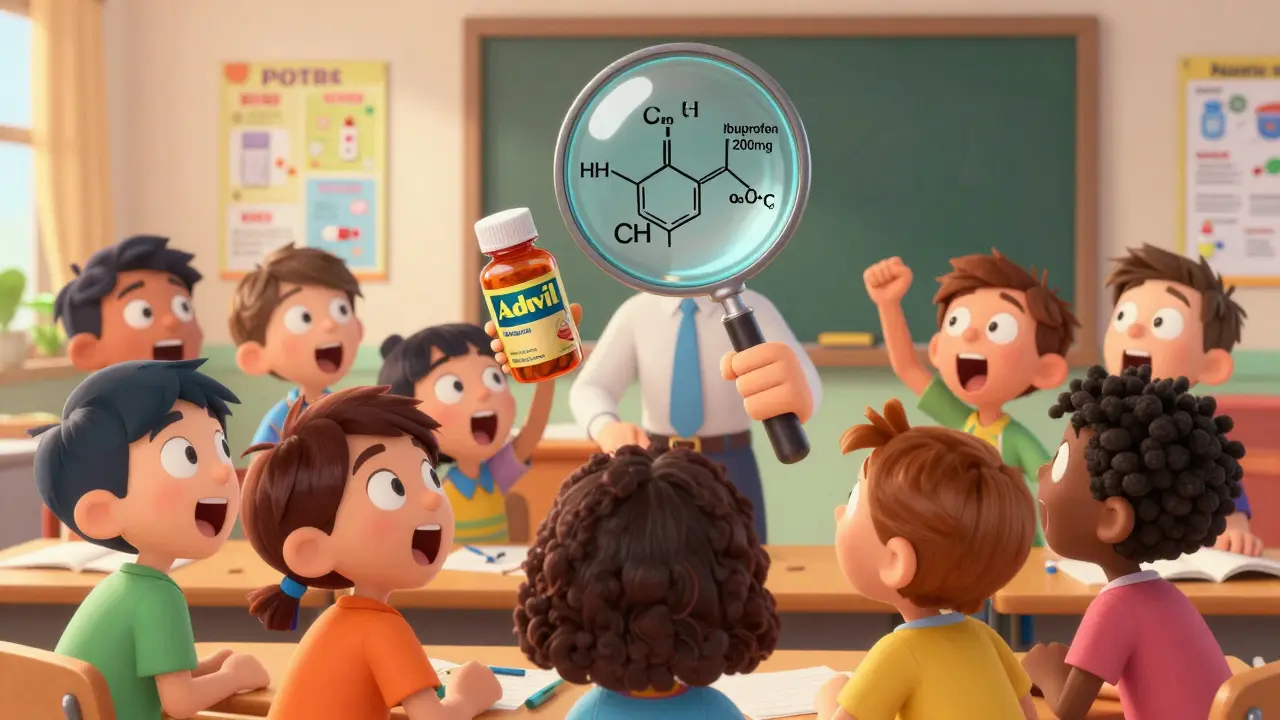
One teacher in Birmingham used a simple trick with her 4th-grade class. She brought in two identical boxes of ibuprofen - one with the Advil logo, one with a plain label. She asked the kids: "Which one do you think works better?" Most picked the branded one. Then she showed them the ingredient list. Both said "ibuprofen 200mg." The kids were shocked. After that, they started asking their parents: "Is this the generic?"
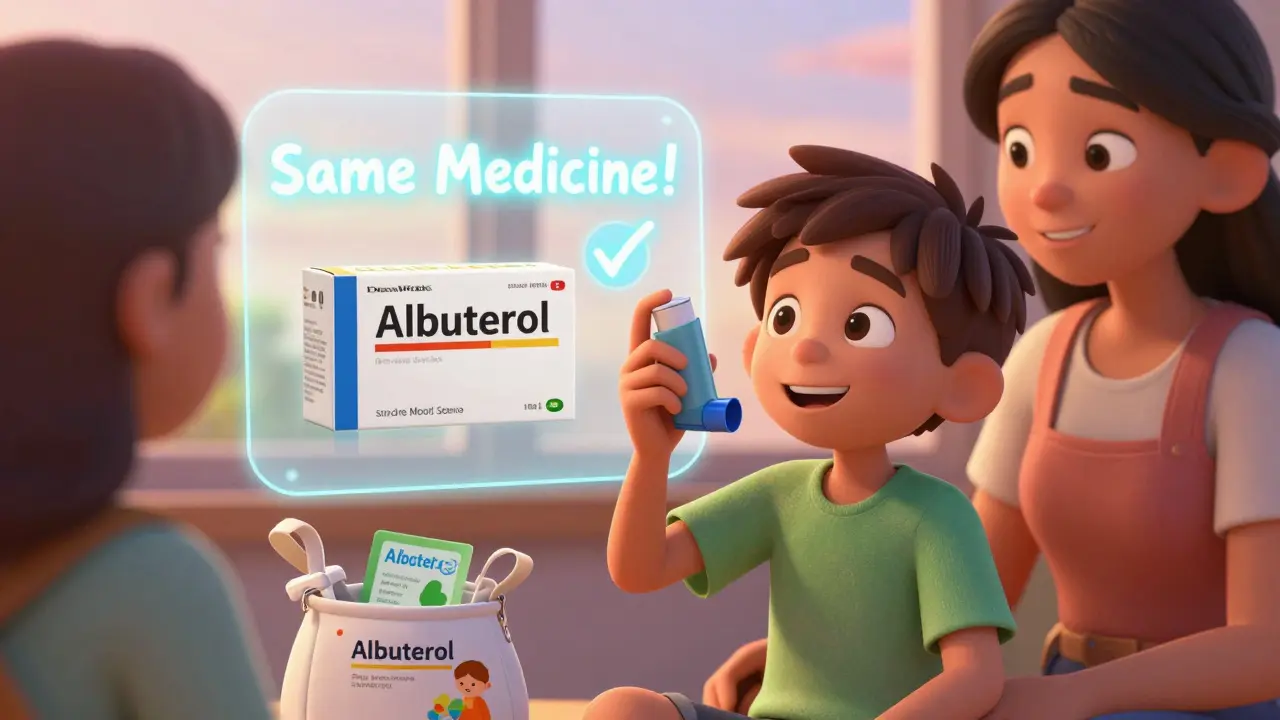
Another parent in Leeds told her 8-year-old son: "Every time we refill your asthma inhaler, the pharmacy might give you a different one. But they’re all the same. I’ll show you the name on the label. If it says ‘albuterol,’ we’re good." He started checking the label himself. Now he asks, "Is this the one with the blue cap?" - not because he’s scared, but because he’s learned to pay attention.
What Schools and Pharmacies Are Doing
Programs like Generation Rx (started in Ohio but used in U.K. schools too) offer free lesson plans for teachers. One activity has kids match medicine bottles to their uses - brand name on one card, generic on another. They learn they’re the same.
Pharmacies in the U.K. now include simple, child-friendly inserts in prescription bags. A typical note says: "This medicine is the same as [brand name]. It’s called [generic name]. It works the same way."
What Parents Should Avoid
- Don’t say, "The doctor chose this one because it’s cheaper." That makes kids think cost equals quality.
- Don’t hide the switch. If the medicine changes, tell your child. Say: "We’re trying a new version. It’s the same medicine, just a different name."
- Don’t use scare tactics. "If you take the wrong one, you’ll get sick" - that creates anxiety. Instead: "The pharmacist checks everything. This one is safe."
Why This Matters Long-Term
Children who understand generics grow into adults who don’t overpay for medicine. They learn to read labels. They trust science over branding. They’re less likely to stop taking medicine because they think it’s "not the real one."
A 2023 study from the University of Birmingham found that kids who were taught about generics were 5 times more likely to take their medicine as prescribed - even when the pill looked different. That’s not just about money. It’s about health.
Quick Tips for Parents and Teachers
- Keep a small chart at home: "My Medicine - Brand Name / Generic Name / What It Does"
- Let kids help pick up prescriptions. Point out the generic name on the label.
- Use apps like NHS Medicines A-Z or the FDA’s Drug Database to show side-by-side comparisons.
- Ask your pharmacist: "Can you explain this medicine to my child?" Most will happily do it.
- When a new medicine comes, say: "This one works just like the last one. Let’s look at the name together."
What’s Next?
More schools are adding medicine literacy to health lessons. The U.K. Department of Health is rolling out a new pilot in 2026 to teach kids ages 7-11 about how medicines are made, tested, and named. The goal? To build confidence, not confusion.
Generic drugs aren’t second-rate. They’re smart choices. And teaching kids that early? That’s one of the best health lessons you can give them.
Are generic drugs really the same as brand-name drugs?
Yes. Generic drugs contain the same active ingredient, in the same amount, and work the same way as brand-name drugs. They must pass the same strict tests for safety, strength, and quality. The only differences are the name, shape, color, or packaging - not the medicine inside.
Why do generic drugs look different?
The law doesn’t allow generic drugs to look exactly like brand-name ones. So manufacturers change the color, shape, or markings. But the medicine inside is identical. Think of it like two different wrappers for the same candy - the taste doesn’t change.
Can I ask my pharmacist to give me the brand-name drug instead?
Yes, but it may cost more. Most prescriptions are filled with generics unless the doctor writes "Dispense as Written" or "Do Not Substitute." If cost is an issue, ask if the generic is covered by your insurance. In the U.K., generics are often cheaper even without insurance.
What if my child refuses to take the medicine because it looks different?
Stay calm. Show them the label. Say: "This is the same medicine as before. The name changed because it’s a different company making it. But the stuff inside is exactly the same." If they’re still unsure, call the pharmacy. A pharmacist can explain it to them directly - many are trained to talk to kids.
Is it safe to switch between generic and brand-name versions?
Yes. Switching between generic and brand-name versions is common and safe. Doctors and pharmacists do it all the time. The FDA and MHRA require generics to perform the same way as the original. There’s no evidence that switching causes harm.
How can I teach my child to recognize their medicine?
Teach them to look at the name on the label - not the color or shape. Make a simple chart: "My Medicine: [Generic Name] - Used for [purpose]." Let them help check the bottle each time. You can even turn it into a game: "Can you find the medicine with the right name?"

One comment
Let me guess... this is Big Pharma's way of getting us to accept inferior drugs so they can keep raking in cash on the 'brand' versions while quietly switching the real stuff to 'generic' and selling it overseas. I've seen the reports. The FDA? Corrupt. The MHRA? Bought off. My cousin's kid took a 'generic' ADHD med and started seeing snakes. No joke. They're testing on children.
And don't even get me started on the color changes. That's not branding-it's mind control. Different pigments = different neural responses. They're programming kids to accept control. Wake up, people.
I find it deeply troubling that this article presents misinformation as fact. The FDA's bioequivalence standards are not equivalent to those of the original innovator drug in terms of pharmacokinetic variance. In fact, the 90% confidence interval for AUC and Cmax allows for a 20% deviation-this is not 'the same medicine.' It is a statistically permissible approximation.
Furthermore, the notion that '9 out of 10 prescriptions are generics' is a misleading metric. It does not account for therapeutic substitution, off-label use, or pediatric formulations. This article is dangerously oversimplified and undermines public trust in pharmacology. I expect better from educational material.
Bro this is so true. I'm from India, generics are EVERYTHING here. We don't even have brands. Just pills. But they work. My sister takes generic metformin for diabetes. Same as the 'brand.' Same results. No drama.
Stop overthinking. Medicine is medicine. The label is just a sticker.
I’ve worked in pharmacy for 12 years. The generic thing? Totally fine. But the real issue isn’t the science-it’s the parents. They panic when the pill changes color. Then they stop giving it. Then the kid gets sick. Again.
Just tell the kid: 'Same stuff. Different wrapper.' Done. No need for charts or apps. Just say it. Calmly.
this is so sweet honestly. i love how you broke it down for kids. my niece used to cry every time her inhaler looked different. now she high fives me when we check the label. she says 'albuterol = good vibes' 😊
You Americans think everything can be reduced to a children’s story. In India, we don’t need 'toy car' analogies. We know that generics are the backbone of public health because our system is built on efficiency, not corporate branding. You teach kids about medicine? We teach them survival.
Also, your 'FDA' is a joke. We have our own standards. And they’re better.
Honestly, I think this whole thing is a capitalist trap. You see, in the 1980s, after the Bayh-Dole Act, pharmaceutical monopolies were dismantled by design. Now, every generic is a Trojan horse for surveillance. The pill’s color? It’s coded. The shape? RFID. The name? A hash linked to your insurance ID. I’ve seen the patents.
My cousin’s kid took a generic asthma pill and his smartwatch started sending data to a server in Texas. Coincidence? Nah. It’s all connected.
Also, I’m developing a blockchain-based medicine verification app. DM me if you want early access. 💡🌐
I love this. Really. I’m a teacher in Manchester and we’ve been doing the 'match the bottle' game for two years now. Kids are brilliant at this stuff. One 9-year-old told me, 'So it’s like Harry Potter’s invisibility cloak? Same wizard, different robe?'
And yes, the pharmacist who came in to help? He brought chocolate. And a real story about how his mum used generics after his dad lost his job.
Simple. Human. Effective.
PS: I’m not surprised you didn’t mention the NHS’s 'meds on time' campaign. It’s quiet, but it’s working.
This article is so naive. You think teaching kids about generics is enough? What about the fact that most generics are made in China and India with unregulated factories? My neighbor’s kid had a seizure because the generic had too much filler. No one talks about that. And now you want to turn this into a cute game?
Parents need to demand the brand. Always. And stop letting pharmacies switch it without asking. You’re risking lives for a few bucks. I’m not being dramatic. I’m being responsible.