

Depression Treatment Risk Calculator
This calculator uses data from the article to show the potential risks and benefits of antidepressant treatment for adolescents. It is not medical advice and should not replace professional consultation.
Input Your Child's Situation
Risk Assessment Results
Based on data from the article:
- 4.2% risk of suicidal thoughts with antidepressants (vs 2.1% with placebo)
- 17.8% increase in completed suicides among 10-19 year olds after warning
- 87% of teens improved without suicidal thoughts on SSRIs
Recommended Action:
Key Takeaways from the Article
When a teenager is struggling with depression, the decision to use antidepressants isn’t just about whether the medicine works-it’s about fear. The black box warning on every antidepressant prescription label is hard to ignore. It’s the FDA’s strongest safety alert, telling doctors and families that these drugs may raise the risk of suicidal thoughts in kids and teens. But here’s the thing: the warning hasn’t made treatment safer. It may have made it harder to get help at all.
What the Black Box Warning Actually Says
In October 2004, the U.S. Food and Drug Administration (FDA) put a black box warning on all antidepressants used in children and adolescents. It wasn’t random. The decision came after reviewing 24 clinical trials with over 4,400 young patients. The data showed that among kids taking antidepressants, about 4% developed suicidal thoughts or behaviors during the first few months of treatment. In the placebo group, that number was 2%. That’s a doubling of risk. No suicides happened in those trials-but the warning was still issued. The warning applies to all antidepressants, not just one class. That includes SSRIs like fluoxetine and sertraline, SNRIs like venlafaxine, and even atypical ones like bupropion and mirtazapine. In 2007, the FDA expanded it to include young adults up to age 24. But the strongest language stays for those under 18. The warning doesn’t say antidepressants cause suicide. It says they may increase the risk of suicidal thinking-especially early on, right after starting the drug or changing the dose. That’s why the FDA also requires every patient to get a Medication Guide. It’s a one-page sheet that tells families: watch for new or worsening sadness, agitation, panic attacks, or talk of self-harm.What Happened After the Warning Went Live
The warning was meant to save lives. But in practice, it did something unexpected. Between 2004 and 2006, prescriptions for antidepressants in teens dropped by 22.3%. That’s not a small blip. That’s a massive shift. A 2023 study in Health Affairs looked at 11 high-quality studies and found something even more troubling: after the warning, doctor visits for depression fell by 14.5%. Diagnoses of depression dropped by 18.7%. Even therapy visits went down by 11.9%. And during that same period, suicide attempts-measured by psychotropic drug poisonings-rose by 21.7%. Completed suicides among 10- to 19-year-olds increased by 17.8%. The CDC confirmed this trend. The timing lines up too closely to ignore. This isn’t coincidence. When families hear a black box warning, they panic. They delay treatment. Some don’t start it at all. A 2021 survey of 500 child psychiatrists found that 76% said families were more hesitant to begin medication. The average delay? Over three weeks. In mental health, three weeks can be the difference between a child getting better and a crisis.Is the Risk Real-or Overstated?
The original data came from short-term clinical trials. Most lasted only 8 to 12 weeks. And in those trials, no one died. Suicidal behavior was rare. But it was consistent across drugs. That’s why the FDA acted. But real life isn’t a clinical trial. In the real world, depression itself is deadly. The risk of suicide for teens with untreated depression is far higher than the risk from medication. A 2023 Cochrane review of 34 studies found the evidence on suicidality was “low to very low quality.” Many trials were too small. Many didn’t track outcomes long enough. Some didn’t even report all their data. Meanwhile, a Mayo Clinic survey of 1,200 teens on SSRIs in 2022 showed that 87% improved without any suicidal thoughts. Only 3% had fleeting suicidal ideas-and those went away after a small dose adjustment. That’s not a red flag. That’s a manageable side effect. And here’s the flip side: teens who avoid medication because of fear are the ones most at risk. A 2020 paper in Frontiers in Psychiatry described two teens with severe depression who refused antidepressants. Both later attempted suicide. Their doctors believed medication could have helped.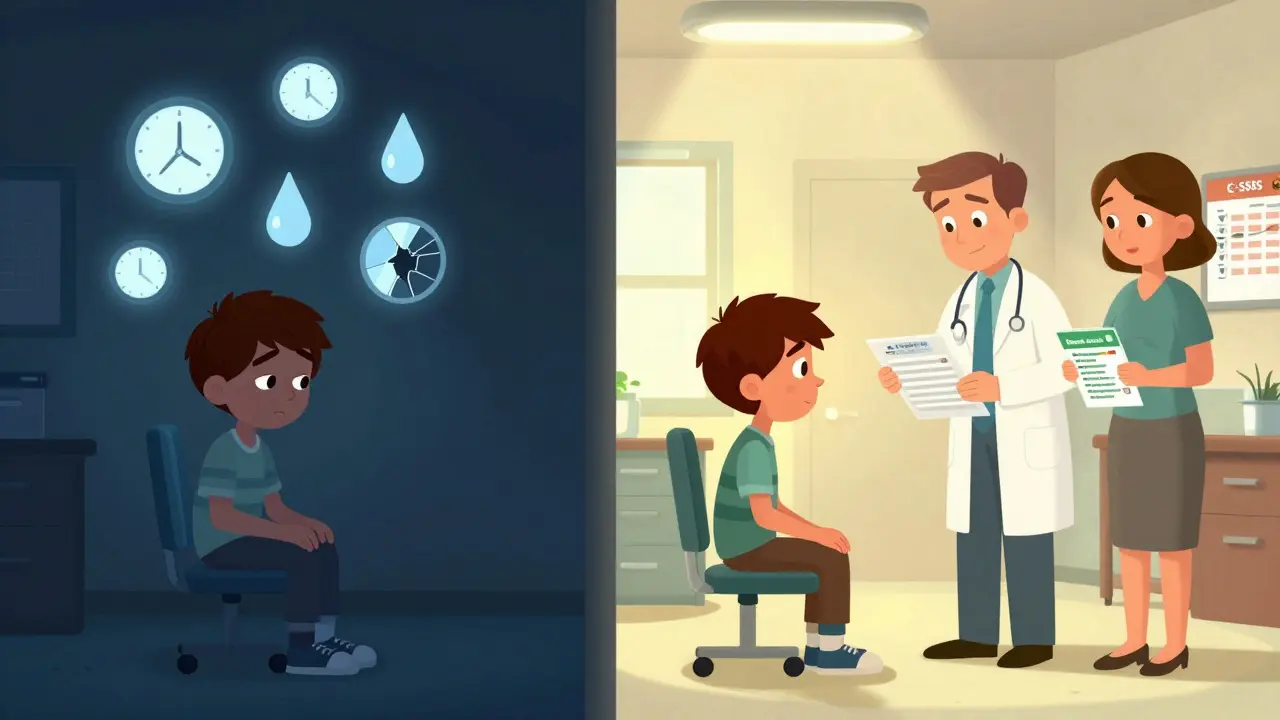
How Doctors Are Supposed to Monitor
The FDA says doctors should watch closely-especially in the first month. The standard is:- Weekly check-ins for the first month (in person or by video)
- Biweekly visits for the second month
- Monthly visits after that
The Bigger Picture: Are We Making It Worse?
The black box warning was created with good intentions. But now, 20 years later, the evidence is piling up that it’s doing more harm than good. The American Academy of Child and Adolescent Psychiatry (AACAP) and the American Psychiatric Association both asked the FDA in 2022 to revise the warning. They argue: for teens with moderate to severe depression, the benefits of antidepressants outweigh the risks. That’s not opinion. That’s what the data shows when you look at real-world outcomes, not just short-term trials. The FDA’s Psychopharmacologic Drugs Advisory Committee met in September 2024 to review the evidence. No decision has been made yet. But the momentum is shifting. Experts like Dr. Christine Y. Lu from Harvard say the warning should be replaced with a routine label warning-clear, but not terrifying. Something that says: “This drug can cause suicidal thoughts in some young people, especially early on. But depression is more dangerous. We recommend close monitoring.” And that’s the truth: depression kills. Antidepressants don’t always fix it-but they often help. And when they do, they save lives.
What Families Should Do
If you’re a parent considering antidepressants for your teen:- Don’t skip treatment because of the warning. The risk of doing nothing is higher.
- Ask for a full suicide risk assessment before starting medication.
- Insist on weekly check-ins for the first month. Don’t accept “we’ll call in two weeks.”
- Watch for changes in behavior-not just sadness. Agitation, sleeplessness, or sudden energy can be early signs.
- Know that side effects like nausea or jitteriness usually fade in a week or two. Suicidal thoughts don’t.
- Fluoxetine (Prozac) is the only SSRI with strong evidence for teens. Others may work too, but Prozac has the most data.
- Don’t stop it suddenly. That can trigger worse symptoms.
- Keep communication open. Ask directly: “Have you had any thoughts about not wanting to live?”
- Keep emergency numbers handy. The 988 Suicide & Crisis Lifeline is free, confidential, and available 24/7.

One comment
Just want to say this post nails it. The black box warning was meant to protect, but it’s become a barrier instead. We’re scaring families away from life-saving care because of a 2% statistical increase in suicidal ideation-while untreated depression kills at rates way higher than that.
Real talk: if your kid is suicidal, the pill isn’t the enemy. Silence is.
I’m a therapist and this resonates so hard. Parents come in terrified of meds, but they’ll happily let their kid spiral for months because ‘maybe it’s just a phase.’ It’s heartbreaking.
My cousin was on Prozac at 16. She went from barely leaving her room to running track within 6 weeks. No suicidal thoughts. Just… relief. Why are we still treating this like it’s a gamble when the odds are clearly in favor of helping?
Black box = fearmongering. Done.
It’s fascinating how the FDA’s overcautiousness has created a perfect storm of medical avoidance. The warning, while well-intentioned, is an example of institutional overcorrection-a classic case of pathologizing risk instead of managing it. The data, as presented, clearly suggests a net benefit of pharmacological intervention, yet the narrative has been hijacked by anxiety-driven policy.
One must ask: if the same logic were applied to insulin or antihypertensives, would we see similar drops in adherence? Of course not. This is a uniquely mental health phenomenon, where stigma masquerades as safety.
And yet, the irony is thick: we demand evidence-based medicine, then ignore the evidence when it contradicts our emotional biases. The CDC’s suicide statistics post-2004 are not a coincidence-they are a consequence.
What’s needed isn’t more warnings, but better education. Clinicians need to be trained to communicate risk without inciting panic. Families need to understand that monitoring isn’t optional-it’s the standard of care. And we need to stop equating ‘side effect’ with ‘danger.’
Fluoxetine remains the gold standard for a reason. The evidence is robust. The hesitation? That’s cultural. And culture can change.
Let’s stop treating depression like a moral failing and start treating it like a medical condition. Because if we don’t, more kids will die-not from pills-but from silence.
Let’s be real-this is just Big Pharma’s Trojan horse. Antidepressants are overprescribed, and the FDA’s warning is the only thing keeping us from turning teens into chemical zombies. You cite ‘87% improved,’ but where’s the long-term data on brain development? You ignore the fact that SSRIs alter serotonin pathways permanently in developing brains. This isn’t medicine-it’s experimentation.
And don’t get me started on the ‘therapy visits declined’ argument. That’s because parents are finally waking up to the fact that talk therapy, mindfulness, and lifestyle changes work better than chemicals. The system is rigged to push pills because they’re profitable. The data you’re quoting? Paid for by drug reps.
As someone from Indonesia, I’ve seen how mental health stigma works differently here. No black box warnings-but also no access to meds or therapists. We don’t have the luxury of debating whether the warning helps. We just wish we had any option at all.
This post made me realize how privileged we are to even be having this conversation.
Agreed. The real issue isn’t the drug-it’s the lack of follow-up. If you’re going to prescribe, you’ve got to monitor. Weekly check-ins aren’t a burden-they’re the bare minimum. I’ve seen too many kids fall through the cracks because the system is overwhelmed.
Also, fluoxetine isn’t just ‘the only one with data’-it’s the only one with decades of real-world use in teens. If it ain’t broke, don’t fix it.
As a parent of a teen who went through this, I want to say: the black box warning felt like a sledgehammer to the chest. I read it, panicked, and delayed treatment for six weeks. By the time we started, she was in crisis.
What I wish someone had told me: the warning isn’t a reason to avoid medication-it’s a reason to be vigilant. We did weekly check-ins. We used the C-SSRS. We kept emergency numbers on the fridge. And yes, she had a few days of jitteriness-but it faded. The depression didn’t.
Don’t let fear make you the villain in your child’s story. Be the one who shows up-even when it’s scary.
Ugh. I HATE how we turn everything into a debate when it’s just… a kid hurting. My sister tried to kill herself at 15. She was on sertraline. She had zero suicidal ideation after two weeks. But the doctor? He spent 20 minutes explaining the black box warning. No one asked her how she felt. Just scared parents and scared doctors.
Stop talking. Start listening.
MARK MY WORDS: this black box warning is a setup. The FDA, CDC, and Big Pharma are working in tandem to normalize psychotropic drugs for children under the guise of ‘mental health awareness.’ Think about it: suicide rates went up AFTER the warning-so who benefits? The drug companies, obviously. They now have a whole generation hooked on SSRIs. And don’t tell me it’s ‘coincidence’-the timing is too perfect. They want us to believe the pills are safe so they can keep raking in billions. The real danger? The pharmaceutical industrial complex. Not the medication.
Also, why do they only study ‘8-12 week trials’? Because that’s all they need to get FDA approval. They don’t care about long-term effects. They don’t care about brain development. They care about profit. And now we’re raising a generation of chemical zombies who can’t function without a pill.
Ask yourself: why is the suicide rate still rising? Because the system is broken. And they’re using fear to sell more drugs.
🚩 WATCH OUT. This isn’t medicine. It’s a trap.
It is evident that the empirical underpinnings of the FDA's black box directive are methodologically flawed. The clinical trials referenced are not only underpowered but also suffer from severe selection bias, as they exclude adolescents with comorbidities, thus rendering generalizability untenable. Furthermore, the reliance on self-reported suicidality-a construct with notoriously poor inter-rater reliability-casts doubt on the validity of the entire risk calculus.
One must also interrogate the confounding variables: the precipitous decline in psychiatric care access during the same period, the rise in social media-induced dysphoria, and the erosion of familial support structures. To attribute rising suicide rates solely to reduced pharmacotherapy is a reductive fallacy.
The true pathology lies not in the SSRI, but in the sociopolitical apparatus that has pathologized adolescent distress and commodified its alleviation. Until we address the systemic neglect of youth mental health infrastructure, no warning label will suffice.
As someone from South Africa, I’ve seen what happens when meds aren’t accessible. No black box warning here-just no access. Period. We don’t get to debate whether it’s risky-we just wish we had ONE pill to offer a kid who’s crying in a room with no windows.
Also, emoji alert 🚨💔🧠: this post should be printed and taped to every school nurse’s wall. The data doesn’t lie. Fear does.
I’m a high school counselor. We have zero psychiatrists on staff. The kids who need meds the most? They wait 6 months. By then, some are gone.
I’ve seen the black box warning make parents say ‘I’ll wait until next semester.’ But next semester never comes.
Just… please, let’s stop talking and start doing.