Nocebo Susceptibility Estimator
How do you typically research new medications?
When a doctor discusses risks, how do they present them?
Have you had negative experiences with medications in the past?
How do you feel when reading a long list of potential side effects?
Recommendation:
Why This Matters
According to recent studies, up to 76% of systemic side effects in clinical trials occur in the placebo group due to expectation alone. Understanding your susceptibility can help you manage expectations and reduce unnecessary symptoms.
- Verbal Suggestions: 70-80% of nocebo triggers
- Observational Learning: 15-20% of triggers
- Prior Experience: 10-15% of triggers
You take a pill for your headache. Within an hour, the pain fades. Did the chemical compound work? Or did your brain simply expect it to? Now imagine you take that same pill, but first read a warning label listing twenty potential side effects. Suddenly, you feel nauseous and dizzy. The medicine hasn’t changed, but your experience has. This is the power of expectation.
For decades, we’ve heard about the placebo effect, where belief triggers healing. But there is a darker twin: the nocebo effect. It’s not just "in your head" in the dismissive sense. It creates real, measurable physiological changes. Recent studies show these negative expectations are often stronger and more persistent than positive ones. Understanding this dynamic is crucial for anyone managing chronic conditions or starting new treatments.
The Science Behind Expectation: Placebo vs Nocebo
To understand why side effects happen even with sugar pills, we need to look at how the brain processes information. The placebo effect occurs when positive expectations lead to beneficial health outcomes. It’s the body’s natural healing response, unlocked by hope and trust in treatment. Conversely, the nocebo effect happens when negative expectations cause symptoms or worsen existing conditions.
The term "nocebo" comes from Latin, meaning "I shall harm," coined by Walter Kennedy in 1961 to contrast with "placebo" ("I shall please"). While placebos have been studied since the 1950s, nocebos were long ignored as mere anxiety. Today, science proves they are distinct neurobiological phenomena.
| Feature | Placebo Effect | Nocebo Effect |
|---|---|---|
| Trigger | Positive expectations | Negative expectations/fear |
| Outcome | Symptom improvement | New or worsened symptoms |
| Persistence | Often diminishes over time | More persistent across treatment periods |
| Strength | 30-60% improvement in subjective symptoms | 20-45% worsening; often stronger than placebo |
| Primary Driver | Conditioning and optimism | Anxiety, verbal suggestions, prior bad experiences |
A pivotal study published in eLife Sciences in 2025 by Kunkel et al. revealed something startling: nocebo effects are consistently stronger than placebo effects. In their analysis, negative responses showed a statistical significance that dwarfed positive ones (F(1,97)=53.93, p<.001). More importantly, while placebo benefits tended to stabilize or fade, nocebo symptoms persisted. From day one to day eight of treatment, negative effects decreased only marginally, suggesting that once fear takes root, it stays rooted.
How Nocebo Creates Real Side Effects
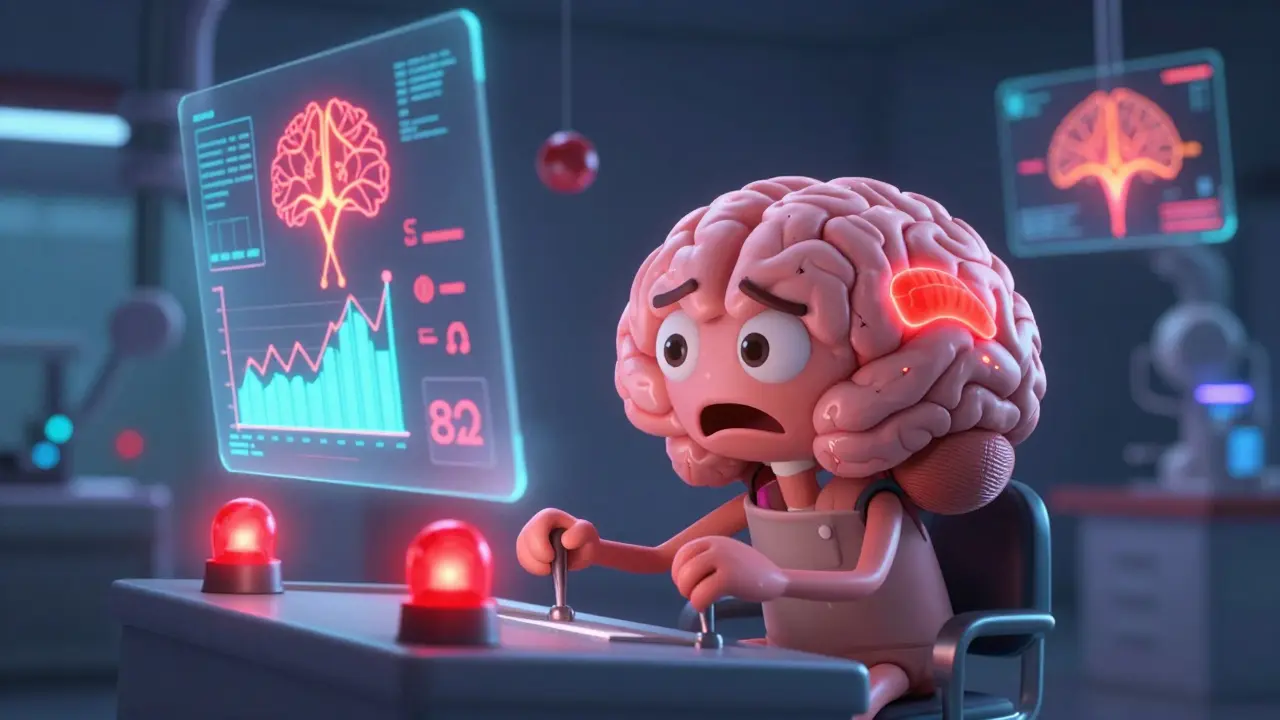
If you’ve ever felt sick after reading a drug’s leaflet, you experienced a nocebo response. But this isn’t imagination. It involves specific brain regions like the anterior cingulate cortex and the insula, which modulate pain and autonomic responses. When you expect pain or nausea, these areas activate, triggering actual physical sensations.
Research by Dr. Karin Meissner in 2022 demonstrated that nocebo effects can alter your biology in measurable ways:
- Cortisol Levels: Stress hormones can rise by 15-25%.
- Heart Rate: Can increase by 5-10 beats per minute.
- Immune Response: Alterations in immune system activity have been observed.
Consider the rollout of COVID-19 vaccines. A study found that 76% of systemic side effects reported after the first dose-such as headaches and fatigue-also appeared in the placebo group. These weren’t allergic reactions to the vaccine ingredients; they were nocebo responses triggered by widespread media coverage of potential side effects. Your brain anticipated the symptom, so your body produced it.
Where Do These Symptoms Come From?
You might wonder how an inert substance causes such specific issues. According to Planès’ 2016 research, nocebo effects operate through three primary pathways:
- Verbal Suggestions (70-80%): What doctors, nurses, or pharmaceutical labels tell you. If a doctor says, "This might make you drowsy," your brain prepares for drowsiness.
- Observational Learning (15-20%): Seeing others suffer side effects. Online forums and social media amplify this. If you read ten stories about a drug causing insomnia, you’re likely to experience it yourself.
- Prior Negative Experiences (10-15%): Past trauma with medications primes your nervous system to react negatively to new treatments.
This explains why side effect profiles in clinical trials often mirror those of active drugs. In anticonvulsant trials, patients given placebos reported anorexia (12.3%), memory difficulties (8.7%), and upper respiratory infections (9.1%). These match the actual drug’s side effects because the participants were told what to expect during informed consent.
The Impact on Clinical Trials and Drug Approval
The prevalence of nocebo effects complicates drug development. Historically, researchers assumed that if a side effect occurred in the placebo group, it was random noise. Now, we know it’s a signal of expectation.
In migraine treatments, 20-30% of nocebo responses match the active drug’s profile. In cancer care, 25-40% of nausea reported is nocebo-induced. This matters because it can mask the true safety profile of a medication. If 50-76% of adverse events in trials are nocebo-driven, regulators must distinguish between chemical toxicity and psychological conditioning.
The FDA’s 2023 draft guidance now recommends separating true drug side effects from nocebo responses using statistical modeling. Similarly, the European Medicines Agency implemented guidelines in 2021 requiring nocebo analysis in adverse event reporting. Pharmaceutical companies are adapting, with 65% of Phase III trials now using "active placebos"-inert substances designed to mimic mild side effects-to maintain blinding and reduce bias.

Managing Nocebo Risks in Daily Life
You don’t need to be in a clinical trial to be affected. Chronic pain patients, for instance, report high rates of nocebo symptoms. A 2023 survey by the International Association for the Study of Pain found that 68% of chronic pain patients experienced side effects that resolved once they learned their medication was a placebo. This highlights the powerful role of context.
So, how do you protect yourself from unnecessary suffering? Communication is key. The American Medical Association recommends that physicians present risks using absolute numbers rather than percentages. Saying "3 in 100 patients experience this" reduces nocebo responses by 15-25% compared to saying "3% risk." Percentages feel abstract and scary; concrete numbers feel manageable.
Dr. Luana Colloca suggests "expectation reframing." Instead of focusing solely on risks, healthcare providers should emphasize positive outcomes while acknowledging potential side effects neutrally. For example: "Most people find relief within a week. Some may feel tired initially, but this usually passes." This approach has shown a 30-40% reduction in nocebo responses.
The Future of Treatment: Open-Label Placebos
One of the most fascinating developments is the use of open-label placebos. Traditionally, placebos required deception-patients had to believe they were getting real medicine. However, recent studies show that even when patients know they are taking a sugar pill, they can still experience benefit. In irritable bowel syndrome, open-label placebos provided 25-35% symptom improvement. For chronic pain, nocebo responses dropped by 20-30%.
This challenges the old assumption that deception is necessary. It suggests that the ritual of treatment-the act of taking a pill, the attention from a doctor-activates healing pathways regardless of the chemical content. As AI-powered tools emerge, we may soon see personalized communication strategies that analyze speech patterns to assess nocebo risk, allowing doctors to tailor their language to each patient’s psychological profile.
Is the nocebo effect real or just in my head?
The nocebo effect is biologically real. While it originates from psychological expectations, it triggers measurable physiological changes, including increased cortisol levels, elevated heart rate, and activation of pain-processing brain regions. It is not "imaginary" pain or sickness; it is a genuine stress response mediated by the brain-body connection.
How common are nocebo side effects in clinical trials?
Very common. Meta-analyses indicate that 50-76% of systemic adverse events in clinical trials occur in the placebo group. For specific conditions like migraines or cancer treatment, 20-40% of reported side effects in placebo groups match the active drug's profile, driven by informed consent warnings and patient expectations.
Can I avoid nocebo effects when taking medication?
You can minimize them by managing your expectations. Ask your doctor to explain risks using absolute numbers (e.g., "1 in 10") rather than percentages. Focus on the therapeutic goals of the medication rather than dwelling on potential side effects. Avoid excessive online research about drug side effects before starting treatment, as observational learning significantly increases nocebo susceptibility.
Why are nocebo effects stronger than placebo effects?
Recent research, including a 2025 study in eLife Sciences, shows that negative expectations trigger more robust neural and hormonal responses than positive ones. Evolutionarily, humans are wired to detect and avoid threats, making fear-based responses (nocebo) more immediate and persistent than reward-based responses (placebo).
What is an open-label placebo?
An open-label placebo is an inert treatment given to a patient who knows it contains no active ingredients. Surprisingly, studies show these can still provide symptom relief (25-35% in IBS cases) and reduce nocebo responses by leveraging the therapeutic ritual and patient-provider relationship without deception.