

For decades, cystic fibrosis (CF) was a death sentence for children. Most kids with the disease didn’t live past their teens. Today, thanks to breakthroughs in science and medicine, the median life expectancy for someone born with CF is over 50 years. That’s not a guess-it’s data from the Cystic Fibrosis Foundation in 2022. But this isn’t just a story of progress. It’s a story of how understanding a single gene changed everything.
What Exactly Is Cystic Fibrosis?
Cystic fibrosis is a genetic disorder that messes up how salt and water move in and out of your cells. It’s caused by mutations in the CFTR gene, which stands for cystic fibrosis transmembrane conductance regulator. This gene normally makes a protein that acts like a gate, controlling chloride ions. When the gate breaks, your body produces thick, sticky mucus instead of the thin, slippery kind it should.
This mucus doesn’t just clog up one system-it hits multiple organs. In the lungs, it traps bacteria, leading to constant infections. In the pancreas, it blocks digestive enzymes, making it hard to absorb nutrients. In the liver, it can cause scarring. And in men, it often means being born without the tube that carries sperm, leading to infertility. About 97-98% of males with CF are affected this way.
The most common mutation, called F508del, shows up in about 70% of cases worldwide. But there are over 2,000 known mutations in the CFTR gene. That’s why not everyone responds the same way to treatment. CF is inherited recessively, meaning you need two bad copies-one from each parent-to have the disease. Carriers, with just one copy, don’t show symptoms but can pass it on.
How Is It Diagnosed?
Most babies in the U.S. are screened for CF right after birth. The test? A sweat test. It’s simple, painless, and accurate. People with CF have sweat with chloride levels above 60 mmol/L-way higher than normal. This has been the gold standard since the 1950s. Genetic testing confirms the specific mutation, which helps doctors pick the right treatment later.
Before newborn screening, many kids weren’t diagnosed until they started having serious breathing problems or poor growth. Now, with early detection, treatment can start before damage sets in. In the U.S., all 50 states have newborn screening for CF since 2010. That’s made a huge difference.
The Old Way: Managing Symptoms
Before modulators, treatment was a full-time job. Adults with CF spent 2-3 hours a day on their care routine. That meant:
- Doing airway clearance-hitting the chest with a device or wearing a vibrating vest for 30-45 minutes
- Inhaling 4-6 different medications, including antibiotics and mucus thinners
- Taking 6-12 pancreatic enzyme pills with every meal
- Counting calories constantly to fight malnutrition
Even with all that, lung function slowly declined. Infections kept coming. Hospital stays were common. Many patients lost weight. The average person with CF in 1960 lived to 14. By 2000, that number had climbed to 31. Progress, yes-but still grim.

The Game Changer: CFTR Modulators
In 2012, everything shifted. The first CFTR modulator, ivacaftor (brand name Kalydeco), was approved by the FDA. It wasn’t a cure, but it was the first drug that fixed the broken protein at the source. It worked only for people with the G551D mutation-a rare one, affecting about 4% of patients. Still, the results were shocking. In trials, lung function jumped by over 10%. People coughed less. Weight went up. Hospital visits dropped.
Then came triple therapy: elexacaftor/tezacaftor/ivacaftor (Trikafta). Approved in 2019, it works for people with at least one F508del mutation-about 90% of the CF population. Clinical trials showed a 13.8% improvement in FEV1 (a key lung measure) and a 63% drop in lung flare-ups. One 28-year-old patient on a CF forum said their daily airway clearance dropped from 90 minutes to 20. That’s not a small win. That’s life-changing.
By 2023, 90% of people with CF in the U.S. had access to at least one modulator. The Cystic Fibrosis Foundation’s 2022 survey found that 89% of users felt they could breathe better. 76% had fewer infections. 68% gained weight. For many, it meant going back to school, working full-time, or even having kids.
But It’s Not Perfect
Here’s the hard truth: about 10% of people with CF still can’t take modulators. Their mutations-often Class I types like nonsense mutations-don’t respond to current drugs. For them, the old daily grind remains. Some are stuck with antibiotics, enzymes, and oxygen tanks.
And there’s another problem: cost. In the U.S., Trikafta costs around $300,000 a year. Even with insurance, patients report out-of-pocket costs of $1,200 monthly. That’s why only 35% of the global CF population has access to these drugs. In low-income countries, many still die before age 20.
Side effects are real too. A 2023 study in the Journal of Cystic Fibrosis found that 3.2% of patients had severe liver enzyme spikes, forcing them to stop treatment. Some developed cataracts. Others had headaches or dizziness. But for most, the trade-off is worth it.
What’s Next? The Future of CF Treatment
The research pipeline is packed. The Cystic Fibrosis Foundation is funding 15 active clinical trials. Here’s what’s on the horizon:
- mRNA therapies: PTC Therapeutics is testing Ataluren for nonsense mutations. It’s designed to trick the cell into reading past the broken gene.
- Gene editing: CRISPR Therapeutics is running a Phase 1/2 trial called CTX110, using CRISPR to fix the CFTR gene directly in lung cells.
- New antibiotics: Aradigm is testing inhaled liposomal ciprofloxacin to fight stubborn Pseudomonas infections.
Vertex Pharmaceuticals, which makes Trikafta, holds 95% of the CF drug market. But their monopoly is starting to crack. Other companies are rushing in. The FDA approved Trikafta for kids as young as 2 in January 2023. That means nearly all newborns with CF can now start treatment before age 3.
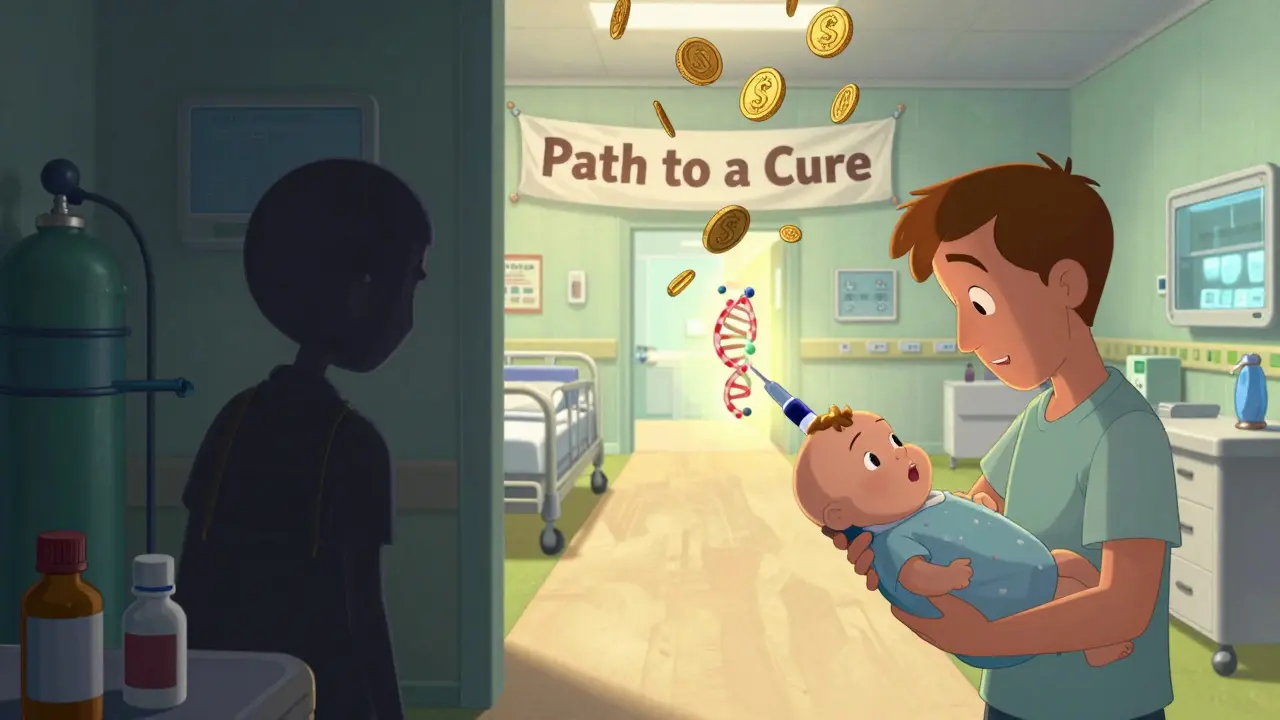
The Cystic Fibrosis Foundation has committed $100 million to its “Path to a Cure” initiative, targeting the 10% left behind. That’s not just hope-it’s a plan.
Life Today: More Adults, More Challenges
Here’s a stat that says it all: 52% of people with CF in the U.S. are now adults. In 1990, only 27% were. That’s a revolution. But adult CF brings new problems-lung scarring, diabetes, bone thinning, mental health struggles. Many patients are juggling jobs, relationships, and insurance battles.
Support networks are stronger than ever. The Cystic Fibrosis Foundation runs 260 accredited care centers in the U.S. and hosts an annual conference with over 3,500 professionals. Online communities like CF Buddy Connect have 12,500 active users. People are sharing tips, venting frustrations, and celebrating wins.
But access remains the biggest hurdle. The WHO calls CF a stark example of global health inequity. In high-income countries, 85% of eligible patients get modulators. In low-income ones? Less than 10%. The drugs exist. The science works. But justice hasn’t caught up yet.
Final Thoughts
Cystic fibrosis went from a pediatric disease to a chronic adult condition in just 20 years. That’s faster than almost any other genetic disorder. The reason? Science that focused on the root cause-not just symptoms. Modulators didn’t just extend life. They gave people back their days, their energy, their future.
But we’re not done. The 10% without options? They need us too. The cost? It must drop. The access? It must expand. The next breakthrough won’t just help one more person. It could change how we treat every rare disease.




One comment
CFTR modulators are a marvel of targeted therapy, but we mustn't forget the foundational work of sweat testing and newborn screening-without those, we wouldn't have early intervention, and without early intervention, modulators wouldn't be nearly as effective.
The 97-98% infertility rate in males with CF is often overlooked in public discourse. It's not just a medical footnote-it's a profound life-altering reality that deserves more attention in counseling and education.
Trikafta's 63% reduction in pulmonary exacerbations is statistically significant, but real-world data shows adherence is uneven. Many patients still skip doses due to cost, complexity, or fatigue. The numbers look great on paper; daily life is messier.
Class I mutations (nonsense) are the hardest to treat because they produce no functional protein at all. mRNA therapies like Ataluren aren't just promising-they're essential. We can't leave 10% behind while the other 90% celebrate.
The global disparity is shameful. $300,000/year is obscene when a child in Nigeria or India dies before age 15 because the drug isn't even available. This isn't science-it's a market failure dressed in white coats.
I’ve met people with CF who now run marathons. That’s not a cure-but it’s a revolution.
It’s wild how much has changed. My cousin was diagnosed in ’98. She spent hours every day with a vest, ate 10,000 calories a day, and still lost weight. Now? She’s got Trikafta, works full-time, and just adopted a dog. Science didn’t just extend life-it gave her back her soul.
And yeah, the cost is insane. But imagine if this was just another chronic illness like diabetes. We’d never accept $300k/year for insulin. Why are we okay with it for CF?
While the data presented is superficially compelling, it fails to account for the confounding variables inherent in longitudinal cohort studies of rare genetic diseases. The apparent increase in life expectancy may be attributable not to therapeutic efficacy per se, but to selection bias, improved palliative care, and heightened surveillance bias.
Furthermore, the emphasis on modulators as a panacea ignores the epigenetic and environmental modifiers that influence phenotypic expression. The CFTR gene is not operating in isolation; its interaction with microbiome composition, dietary intake, and air pollution is profoundly understudied.
Moreover, the assertion that 90% of patients now have access is misleading. Access ≠ affordability. Access ≠ equitable distribution. Access ≠ cultural competency in delivery systems. The data presented is a triumph of marketing over medicine.
One must also interrogate the role of Vertex Pharmaceuticals' patent monopolies. The FDA's expedited approval pathway, while laudable in intent, has created a regulatory capture scenario wherein a single corporation controls the entire therapeutic landscape.
Finally, the narrative of progress obscures the fact that many patients experience severe adverse effects-liver toxicity, cataracts, psychiatric disturbances-which are systematically downplayed in industry-funded trials.
Therefore, while the article presents a compelling narrative, it is fundamentally a piece of biopolitical propaganda, designed to obscure systemic failures under the veneer of scientific triumph.
Let’s be real-this whole ‘CF is a success story’ narrative is pure American exceptionalism. We spend billions on drugs that cost more than a house, then pat ourselves on the back while kids in India die because their governments won’t pay for it. We didn’t cure CF-we just made it profitable.
And don’t get me started on the ‘90% access’ stat. That’s only true if you live in a country with private insurance and a CEO who doesn’t care if you go bankrupt. In the real world? Most people with CF still work two jobs just to afford their meds.
And yes, I know this sounds harsh. But if you think this is progress, you’re not paying attention.
The advancement in CF care is one of the most remarkable achievements in modern medical science, and it underscores the critical importance of sustained, long-term investment in genetic research.
It is imperative to recognize that the development of CFTR modulators did not occur in isolation; it was the culmination of decades of collaborative efforts across academia, non-profit foundations, and pharmaceutical innovation.
Moreover, the ethical imperative to extend equitable access to these therapies cannot be overstated. The global disparity in access reflects not a failure of science, but a failure of policy, governance, and international solidarity.
As we look toward mRNA and CRISPR-based interventions, we must ensure that these next-generation therapies are developed with global accessibility as a foundational principle-not an afterthought.
The transformation of CF from a pediatric fatal disease to a manageable chronic condition is not merely a medical milestone-it is a moral one.
modulators are cool and all but i still gotta do my vest routine every day. its not like im suddenly a superhero or anything. just less tired.
Everyone’s acting like this is some miracle but let’s be honest-this whole thing was funded by rich white people who wanted their kids to live longer. Meanwhile, people in Africa or Asia? They still die. This isn’t science-it’s privilege with a lab coat.
And don’t even get me started on Trikafta. I heard a guy in a forum say his insurance paid $200k but he still owed $5000 a month. That’s not healthcare. That’s extortion.
Real progress? That’d be making CF care free. Not giving rich people better meds while the rest of the world gets forgotten.
Y’all act like modulators are magic. I’ve been on Trikafta for 3 years. My lungs feel better, sure. But I still get sick every winter. Still need enzymes. Still can’t eat a salad without a panic attack. It’s not a cure. It’s a really expensive Band-Aid.
And the ‘89% feel they can breathe better’? Bro, that’s like saying ‘70% of people with a broken leg feel better after wearing a sock.’
Don’t get me wrong-I’m grateful. But let’s stop pretending this is a fairy tale.
Did you know the FDA approved Trikafta using data from a trial with only 440 patients? That’s not science-that’s a gamble. And now millions are on it. What if the long-term effects are worse than we think? What if it causes hidden damage to DNA? Who’s monitoring that?
And who owns the data? Vertex. Who profits? Vertex. Who controls access? Vertex. This isn’t medicine. It’s a corporate monopoly disguised as hope.
And don’t tell me about ‘clinical trials.’ They’re all funded by the same companies that make the drugs. It’s like letting Tesla run the NHTSA.
They’re not curing CF. They’re creating lifelong customers.
My kid got diagnosed at birth. We started meds before she was 6 months old. She’s 7 now. She runs, plays soccer, eats pizza without panicking. We still do the vest. Still count calories. Still have ER trips. But she’s alive. She’s happy. And that’s more than my sister had.
Yeah, the cost is insane. But if you told me 10 years ago I’d be watching my daughter laugh on a swing… I’d have cried. This isn’t perfect. But it’s enough.
I’ve been reading about CF for years, and honestly? This post made me cry. Not because it’s sad, but because it’s beautiful. People are living full lives now-graduating, traveling, falling in love, having kids. That’s not just science. That’s human resilience.
And yes, the 10% left behind? They’re not invisible. They’re the reason we keep pushing. The next breakthrough? It’s not just about genes. It’s about justice.
The historical context of cystic fibrosis care is deeply instructive. From the 1930s, when the disease was misclassified as a malabsorption syndrome, to the 1989 identification of the CFTR gene, each phase of research built upon the previous with methodological rigor.
The current therapeutic paradigm, while effective for the majority, must be contextualized within the broader framework of precision medicine. The heterogeneity of mutations necessitates a stratified approach, which is precisely why the pipeline of mRNA and gene-editing therapies is so promising.
Moreover, the socioeconomic implications of drug pricing cannot be divorced from the ethical obligations of medical science. The disparity in access between high- and low-income nations is not merely an economic issue-it is a violation of the fundamental principle of equity in healthcare.
Therefore, while the progress is undeniable, the imperative remains: innovation must be coupled with institutional reform.
So… the government let a company make a drug that costs $300k/year… and then told people it’s ‘progress’? What’s next? Charging for oxygen? Charging for breathing?
I bet if you had a kid with CF and had to sell your house to keep them alive… you’d call this ‘progress’ too.
Or maybe you’d just be too busy crying to type.
I’m a nurse in a CF clinic. I’ve seen kids go from oxygen tanks to soccer fields. I’ve seen parents cry because their child ate a whole pizza without getting sick. I’ve also seen them cry because they can’t afford the next prescription.
This isn’t about politics. It’s about people. And we’re failing them.
Thank you for sharing your experience as a nurse. Your perspective anchors the data in humanity. The emotional weight of these treatments-both their triumphs and their burdens-is what drives ethical innovation. We must ensure that policy reflects not just efficacy, but dignity.